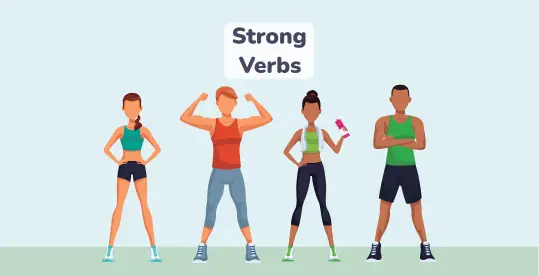
What are strong verbs?
Strong verbs depict a distinct and specific action, independent of any additional words. Such verbs in English have a sense of vigor and connotation in one single word, and thus the sentence becomes concise.
Examples of strong verbs:
Powerful verbs in writing are like fine instruments. They contribute to tightening up the sentences, making them more vivid and comprehensible.
In conventional grammar terms, a strong verb is an irregular verb (such as go → went and see → saw). However, in vocabulary building and writing, strong verbs generally imply vigorous and expressive verbs.
Weak verbs vs strong verbs: understanding the difference
When talking about weak verbs vs strong verbs, there is a difference in precision and clarity. While weak verbs require additional words in order to convey full meaning, strong verbs provide exact action without any ado.
Weak verbs tend to be vague and versatile; however, this may make your writing longer and less compact. On the other hand, strong verbs in English make your text more vivid and concise.
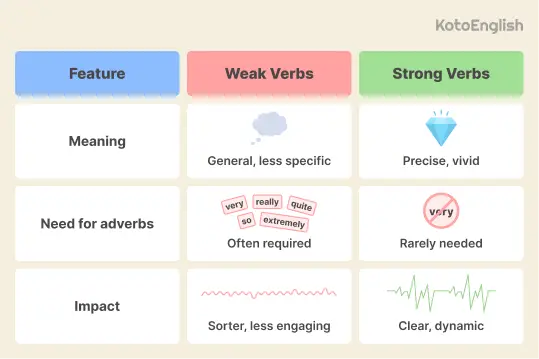
Strong verbs for writing enhance readability and create a rhythmic flow to the writing. By reducing excess words, they make it easier for the reader to understand what is being done. Often, replacing weak verb phrases with one strong verb results in more concise yet vivid sentences.
|
Weak version |
Strong version |
|---|---|
|
The chef made the food very quickly.
|
The chef
|
|
He spoke in a very angry way.
|
He
|
|
The crowd laughed very loudly at the joke.
|
The crowd
|
|
The tired runner went very slowly to the finish.
|
The tired runner
|
It is common practice for authors to use weak verbs due to their habitual nature, such as make, do, go or have. They are correct in their own right; however, using them frequently tends to reduce the impact of the statement.
Why English learners should use strong action verbs
One of the most efficient methods to improve your English skills is through the use of strong action verbs. Powerful action words will not only enable your speech and descriptive writing to become more succinct but also vivid without making it complicated. Three major advantages are listed below:
- Concise language. Dynamic verbs have powerful meanings contained in one word rather than several words. You do not need additional phrases or helping verbs to express the same idea, which makes sentences easier to read.
- Better imagery. Precise action words enable the reader to visualize what is being described. An exact verb paints an accurate mental picture, making your communication clearer and more vivid.
- Higher scores in exams. In tests such as IELTS, the use of strong verbs will earn you higher lexical resource scores. The examiner will find that your vocabulary usage is accurate and diverse.
Verbs are where the difference is most noticeable, and it frequently boils down to word choice.
A comprehensive list of strong verbs by category
Creating a list of strong verbs will be much easier if we classify them into categories. In such a case, they will be better remembered and applied to real life. You will be making semantic linkages instead of concentrating on discrete vocabulary elements.
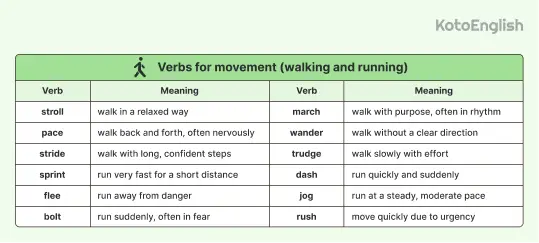
Verbs for movement (walking and running)
These are verbs used to describe the movement of people and objects. Selecting the appropriate verb may convey the character’s mood or even his intentions without any additional information.
|
Verb |
Meaning |
|---|---|
|
stroll
|
walk in a relaxed way |
|
march
|
walk with purpose, often in rhythm |
|
pace
|
walk back and forth, often nervously |
|
wander
|
walk without a clear direction |
|
stride
|
walk with long, confident steps |
|
trudge
|
walk slowly with effort |
|
sprint
|
run very fast for a short distance |
|
dash
|
run quickly and suddenly |
|
flee
|
run away from danger |
|
jog
|
run at a steady, moderate pace |
|
bolt
|
run suddenly, often in fear |
|
rush
|
move quickly due to urgency |
Such verbs provide greater freedom in describing movements. The use of such words as stroll versus trudge immediately sets a different tone for the readers.
Verbs for communication (speaking and looking)
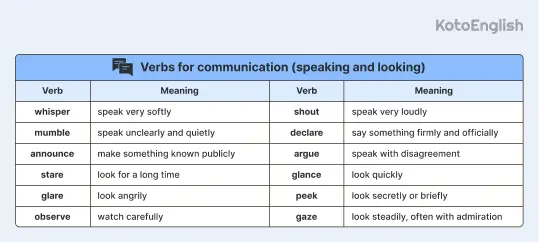
Communication verbs demonstrate how you conveys their ideas and perceive things. Properly used verb can communicate tone, attitude, or intent by one word only.
|
Verb |
Meaning |
|---|---|
|
whisper
|
speak very softly |
|
shout
|
speak very loudly |
|
mumble
|
speak unclearly and quietly |
|
declare
|
say something firmly and officially |
|
announce
|
make something known publicly |
|
argue
|
speak with disagreement |
|
stare
|
look for a long time |
|
glance
|
look quickly |
|
glare
|
look angrily |
|
peek
|
look secretly or briefly |
|
observe
|
watch carefully |
|
gaze
|
look steadily, often with admiration |
In some cases, speakers may also use intensive pronouns (such as myself, yourself) to emphasize who performs the action, but the verb itself still carries the main meaning.
Verbs for emotions and destruction
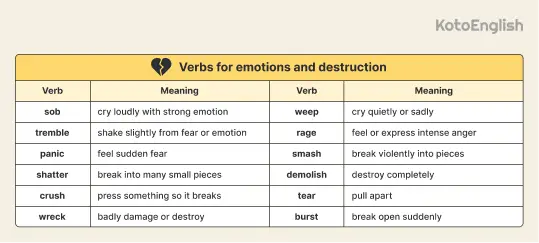
The better verbs have very expressive meanings, and they convey emotion and action very intensely. They are quite appropriate for use in situations of dramatic events or intense emotions.
|
Verb |
Meaning |
|---|---|
|
sob
|
cry loudly with strong emotion |
|
weep
|
cry quietly or sadly |
|
tremble
|
shake slightly from fear or emotion |
|
rage
|
feel or express intense anger |
|
panic
|
feel sudden fear |
|
smash
|
break violently into pieces |
|
shatter
|
break into many small pieces |
|
demolish
|
destroy completely |
|
crush
|
press something so it breaks |
|
tear
|
pull apart |
|
wreck
|
badly damage or destroy |
|
burst
|
break open suddenly |
These verbs bring about an emotional element. They contribute to creating a powerful image in the description of an event or action.
How to replace weak verbs: practical tips
Revising weak verbs requires less grammatical repair and more refining of the tune. At the outset, nothing seems problematic. As you progress, some sentences sound flat or forced. That is when you know it is time to strengthen the language by making the verb do the work.
Step 1: Find “very + verb” or “verb + adverb” constructions
Such structures serve as scaffolding. They are never meant to be permanent, but they do complement the message. Eliminating the building blocks is all that is needed for a better verb. Constructions like verb + adverb or very + verb often rely on adverbs and adjectives to add meaning, because the verb itself is too general.
Step 2: Get rid of unnecessary “to be”
Forms of the verb to be often appear in longer, less direct constructions. Occasionally, the actual action can be found concealed within nouns and embedded within longer expressions. By setting this action free into the verb, the sentence comes to life.

Step 3: Avoid constant use of “get”
Get permeates everyday English. This word functions well, although sometimes the precise meaning gets obscured. Removing the term “get” is akin to focusing a camera lens.
By doing so, incorporating various subjects such as proper nouns, common nouns and scenarios encountered daily aids in identifying weak verbs and substituting them appropriately.
Conclusion
Strong verbs in English are instruments in crafting effective communication. The use of more vivid action verbs minimizes the need for superfluous language that would otherwise hinder the flow of your thoughts. In this tutorial, we have observed how improved verbs contribute to better clarity, visualization, and articulation of your thoughts.
Regular practice ensures that this technique becomes second nature when conversing and writing in English. While concentrating on verbs might not appear to be significant, it makes an enormous difference in improving your English proficiency.
FAQ
An action verb simply describes what someone or something does, such as move, make, or go. A strong verb is more specific and expressive, adding detail and intensity to the action. For example: move → glide, drag, crawl; make → craft, assemble, forge; go → wander, charge, slip; touch → tap, stroke, grasp; see → scan, spot, peer.
No, these are different ideas. In English grammar, the term can refer to irregular forms like go → went. In vocabulary and writing, it describes expressive verbs that make language more vivid, such as grab, whisper, or shatter. The meaning depends on the context.
Strong verbs help you use more precise and varied vocabulary, which is important for the lexical resource criterion. They allow you to express ideas clearly without overusing basic verbs like make, do, or get. It makes your writing sound more natural, controlled, and academically appropriate.
No, not always. Weak verbs are a normal part of English and are useful in many situations. The goal is not to remove them completely, but to avoid overusing them when a more precise verb can improve clarity. Balance is key and powerful verbs should be used where they add value to the sentence.