Common action verbs that start with “k”
Action verbs represent the performance of the subject, whether physical or mental. Even though there could be very few verbs that start with the letter “k,” they are actually very important.
To enhance understanding, such terms may be categorized into physical action verbs and psychological action verbs.
If you feel like you need to refresh your memory, we recommend checking our guide to English verbs, where all the essential words are gathered, and then coming back for this material.
Physical action verbs
This type of action verbs starting with “k” describe visible, physical activities:
- kick — to strike with the foot.
- knock — to hit a surface, usually to get attention.
- kneel — to go down on one/both knees.
- knead — to press and work dough


Mental and communication verbs
When you need to write/talk about thinking, knowing, or speaking, you are recommended to use these words that start with “k:”
- know — to have information or understanding
- kid — to joke or tease someone playfully
- kvetch — to complain persistently (informal)
Positive verbs that start with “k”
The verbs that are positive create feelings of encouragement, advancement, and connection. It is possible, even with a few positive “k” verbs, to inject energy and motivation into your speech. It will benefit your speech about actions with a constructive, uplifting tone that matters for each type of communication.
- kindle — to inspire or spark a feeling or idea
- kiss — to show affection, care.
- keep — to continue or maintain something positive.
- kick-start — to give something a strong beginning


If you would like to find more tools to support your progress in English, explore the top-rated English learning apps that can help you build your English vocabulary.
The tricky silent “k”: verbs you need to know
Another perplexing aspect of English orthography concerns the letter “k” appearing before “n,” known as words with silent “k.” According to historical linguistic evidence, both letters were used in the past when Old English was spoken; however, the need for more efficient pronunciation rendered the second letter unnecessary. Here are the example sentences:
In each case, you will hear that the words begin with an /n/ sound, not /k/. Mastering these terms will improve both pronunciation and listening skills. For more practice, you can explore verbs that start with “p”.
Essential phrasal verbs starting with “k”
Phrasal verbs constitute an essential element of natural language, particularly for non-native speakers learning English. Phrasal verbs are created by combining verbs with particles (adverbs or prepositions). Phrases consisting of verbs with keep, kick, and knock are among the most common and you already know them from the sections above.
Phrasal verbs with “keep”
The phrasal verbs that have keep in them are used when discussing issues like continuity, control, or maintenance. They are especially effective for both written and spoken English.
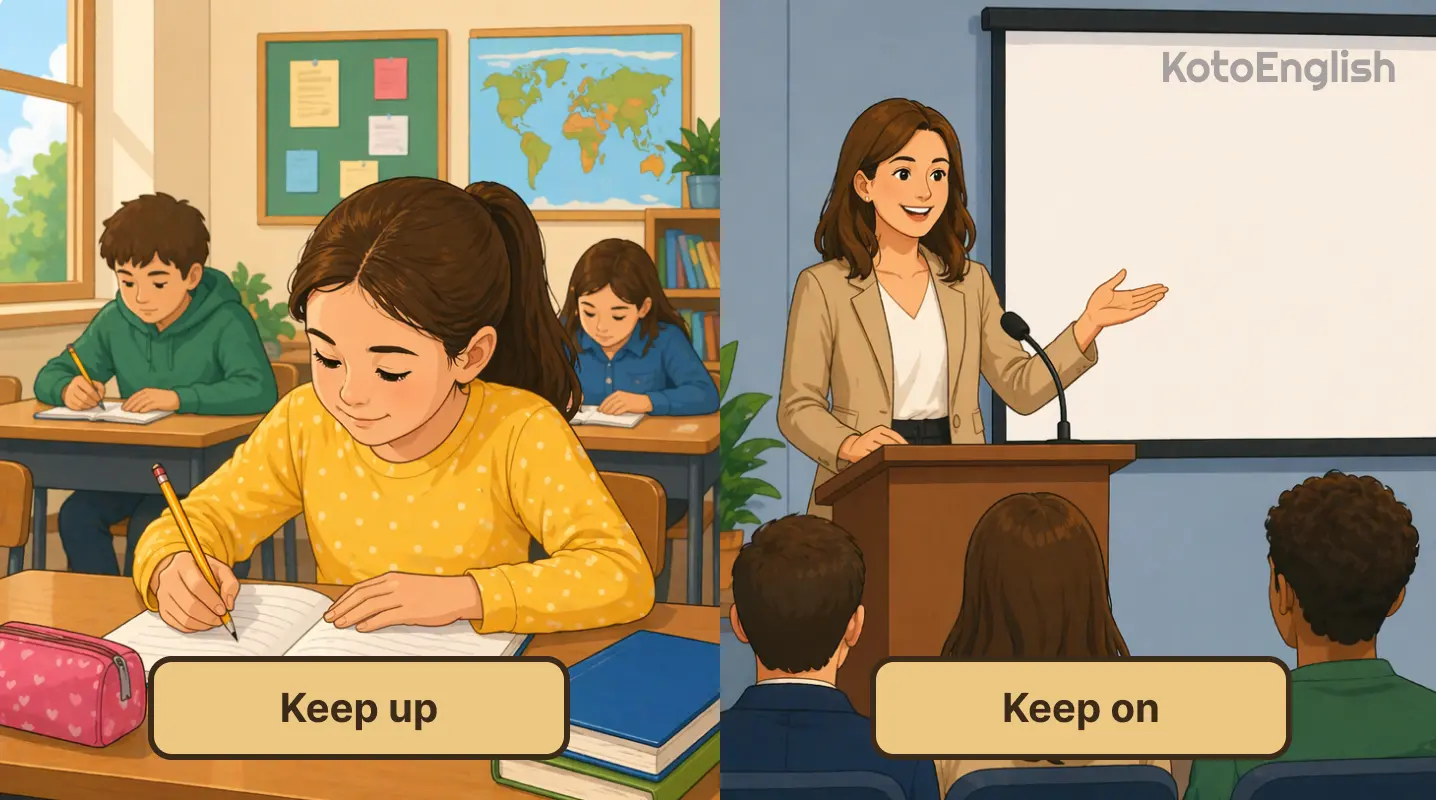
- keep up — to continue at the same level or pace
- keep on — to continue doing something
- keep away — to stay at a distance
- keep out — to not enter

Phrasal verbs with “kick” and “knock”
The phrasal verbs associated with kick and knock are generally used to refer to actions, incidents, or effects. They are used extensively in informal situations.
- kick off — to start something
- kick back — to relax
- knock out — to make someone unconscious
- knock down — to hit something or someone so it falls
If you would like to continue expanding your vocabulary, you can turn to the guide on verbs that start with “t”.
Regular vs. irregular verbs that start with “k”
Most regular verbs starting with “k” are predictable, requiring you to add -ed to form the past simple and past participle. In real examples, it goes like this:
Although some of the terms go further than a past form, not adding a suffix to the base form, and are completely different. They must be learned since they often occur in daily conversation. Here are the common irregular verbs that start with “k” and their forms in different tenses:
|
Base form |
Past simple |
Past participle |
|---|---|---|
|
know
|
knew
|
known
|
|
keep
|
kept
|
kept
|
|
kneel
|
knelt/kneeled
|
knelt/kneeled
|
|
knit
|
knit/knitted
|
knit/knitted
|
Learn irregular forms as a set and not separately to keep the core idea. To bring more effectiveness, create sentences related to your life.
Commonly confused “k” verbs and mistakes to avoid
Certain “k”-verbs might lead to problems due to similarities in their spellings, pronunciations, and dialectical differences in meaning. The following examples highlight some common difficulties, along with their explanation and useful hints.
- Confusing know and ken
What makes it difficult is that both terms are associated with knowledge, but know is the common verb form, whereas ken is rarely used in modern-day English, being either dialectical (Scots) or obsolete.
|
I know the answer.
|
I ken the answer.
|
|
He knows a lot about math.
|
He kens a lot about math.
|
In general contexts, it is preferable to use “know” and treat “ken” as stylistic or regional only.
- Writing “knit-pick” instead of “nitpick”
It can be difficult to understand because it is derived from nit (egg of a louse), not from knit. The pronunciation causes even native English speakers to mispronounce this word.
|
She always nitpicks my work.
|
She always knit-picks my work.
|
|
Stop nitpicking every sentence.
|
Stop knitpicking every sentence.
|
nit = minute detail → nit-pick = focus on tiny flaws.
- Mixing up keep and hold
Both terms are related to ownership; however, while keep means “to continue” or “maintain,” hold pertains to “to carry” or “contain.”
|
Keep working hard.
|
Hold working hard.
|
|
Hold this bag for a second.
|
Keep this bag for a second.
|
Use “keep” for duration/state and “hold” when it comes to physical action.
Conslusion
Although verbs beginning with “k” appear to have a rather narrow range, they actually encompass all important aspects of communication, ranging from physical activity to thought processes and expressions used in day-to-day life. Knowledge of how they should be used and pronounced can enrich one’s language skills.
In order to improve your learning further, take up the challenge of writing five new verbs beginning with “k” from this article. You can make your own sentences using these words and thus memorize them better.
FAQ
Examples of informal “k” verbs are kick it (relax), knock back (quickly drink), and key in (concentrate). Many are contextual in nature and primarily used in conversational English. Although they can be found in informal speech and writing.
Indeed, there are some that originated from different languages. For instance, the word karaoke, which is of Japanese origin, can be utilized as a verb in informal contexts. On the other hand, the verb kowtow, which derives from Chinese, refers to acting subserviently.”
Verbs that are typically found in business contexts may include maintain (keep), understand (know), be key (identify as crucial), kick off (initiate a project). Such words are employed to describe processes, make decisions, and perform tasks during meetings, emails, etc.
Certainly, there are some nouns beginning with “k” that may be considered verbs through the process of conversion. These include the noun key that can have the meaning of input and key into as well as the word knife that means “cut.