
Most common action verbs that start with “p”
An action verb indicates the activity carried out by the subject, either physical or mental. They are mostly dynamic English verbs and can be used in progressive tenses, and today, we will consider the most typical ones with sentence examples for each of them.
Physical action verbs
These action words describe visible performances, so they are often used in continuous tenses.
- paint — to apply color → She is
painting the wall in green. - park — to stop a vehicle → He
parked the car outside. - pass — to give something → Susan
passed me the book. - pay — to give money → Let me
pay for lunch, friends. - peel — to remove skin → He is
peeling an apple for me. - pick — to choose or take →
Pick a card and memorize it. - pull — to draw toward → You need to
pull the door open. - push — to move away →
Push this box carefully. - pack — to put things into a bag →
Pack your bag for tomorrow. - pour — to make liquid flow → Will someone
pour me some water?

Mental and communication verbs
These terms describe thinking, feeling, communication. It is differentiated as stative vs. dynamic verbs, so you will not usually use -ing form.
- perceive — to understand → He
perceives the problem differently. - please — to make happy → I’m really
pleased with the results of this room makeover. - prefer — to like something more → I
prefer tea to coffee. - pretend — to act falsely → The kids are
pretending to sleep. - promise — to give your word → He
promised to help me.
Positive verbs that start with “p”: your vocabulary
Such verbs are perfect for emphasizing your accomplishments, responsibilities, and results because they have an action-oriented ring about them — exactly what any recruiter or client would expect from you.
In real-world conversations or chatting, you can avoid writing vague things. Let’s consider a situation when one writes, “I dealt with customers and assisted my team.” In another case, someone says, “I supported customers and enhanced response times.” The second makes much more sense since it actually implies that the writer is doing something productive.
Here are some more examples when you are forming the past tense:

By using these “p” verbs, you sound stronger and more professional, allowing you to explain not just what you did but also how your work and efforts created value.
Grammar rules: regular vs. irregular “p” verbs
The formation of verbs in the past simple and past participles is an important aspect of English grammar. The rule regarding starting with “p” verbs is that regular verbs take -ed, whereas irregular verbs undergo some transformation and need to be memorized. With our simple guide, you will be able to do it effortlessly.
Regular verbs that start with “p”
Verbs that add -ed to show the past are called regular verbs. Here is how it works:
- play → play
ed
- paint → paint
ed
- push → push
ed
Look out for spelling rules!
Consonants double: plan → planned
K is added after c: panic → panicked
Y becomes i: try → tried
Irregular verbs that start with “p”
As for the most valuable verbs in this section, luckily, you need to memorize only a few of them that are common for daily communication. Here are all of them:
|
Base |
Past |
Participle |
|---|---|---|
|
pay |
paid
|
paid
|
|
put |
put
|
put
|
|
prove |
proved
|
proven/proved
|
In practice, what really matters here is not only learning the rule, but also being able to identify the patterns very quickly in the course of writing or speaking. These terms can be used in other cases as well, for example, you can check on phrasal verbs with “put” to learn more.
Regular verbs can easily be predicted and constructed while irregular verbs need to be learned through usage.
Essential phrasal verbs starting with “p”
Phrasal verbs with “p” can be challenging since they have idiomatic meanings that do not match their literal meanings. Therefore, you should always study these terms as whole units rather than trying to translate each word.
|
Phrasal verb |
Meaning |
Example |
|---|---|---|
|
put off |
to postpone |
They
|
|
put on |
to wear |
She
|
|
pick up |
to collect or learn |
I will
|
|
point out |
to show/highlight |
She
|
|
pay off |
to bring a good result |
All our hard work
|
|
pull over |
to stop a car at the side of the road |
The driver
|
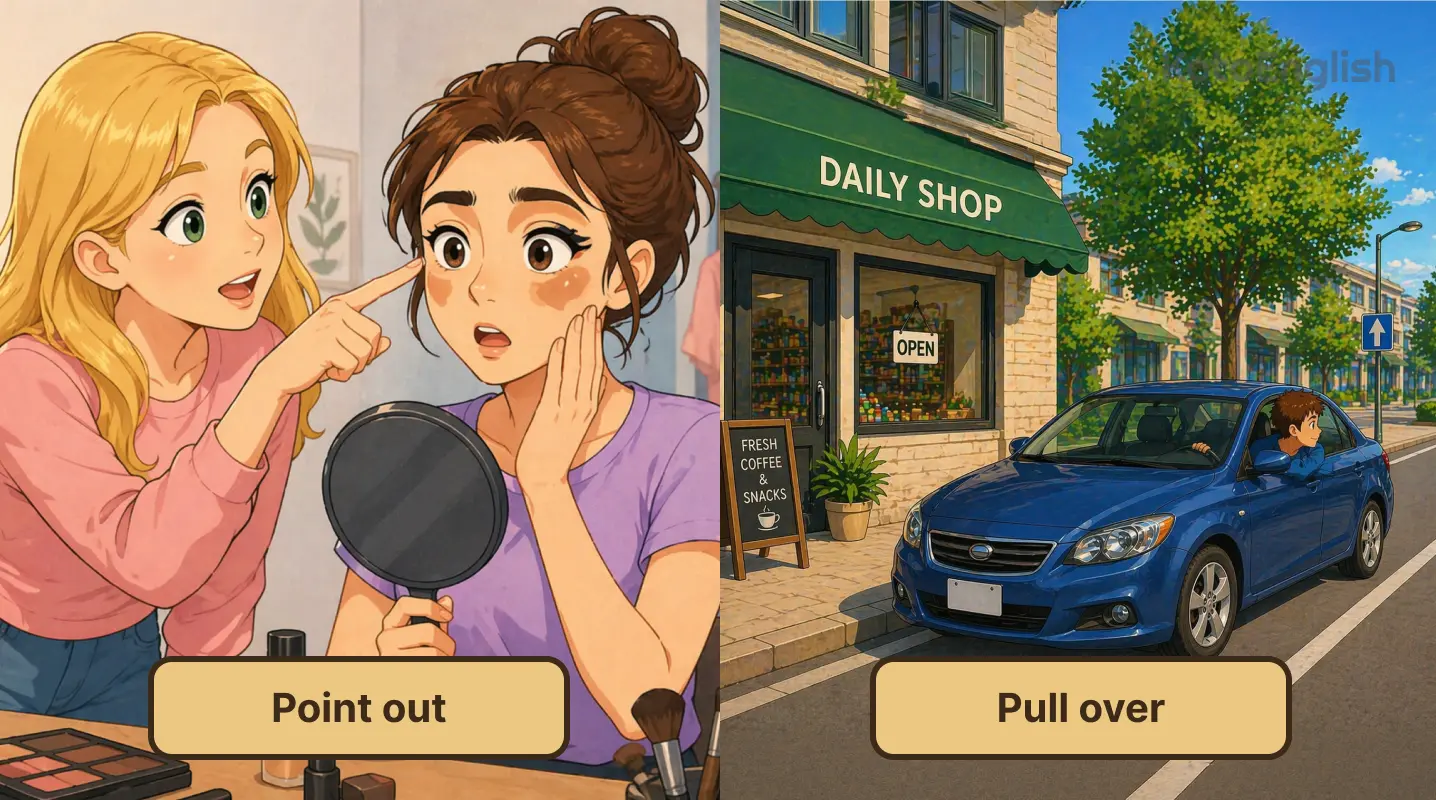
These special phrases can be used with the Present Continuous tense, simple, past, and others, allowing you to make your speech/writing more expressive and interesting.
Common mistakes when using “p” verbs
English verbs starting with “p” can cause confusion when it comes to spelling, grammar, style, and avoiding them will help to sound more professional and clear. Below are the three core mistakes you can make when learning these terms when it comes to meanings and definitions.
Practice vs. practise
When you are trying to expand your vocabulary by consuming content from various spelling differences, you can be confused between British (practice = thing, practise = action) and American (practice, which can be the noun and the verb) English.
|
She practises yoga and goes to a practice every weekend.
|
She practices yoga and goes to a practice every weekend.
|
|
This is a good practise for beginners.
|
This is a good practice for beginners.
|
Passed vs. past
The terms above are homophones and are thus commonly misunderstood. However, these terms perform different roles in a sentence. “Passed” is a verb, whereas “past” may be used as a preposition, an adverb, an adjective, or a noun.
|
She pass the exam last week.
|
She passed the exam last week.
|
|
He walked passed the building.
|
He walked past the building.
|
Permit vs. allow
The two verbs are grammatically correct; however, their styles vary. The verb “permit” is more formal and commonly found in regulations and notices, whereas “allow” is more informal and conversational.
|
My parents do not permit me to stay out late.
|
My parents do not allow me to stay out late.
|
|
This cafe doesn’t allow smoking.
|
Smoking is not permitted in this area.
|
Conslusion
A good list of verbs starting with “p” is going to add greatly to your vocabulary, both the commonly used ones as well as more complex ones that have professional connotations. Rather than merely learning the verbs by rote, try writing sentences using them.
For meaningful improvement, pay attention to practice and repetition: classify verbs based on their meanings, observe how they are used in sentences, and review them often. In this manner, “p” verbs will become second nature to you in communication.
FAQ
There are verbs that are always followed by -ing verb forms, and not to. Examples include practice, postpone, and propose (practice speaking, postpone buying, propose going).
Conversion is illustrated by many “p” terms, including park, plant, plan, and promise (can be used as nouns or verbs).
It is recommended to use formal verbs such as postulate, perceive, propose, predict, and portray to enhance your academic tone.
There are some terms that are only used together with particular prepositions, e.g., participate in, pay for, protect from, and prepare for.