The core mechanics: how does LingQ work
LingQ serves as an instructional setting that allows users to engage with authentic texts and vocabulary. It can also be a premier option for those who like watching top-rated films to learn real English, adding subtitles for more understanding.
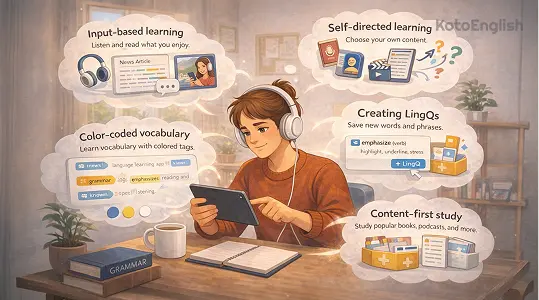
Let’s check the core mechanisms:
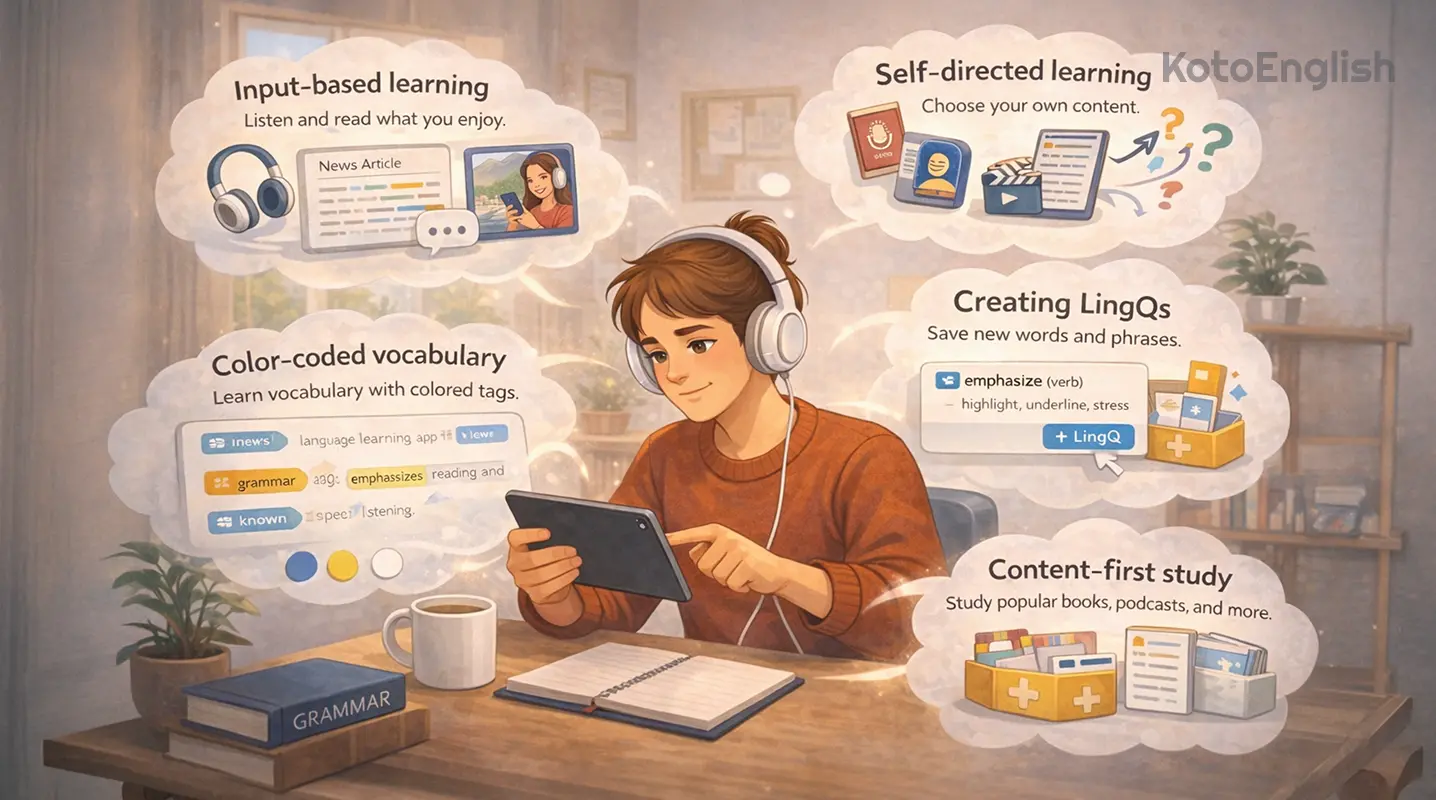
- Input-based learning
Unlike traditional learning methods that rely on the study of grammar, LingQ emphasizes reading/listening. It is based on the principle that language is improved by exposing oneself to meaningful material repeatedly.
- Content-first study
Users acquire knowledge through what they like: narratives, articles, discussions, audio clips, other materials rather than through exercises on their own. It helps create a more realistic approach, as meaning is derived not only from an exercise but also from the whole sentence or context.
- Color-coded vocabulary
Each term in any lesson is tagged according to its degree of familiarity. The blue tags indicate total unfamiliarity with words, the yellow tags indicate the learning process for words, while the white tags signify total familiarity with known words.
- Creating LingQs
Learners can add any unknown words or phrases that they come across during their reading to their vocabulary as LingQs for further study. As such, it makes studying English an interactive activity since any unknown vocabulary can be added and studied again and again.
- Self-directed learning
The system provides users with the necessary resources and guidelines, though it does not offer strict guidance on how to learn. The website is well-suited for individuals who can make their own choices about the reading materials they select.
The library and Mini Stories
A function unique to LingQ is its content library, which serves as the initial platform for new users. It provides access to a vast collection of content, ranging from stories and dialogue to articles and podcasts, organized by difficulty level.
The Mini Stories collection — short, structured texts for common vocabulary and basic sentences — is paired with audio, simultaneously enhancing listening and reading.
It follows a pattern, making it easier for new learners to digest. Repetition of phrases and concepts will make it easier for students to notice the patterns, even if the explanation of grammatical rules is not provided.
Importing content: the main feature
The LingQ tool helps users to make any outside text or video lesson where all the words become clickable. Rather than restricting themselves to a limited library of materials, they can use their own choice of content to learn from. Here is how it works:
- Importing content from the web
The users can copy text or insert websites into the software LingQ. Once inserted, the software will process the text such that each word is made clickable, which has the facility of translation instantly and is even saved as a LingQ.
- YouTube import
YouTube videos with subtitles can be imported to LingQ. These subtitles are then extracted and paired with the audio to create lessons in which you will read, listen, and learn new vocabulary.
- Netflix import (via external tools)
However, Netflix material cannot be directly imported into LingQ. The user may have to use browser plugins for extracting subtitles that can be added to the language learning app. Then the content will function in the same way as other lessons.
- User-controlled content selection
The system does not restrict users from using any pre-made learning material. It is left for the learners to choose the material they want to incorporate into their training process.
This particular feature makes it possible to use LingQ differently. Rather than engaging with ready-made lesson plans, learners now have the ability to make their own learning content out of regular content while staying within one platform.
Browser extension and AI tools
Importation is done using the LingQ extension in the web browser and its own import solutions.
- Browser extra tool workflow
LingQ’s browser extension enables the user to import content from websites instantly by simply clicking on the extension. The text selected becomes a part of the lesson in LingQ once the button is pressed.
- AI transcription for unsupported audio
In case audio materials lack subtitles, LingQ utilizes artificial intelligence (AI) transcriptions to convert audio into text. Consequently, users can engage with podcast content or any other audio recording regardless of its initial purpose.
- Minimal tech setup
It was built to minimize resistance. Most of the information can be made into lessons within a few simple steps, making it simpler to continuously utilize outside sources for educational purposes.
LingQ pricing: Is a premium necessary?
The free package of LingQ allows you to get familiar with the workings of this platform, but it does not provide sufficient means for the practical use of its methods. The major limitation consists of the limitation on saving LingQs, as the entire system relies on vocabulary acquisition through reading and listening.


This explains why the disparity in the comparison between the LingQ free vs Premium options stands out. The free option will help you evaluate LingQ’s interface and reading-listening techniques and see if they fit your learning style. It will be sufficient for experimentation, but insufficient for progression.
The LingQ premium price is paid to get rid of all those limitations, allowing users to have access to the complete learning process. It works better for students who intend to use LingQ three to four days per week or more. For students who enjoy using articles and other materials to learn, only the paid version of LingQ will deliver significant benefits.
When talking about LingQ cost, there are different subscription plans available, with cheaper ones offered for a greater duration. In addition, there is one plan that comes with extra artificial intelligence-powered capabilities at a premium cost.
Ultimately, if one is already accustomed to learning by immersion, he or she should be willing to pay for LingQ Premium to streamline the process. If not, then LingQ Premium may be less valuable since it doesn’t offer courses, grammar lessons or detailed instructions. To put it simply:
- Free is for testing the study method.
- Premium is for using the methodology seriously.
It is also worth noting that point systems are available alongside LingQ subscriptions. From the information found in the LingQ forum, points are utilized for services related to tutoring on the website such as writing corrections, live chats, and premium classes.
Users can buy them or earn them through referrals, sharing lessons in the Library, and other activities you will be familiar with when you start using the platform.
LingQ vs Duolingo: Which approach is better?
Writing a LingQ review in an unbiased way, the issue is not so much which one is objectively superior; rather, it lies in what learning experience one seeks to attain. LingQ excels at the learner looking for a practical and experiential method of language acquisition.
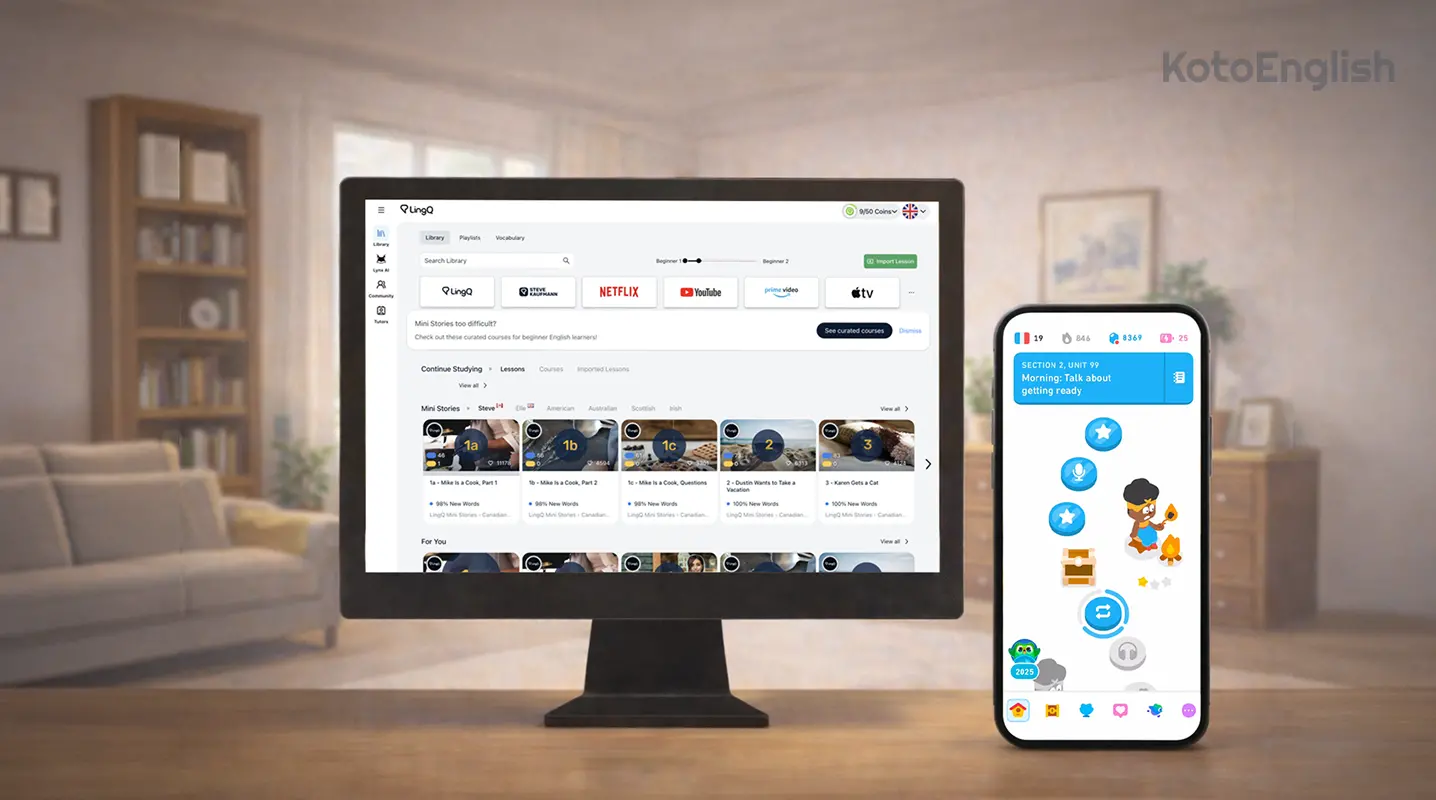
In the review of gamified learning on Duolingo, we defined what works well for the organized learner seeking simplicity. For now, you will see a brief comparison:
|
Category |
LingQ |
Duolingo |
|---|---|---|
|
Method |
Reading and listening to real content |
Short gamified lessons |
|
Best for |
Vocabulary tracking and growth |
Daily practice to build a habit |
|
Content |
Articles, audio, imported materials |
Built-in exercises |
|
Strcuture |
More flexible, less guided |
More guided |
The distinction between the two lies in the method of studying. For someone looking to learn through more immersive means using content, LingQ would be more suitable, whereas for someone looking for a straightforward and disciplined schedule to keep consistency, it is worth reviewing Duolingo.
LingQ alternatives and competitors
When individuals seek other completely free language app alternatives, they typically contrast LingQ with programs that offer another approach to learning and are also the most popular ones. This is evident in how Babbel is frequently associated with LingQ, given its methodical approach compared to the content-based model.
To make the LingQ app review complete, we would like to consider that the comparison between LingQ and Babbel is rather straightforward. LingQ allows users more liberty when learning by reading and listening, whereas Babbel offers more structure and guidance with small classes and progression between subjects.
It really comes down to the type of assistance the learner needs. If a learner needs autonomy, LingQ would be a much better choice. If he prefers guided assistance, then Babbel might be a good choice. If you want to know more about the format used in Babbel, refer to our thorough Babbel app review.
Pros and cons of using LingQ
Most people consider the benefits and drawbacks of LingQ in an attempt to answer a basic question — will it really be useful to them or will the app seem overwhelming? The truth is that LingQ is not a regular language app, so there is a lot to explore, and we will consider the LingQ pros and cons:
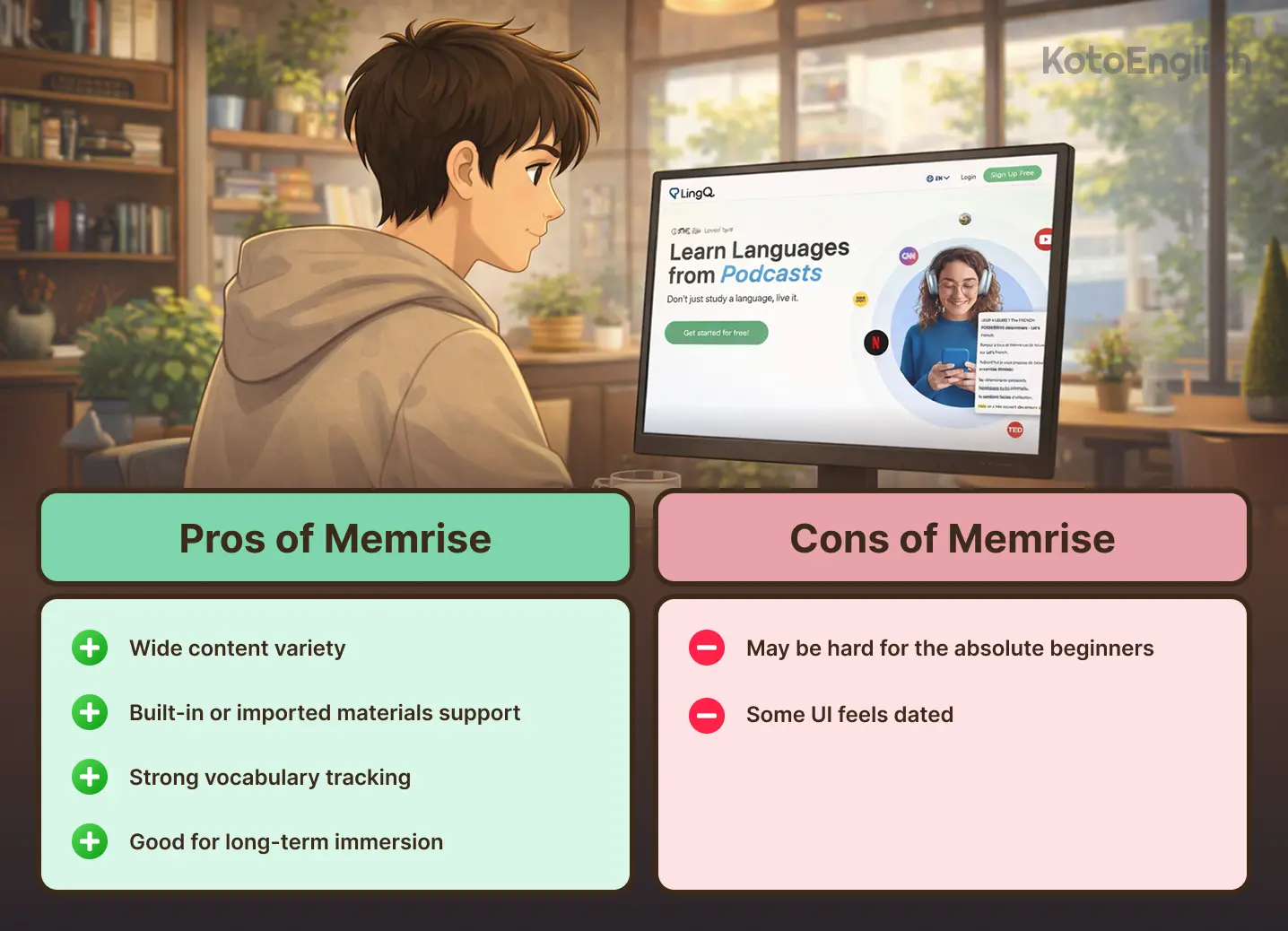
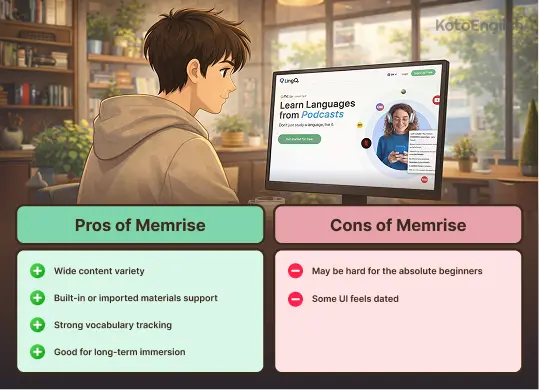
From the perspective of LingQ premium review, the primary benefit comes from the level of freedom it gives users, along with their ability to learn in context. The primary disadvantage is that the app relies on the user being in charge of everything.
Community and tutors
LingQ is not only an application but also an overall learning system that includes a community feature and online tutoring. This function is essential because it introduces another aspect beyond the traditional reading and listening, including engaging with tutors and writing.
This approach is beneficial for those who prefer reading and listening exercises on the platform but still need guidance from a native English speaker or a tutor from time to time. For instance, a user can learn new words on their own and then send their work for correction, or attend a discussion class to practice speaking skills.
There is also a community dimension through the lessons that are shared and the referral system. People can submit their material to the LingQ library, and the platform fosters a sense of community compared to a closed-course platform. In addition to the official material, one can also use material prepared by others.
Conclusion
As seen in the LingQ review 2026 above, this application cannot meet all learners’ needs, but it works perfectly well for a particular category of users. These are individuals who feel confident enough when learning on their own and who are ready to learn by constant exposure to the language studied.
It is a perfect fit for those learners who have some background knowledge and wish to improve their vocabulary through reading and listening activities. Studying process depends upon patience and takes time because improvement does not occur rapidly; rather, it develops slowly through consistent language exposure.
Summing up, it is worth noting that the platform is a method-driven environment that intermediate and advanced students may find exciting.
FAQ
LingQ Premium membership enables access to an endless array of languages provided by the website. Over 40 languages including those that are widely used to less-used ones, will be at your disposal.
It may also pose difficulty for complete beginners. While LingQ provides materials that are easy for beginners, including Mini-Stories, this method requires users to have some vocabulary already before starting. This is why it is better suited to intermediate and advanced levels.
Yes, this is one of the essential features of LingQ. Users are able to input articles, novels, YouTube video transcripts, Netflix subtitles, and more through their browser extension.