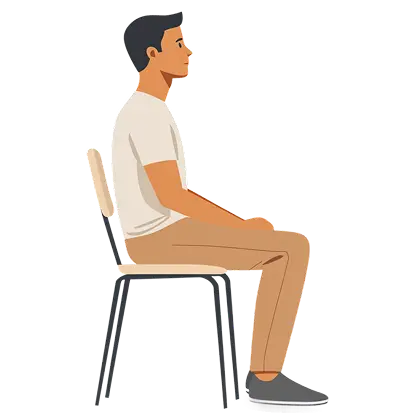
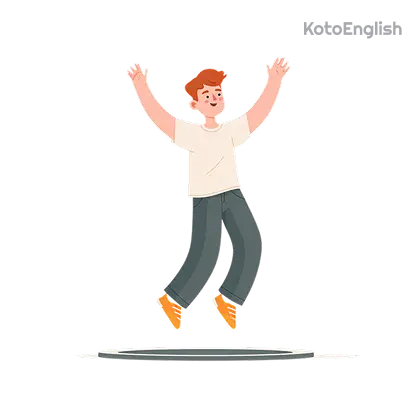
Stand – to be in an upright position on your feet, remain in a particular state or condition, or stay in a specific place or situation. It can also describe supporting, tolerating, or representing something.
How to Pronounce "Stand"
 Audio (UK):

 Audio (US):
Pay close attention to the /æ/ sound in the middle – it is a short, open vowel pronounced with your mouth slightly wider than for the sound /e/. It is the same vowel sound you hear in words like “cat,” “map,” and “hand.”
Level up your English with Koto!
Examples of "Stand" in a Sentence
The verb “stand” describes more than the action of standing upright. It can show a person being present at a location while displaying their ability to remain in position and even their emotional response.
- Physical Position or Action

- Expressing Feelings or Tolerance
The expression “can’t stand” is extremely common in spoken English and means to strongly dislike or not tolerate something. Native speakers use it very naturally in everyday conversations.
Conjugation of the Irregular Verb “Stand”
“Stand” is an irregular verb, meaning its past forms do not end in -ed. Instead, both the Past Simple and Past Participle forms change to stood. Review the tables below to see how “stand” works across different tenses and forms.
Simple Tenses of “Stand”
|
Tense |
Form |
Structure |
|---|---|---|
|
Present Simple |
stand/stands |
I
|
|
Past Simple |
stood |
They
|
|
Future Simple |
will stand |
She
|
Continuous and Perfect Forms
|
Tense |
Form |
Example |
|---|---|---|
|
Present Continuous |
am/is/are standing |
He
|
|
Past Continuous |
was/were standing |
We
|
|
Future Continuous |
will be standing |
At this time tomorrow, I
|
|
Present Perfect |
have/has stood |
She
|
|
Past Perfect |
had stood |
They
|
|
Future Perfect |
will have stood |
By the end of the event, he
|
|
Present Perfect Continuous |
have/has been standing |
I
|
|
Past Perfect Continuous |
had been standing |
She
|
|
Future Perfect Continuous |
will have been standing |
By midnight, they
|
Infinitive and Gerund
|
Form |
Structure |
Example |
|---|---|---|
|
Infinitive |
to + verb |
I want
|
|
Gerund |
verb + -ing |
|
Common Phrasal Verbs with “Stand”
To boost your English fluency, take a look at the following phrases that are constantly used by native speakers every day. Read them and remember!
- Stand up – to rise to your feet from a sitting position
- Stand out – to be more noticeable or impressive than others
- Stand by – to support someone or remain ready for action
Synonyms and Antonyms for “Stand”
Discover new connected vocabulary to the word “stand” in terms of synonymous expressions and opposite counterparts. This will enhance your lexicon and make you more flexible while speaking or writing in English.
|
Synonym |
Meaning |
|---|---|
|
Rise |
to move from sitting or lying to a standing position |
|
Remain upright |
stay standing without falling |
|
Endure |
tolerate something difficult or unpleasant |
|
Tolerate |
accept or deal with something annoying or uncomfortable |
Examples of usage:
|
Antonym |
Meaning |
|---|---|
|
Sit |
rest with your body supported in a seated position |
|
Lie down |
place your body in a horizontal position |
|
Collapse |
fall down suddenly |
|
Give up |
stop supporting or resisting something |
Examples of usage:
“Stand” in Spanish, French, and German
Despite its seemingly straightforward meaning, the concept of standing is represented by very diverse terms in many languages. Some use a single verb, while others rely on descriptive phrases that emphasize posture and physical state rather than just the action itself.
| Language | Word for “Stand” |
|---|---|
 Spanish
|
Estar de pie |
 French
|
Se tenir debout |
 German
|
Stehen |