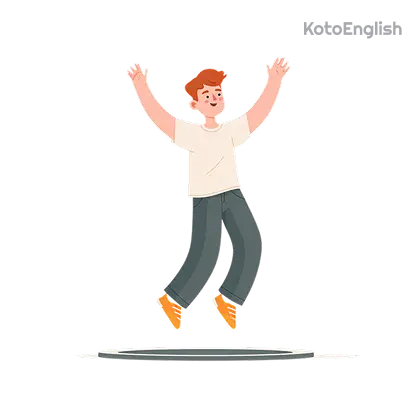
Jump – to push yourself off the ground with your legs, move quickly upward or forward through the air, or react suddenly to something. It can also describe a rapid increase, change, or movement from one place or situation to another.
How to Say “Jump” Correctly
 Audio (UK):

 Audio (US):
The pronunciation of the word “jump” begins with the soft /dʒ/ sound, which resembles the first letter of “job” and “juice”. The tongue should be pressed against the palate briefly before producing the sound smoothly. Lastly, produce the /p/ sound distinctly, without leaving it out, as English speakers tend to emphasize consonant sounds at the end of words.
Level up your English with Koto!
The Complete Conjugation of “Jump”
Since “jump” is a regular verb, changing its forms is quite straightforward. However, knowing how to use it fluently across all tenses is key to mastering conversational English.
Simple Tenses (Present, Past, Future)
|
Tense |
Structure |
Example |
|---|---|---|
|
Present Simple |
jump/jumps |
I
She
|
|
Past Simple |
jumped |
He
|
|
Future Simple |
will jump |
They
|
Continuous and Perfect Forms
|
Tense |
Structure |
Example |
|---|---|---|
|
Present Continuous |
am/is/are jumping |
She
|
|
Past Continuous |
was/were jumping |
They
|
|
Future Continuous |
will be jumping |
I
|
|
Present Perfect |
have/has jumped |
We
|
|
Past Perfect |
had jumped |
He
|
|
Future Perfect |
will have jumped |
She
|
|
Present Perfect Continuous |
have/has been jumping |
I
|
|
Past Perfect Continuous |
had been jumping |
They
|
|
Future Perfect Continuous |
will have been jumping |
By noon, she
|
Infinitive, Gerund & Imperative Mood
|
Form |
Structure |
Example |
|---|---|---|
|
Infinitive |
to + verb |
I like
|
|
Gerund |
verb + -ing |
|
|
Imperative |
base form |
|
Seeing “Jump” in Action: Sentence Examples
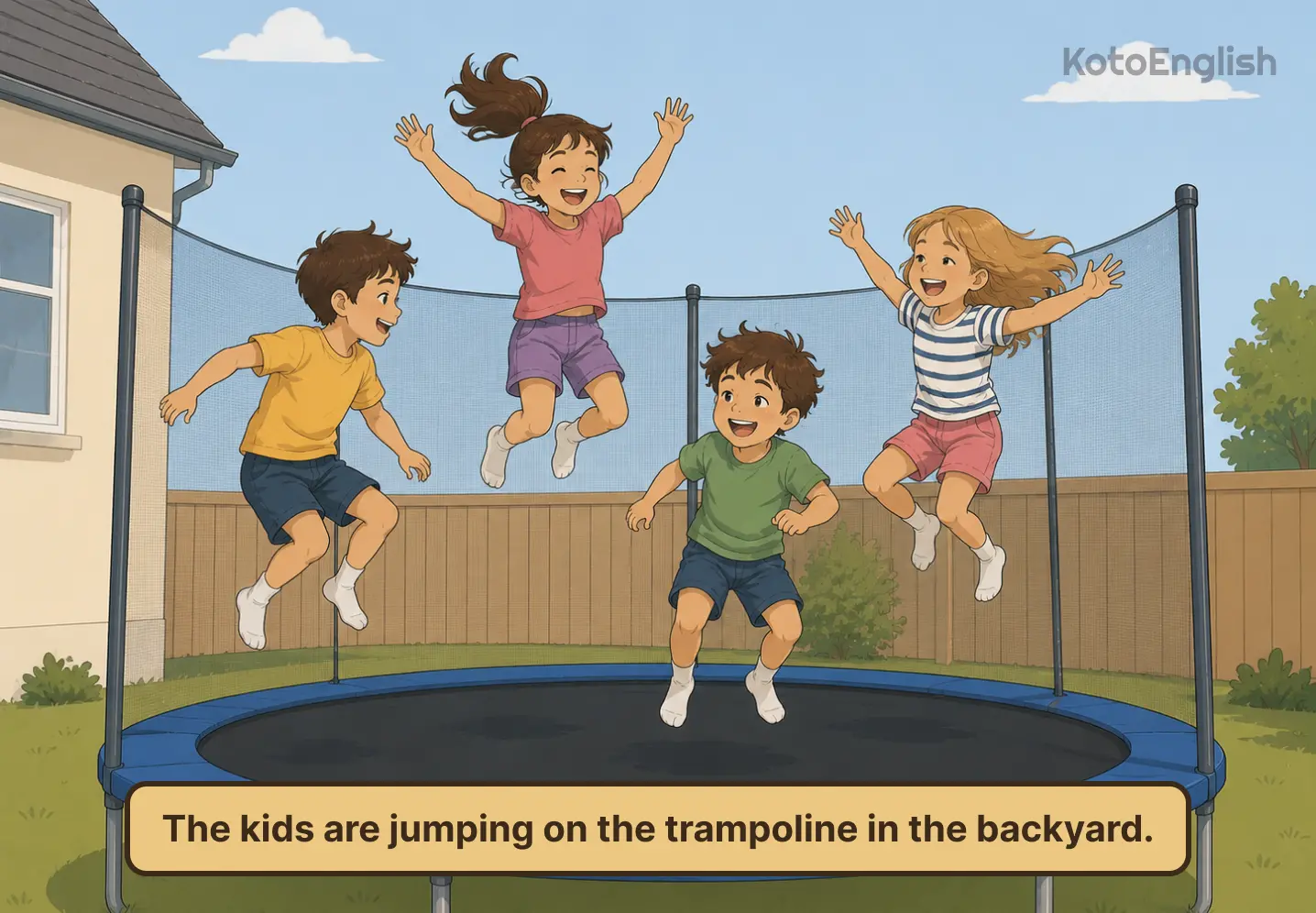
The word “jump” describes physical movement, emotional responses, sudden events and quick development. The following patterns of usage demonstrate how this verb becomes more adaptable to different situations and contexts.
Synonyms & Antonyms for “Jump”
The English language has a range of movement verbs that express more than just the direction of an action. The variations in meaning between similar and opposite verbs show how small differences in motion can change the meaning of a sentence entirely.
Words with Similar Meaning
- Leap – jump a long distance or high into the air
- Hop – make a small jump, usually on one foot
- Bound – jump forward with large energetic movements
- Vault – jump over something using your hands or a pole for support
Opposite Actions
- Drop – move downward freely
- Fall – come down suddenly from a higher position
- Descend – move downward slowly or carefully
- Plummet – fall very quickly and suddenly
How to Say “Jump” in Other European Languages
European languages possess striking similarities when it comes to describing motion, but still each word has a unique phonetic flavor of its own. A brief analysis of these translations gives you a rapid insight into how various nations speak about jumping.
| Language | Word for “Jump” |
|---|---|
 German
 |
Springen |
 Italian
 |
Saltare |
 French
 |
Sauter |
 Spanish
 |
Saltar |