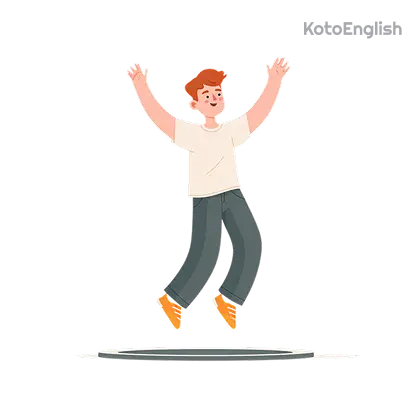
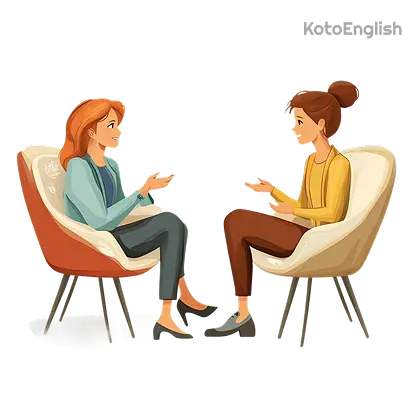
Sit – to rest your body on a chair, seat, or other surface with your weight supported by your bottom, or to remain in a particular position or place. It can also describe being located somewhere or staying inactive for a period of time.
Pronunciation & Spelling of “Sit”
 Audio (UK):

 Audio (US):
Pay special attention to the short /ɪ/ sound in the middle – it is quick and relaxed, similar to the vowel sound in “bit” or “milk”. Avoid confusing it with the long /iː/ sound used in “seat” /siːt/, which is pronounced longer and tenser.
Level up your English with Koto!
The Biggest Challenge: “Sit in,” “Sit on,” or “Sit at”?
English learners struggle with these prepositions because they need to select the correct option based on the specific surface or position that exists. The following comparison shows you a basic method to differentiate between these things.
|
Expression |
When to use it |
Examples |
|---|---|---|
|
Sit in |
describes being inside something with sides or an enclosed space |
|
|
Sit on |
refers to resting your body on top of a surface |
|
|
Sit at |
shows a position near something for a specific activity |
|
Native speakers will always select such prepositions without thinking because of common phraseology. Listening to authentic speech and learning such phrases as a whole will enable you to remember them better.
Conjugation of the Irregular Verb “Sit”
As “sit” is an irregular verb, it doesn’t have an ending -ed. Luckily, the Past Simple form and the Past Participle coincide – both are “sat,” which means you only have to learn these forms.
Simple & Continuous Tenses
|
Tense |
Form |
Example |
|---|---|---|
|
Present Simple |
sit/sits |
I
|
|
Past Simple |
sat |
She
|
|
Future Simple |
will sit |
They
|
|
Present Continuous |
am/is/are sitting |
He
|
|
Past Continuous |
was/were sitting |
We
|
|
Future Continuous |
will be sitting |
At this time tomorrow, I
|
Perfect Tenses
|
Tense |
Form |
Example |
|---|---|---|
|
Present Perfect |
have/has sat |
She
|
|
Past Perfect |
had sat |
They
|
|
Future Perfect |
will have sat |
By noon, he
|
|
Present Perfect Continuous |
have/has been sitting |
I
|
|
Past Perfect Continuous |
had been sitting |
She
|
|
Future Perfect Continuous |
will have been sitting |
By evening, we
|
Participle & Gerund Forms
|
Form |
Structure |
Example |
|---|---|---|
|
Present Participle |
sitting |
The man
|
|
Past Participle |
sat |
Exhausted, they remained
|
|
Gerund |
sitting |
|
Real-Life Sentence Examples with “Sit”
The word “sit” is commonly connected with posture, but its application goes much further than just that. In regular language, it can also refer to a state of being stationary, waiting, positioning, or remaining constant.
Literal Meaning (Posture and Location)

Figurative Meaning (Inaction or Placement)
Essential Phrasal Verbs with “Sit”
In order to boost your fluency and general comprehension of English language, take a closer look at the following expressions and real-life examples with these phrases. Read, listen and remember them!
- Sit back – relax and let things happen without trying to control them
- Sit tight – stay where you are and wait calmly for further information or action
- Sit through – remain until the end of something long, boring, or uncomfortable
- Sit around – spend time lazily or without doing anything productive
- Sit down – take a seat, often before having a serious talk or discussion
Synonyms & Antonyms for the Word “Sit”
The choice of words used to talk about sitting often indicates mood, formality level, or social situation. In English, various terms for sitting can alter the entire tone of a phrase, ranging from very casual to an abrupt action.
Synonymous expressions: take a seat grab a chair settle down perch
Opposite expressions: stand rise get up depart
English speakers tend to opt for common expressions such as “take a seat”, “grab a chair”, etc., rather than using the same verb “sit”. This approach may help improve your fluency.
“Sit” in Other Languages
Discover the proper spelling and pronunciation of the word “sit” in other popular languages.
| Language | Word for “Sit” |
|---|---|
 Spanish
|
Sentarse |
 French
|
S'asseoir |
 German
|
Sitzen |
 Italian
|
Sedersi |