Walk – to move forward by putting one foot in front of the other at a regular pace, without running. It is one of the most basic ways people travel short distances and is also often done for health or relaxation.
Past and present participles of “walk”:
|
Past participle |
Present participle |
|---|---|
|
walked |
walking |
Walk: British vs American Pronunciation
 Audio (UK):

 Audio (US):
“Walk” sounds very similar in British and American English, but the vowel is slightly different. For example, the vowel in British English will have a more rounded and prolonged pronunciation /wɔːk/, whereas the vowel sound in American English will be relatively flat, like WAHK.
The Secret of the Silent “L”
In the word “walk,” the letter l is silent, meaning that it is not sounded at all. In the case of alk groups, this is why the word sounds like WAWK or WAHK rather than WAL-K. Examples of words where this is common include “talk” and “chalk.”
Level up your English with Koto!
Examples of “Walk” in a Sentence
The word “walk” becomes understandable through its usage in actual situations. Here you can see how people use the word in their daily conversations across various social contexts.
Walking as a Daily Routine
Talking About the Past and Future
Using “Walk” as a Noun
Synonyms for “Walk”
There are many words that can be used to express walking in English. Every verb provides a different nuance, allowing you to convey both the activity and the manner in which it is performed.
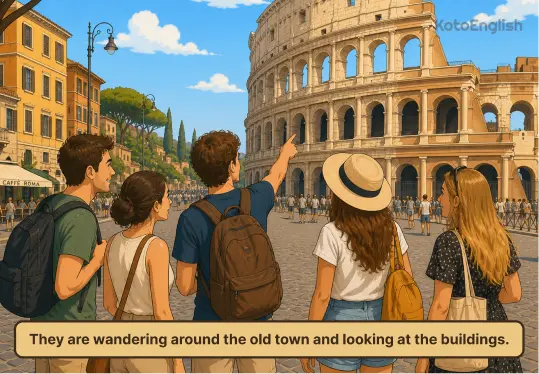
Moving Slowly: Stroll and Wander
- stroll – to walk slowly in a calm and pleasant way
- wander – to walk without a clear direction, often exploring
- amble – walk in a slow, easy way
- saunter – walk in a relaxed, confident way
Moving for Exercise: Hike and March
- hike – walk long distances, usually in nature
- march – walk with strong, regular steps
- trek – walk a long and often difficult journey
- tramp – walk heavily or for a long time
Fast Walking: Pace and Stride
- pace – walk back and forth (often thinking or nervous)
- stride – walk with long, confident steps
- rush – walk quickly because you are in a hurry
- hurry – move fast to get somewhere
Opposite Actions (Antonyms)
However, not all scenarios feature people walking. In some cases, the opposite may be that someone remains stationary or travels at an entirely different speed. The following words refer to actions different from walking.
Staying Still
- stop – to stop moving
- stand – to be on your feet without moving
- stay – to remain in one place
Moving Fast
- run – to move quickly on your feet
- sprint – to run very fast for a short distance
- dash – to move quickly and suddenly
“Walk”: Collocations & Phrasal Verbs
The word “walk” is found in many collocations that extend its literal sense. The usage of these phrases in the English language is quite extensive and they can be effectively employed to describe behavior.
Essential Phrasal Verbs
|
Phrase |
Explanation |
Example |
|---|---|---|
|
walk in |
come into a place, often without planning or invitation |
She just
|
|
walk out |
to leave a place suddenly, especially to show anger or disagreement |
He
|
|
walk away |
leave a situation on purpose, often to avoid problems or conflict |
She chose to
|
|
walk into |
enter somewhere or become involved in something, sometimes unexpectedly |
They
|
Popular Word Pairings
|
Phrase |
Explanation |
Example |
|---|---|---|
|
walk the dog |
to take a dog outside for exercise or to walk together |
I
|
|
walk home |
return home on foot instead of using transport |
We
|
|
walk upstairs |
go up to a higher floor using the stairs |
He
|
Fun Idioms with “Walk”
|
Phrase |
Explanation |
Example |
|---|---|---|
|
a walk in the park |
something that feels very easy to do |
The exam
|
|
walk on air |
to feel extremely happy or excited |
He was
|
|
walk the extra mile |
to make an extra effort beyond what is expected |
She always
|
“Walk” in Other Languages
The concept of walking is present everywhere, but each language describes it uniquely. These translations will help you see the ways in which “walk” is depicted in other cultures.
| Language | Word for “Walk” |
|---|---|
 Spanish
|
Caminar |
 French
|
Marcher |
 German
|
Gehen |