What affects how long it takes to learn English?
Many people think that speed is related to talent. In reality, everyone is able to meet the desired benchmark and improve English for work, relocation, or fun with support from appropriate textbooks and the best free language learning apps.
However, two individuals may learn the same language for the same period and reach different results because of different circumstances.
Your starting level
Your current level alters the whole process. If you are at the A1 level, you will start with the basics of English vocabulary, phrases, and grammar, as well as listening at a slow pace. For a beginner, it is significant to make small improvements in English.
If you are at an intermediate level, your task is different. You already know the basics; now you need to make it precise and expand your vocabulary and grammar with more confidence.
How much time do you spend studying?
When study sessions are intense, the timeline shortens significantly. If a person studies for three hours a week, they will move forward, but at a slow pace. If a person spends an hour a day studying English, there will be more repetition and more opportunities to remember the learned material.
Your learning method
The quality of progress can vary from one approach to another. In self-study, for instance, it is common to use a combination of apps to develop different skills at a quick pace. A structured English course can be helpful in keeping you organized, giving you feedback, and preventing you from developing incorrect language habits.

Your native language
Language distance is more significant than many students realize. If your native language has similar words, grammar or sounds to English, some aspects of this may seem more familiar. For example, if you know German or Spanish, you will find many words that sound alike.
If your native language is significantly different from English in grammar and syntax, it may take longer for you to acquire certain aspects such as word order or articles. At the same time, languages that are closer to English can create their own challenges, as learners may confuse similar vocabulary or grammatical patterns.
Motivation
Motivation is what gets you started, and consistency is what will keep you going. If you have solid reasons to learn a language, such as advancing in your profession, taking an exam, or relocating, you are more likely to stick with it.
English learning timeline by level
You will understand the realistic learning process when you review the CEFR system. These levels describe what learners can do with the language, from survival communication to advanced professional use.
The table below shows a general idea of what each level means and how many hours you need to spend to reach it:
| Level | What it typically means | Estimated cumulative study hours |
|---|---|---|
|
A1 |
Basic words, phrases, and simple interaction |
80-120 |
|
A2 |
Everyday communication in familiar situations |
180-200 |
|
B1 |
Conversational independence in common topics |
350-400 |
|
B2 |
Confident communication with more complexity |
500-600 |
|
C1 |
Advanced professional or academic English |
700-800+ |
Note that these are estimates. They can tell you how many hours it will take to learn English or reach B2 in English, but your own speed depends on your learning method.
Beginner (A1) to elementary (A2)
Students lay the foundation of the first functional layer of the language at the A1 English level. They learn how to use the most commonly used words like greetings and develop basic listening skills.
At the A2 English level, students can express themselves in everyday situations with more independence. They can ask for assistance, discuss their daily routines, and describe locations, among others.
Elementary (A2) to intermediate (B1)
The transition from A2 to B1 English is one of the most thrilling parts of the process. At this level, people start speaking with fewer hesitations, managing simple conversations, and even putting forward ideas beyond memorized sentences.
Students can apply their skills and stop regarding conversations as a survival mechanism. It is the point at which learners start feeling they are able to study English for practical purposes.
Intermediate (B1) to upper-intermediate (B2)
Because learners are already aware of many things, the progress is not as dramatic as before. They are now focusing on nuance, flexibility, and control.
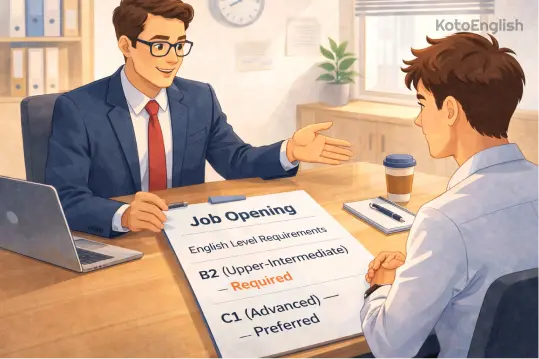
This stage is popular because many international companies require intermediate or upper-intermediate English. At this level, students are able to talk about both familiar and unfamiliar topics and follow native speakers.
Upper-intermediate (B2) to advanced (C1)
The transition from B2 to C1 English is more about refining the language rather than unlocking it, as one improves argumentation, vocabulary, and tone. It is when you polish your skills with unusual terms such as these 80 cool English words or uncover specific grammatical nuances.
This stage is significant for those who require English for academic or professional purposes. It is usually the longest stage because it is now about accuracy, clarity, and complexity.
How long does it take to become fluent in English?
Fluency is one of the most misunderstood goals in language learning, and it is often seen as a destination, whereas in fact, the word has many different meanings depending on the context in which it is used. Before we can estimate the English learning timeline, we need to understand what fluency is.
What “fluent” really means
For most students, fluent doesn’t mean perfect. It means you can use English with enough confidence that the conversation will keep going. You won’t be translating each sentence in your head.
In more concrete terms, fluent might mean:
- You can talk without long pauses
- You can understand native speakers
- You can express your opinions naturally
That kind of fluency will develop around the B2-C1 levels, depending on the circumstances.
Average study hours according to research
When learners ask how many hours it takes to become fluent in English, the common answer is to point to a range rather than a number. According to research from the Foreign Service Institute, languages that fall under the easiest category require approximately 600 to 750 hours of study to attain a level of professional working proficiency.
Although it is true that this estimate represents how difficult a language is to an English-speaking person, it is also true that this is often used as a benchmark to represent languages with relatively simple grammar structures. For many English language learners, the timeline may fall within this range.
In contrast, it would take 2,200+ hours to be really good at Chinese, Japanese, and Korean if your native language is English.
Passive vs. active learning time
Learners often treat all English exposure equally. While watching videos or listening to music can be beneficial for language comprehension, these practices alone are not the best ways to learn English.
The key to turning knowledge into skill is forcing yourself to recall information and make decisions.
| Learning type | Examples | Main result |
|---|---|---|
|
Passive learning |
watching films, listening to podcasts, reading subtitles |
better recognition and understanding |
|
Active learning |
speaking practice, writing, discussion, correction |
faster development of fluency and control |
The strongest routines combine both. Passive learning feeds your input; active learning turns it into communication.
How long does it take to learn English for different goals?
If your goal is to order food and ask for directions, you don’t need to expand your vocabulary as much as someone who is planning to go to university or build a career.
For travel
People who learn English for travel generally center on high-frequency situations such as transportation, hotels, checking in, and casual dialogues. Such vocabulary is limited to a few dozen phrases, and learners may be able to pick up useful skills in no time.
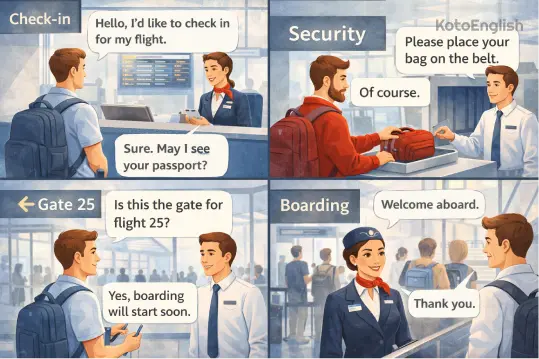
The timeline typically extends to about 3–6 months for basic conversational English.
For work
To learn English for the workplace, students need more than memorized phrases. They must understand meetings, write messages, explain ideas, and respond clearly under pressure. That takes longer because communication in the workplace needs flexibility.
An average timeline is around 6–18 months for practical workplace communication.
For studying abroad
Academic English requires good reading, listening, and writing skills. Students planning to study abroad in English are typically expected to have B2 or C1 proficiency, especially if lectures, essays, and seminars are part of the course.
Plan roughly 1–2 years for academic readiness.
For moving to an English-speaking country
Migrating to an English-speaking country calls for a distinct skill set. It involves navigating everyday living, social interactions, services, and possible employment. This extends the period, even if you have a foundation.
Account for about 1–3 years for stronger everyday fluency.
For passing IELTS or TOEFL
When you need to learn English for IELTS, the deadline for preparation is based on the gap between your current level and your desired score. If you are close enough to the B2 English level, intensive studies will help you improve it in several months.
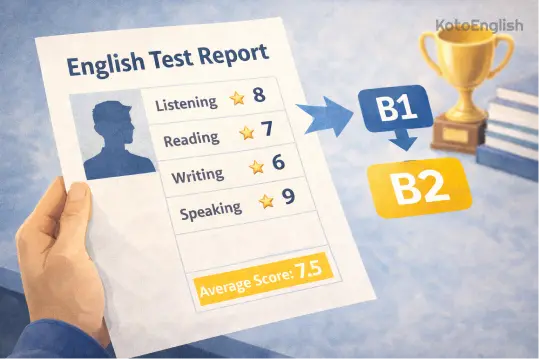
With no prior knowledge, your success significantly depends on whether you choose the best English grammar book and practice enough.
If you don’t start from scratch, a possible timeline will be in the range of 3–12 months.
How to learn English faster
Consider that there is no magic. People who learn fast tend to have routines that are practical, repeatable, and related to real-world usage. They do not accumulate materials and wait until the golden hour comes but practice.
Study every day
Study sessions do not need to be lengthy to be effective. In fact, even spending twenty or thirty minutes a day on exercises can add up to your English proficiency, as long as it is regular. This helps keep the language alive, so there is not as much review of previously learned information needed.
Focus on speaking from day one
Learners often ask, “How long does it take to speak English fluently?” before even attempting to produce a sentence. This is a false barrier. Joining a speaking class, using conversational AI tools or at least shadowing will help you quickly reduce anxiety and express your ideas. At first, you will make mistakes, but correctness will come naturally over time.
Use English in real life
You will be able to learn English fast when it is outside of formal study settings. For example, you can listen to podcasts, voice messages, or work-related conversations. The more English is used in real-life settings, the more natural it becomes.
Learn vocabulary in context
There is little point in trying to memorize individual words. Terms will be retained and used more readily if they are learned in phrases, collocations, and situations. This helps you improve English skills.
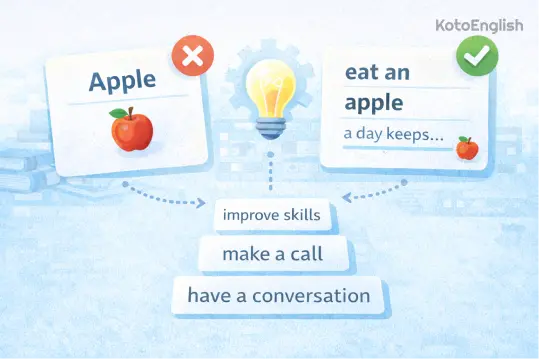
Combine different learning methods
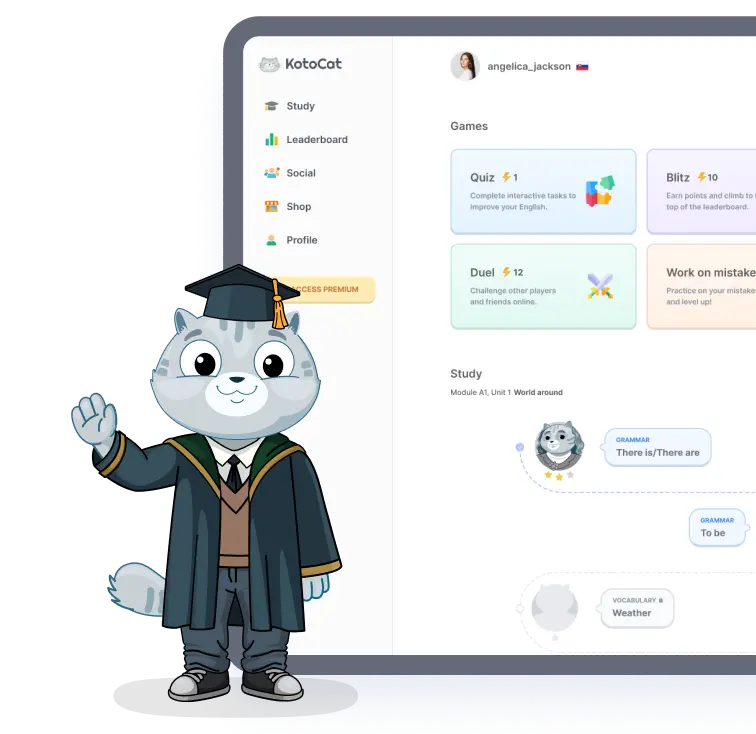
Use several structured tools that support different parts of learning. Apps such as KotoEnglish help build daily vocabulary and basic grammar through repetition. Online courses provide structured English lessons and explanations. Language exchange platforms allow real conversations with other learners or native speakers.
Realistic timeline: example scenarios
Various routines yield different types of progress. Some approaches help build knowledge gradually, while others lead to faster progress, especially when exposure is frequent.
If you study 3 hours per week
At this rate, you may still make progress in terms of grammar, reading, and exercises. Nevertheless, fluency may not advance as quickly since you do not have as many opportunities to recall words and use them under pressure. Here, the difficulty is not in learning new material but in keeping it in memory between lessons.
If you study 1 hour per day
Daily study often helps create stronger continuity. For example, it is easier to retain vocabulary and grammatical structures before they disappear from memory. This often helps create faster progress not only in knowledge acquisition but also in speaking fluency and listening speed.
If you live in an English-speaking country
Many learners improve faster after they move to an English-speaking country. However, this is only beneficial to students if it translates into involvement. It is common for people who migrate to other countries to develop limited skills when they avoid real communication.
| Study intensity | What progress often looks like |
|---|---|
|
3h/week |
slower growth, steady foundation, longer route to fluency |
|
1h/day |
stronger momentum, faster gains in speaking and comprehension |
|
Immersion |
rapid exposure, best results when paired with active use |
Why some people learn English faster than others
Some learners progress faster not because of any special talent, but simply because they use their available time more effectively. They create opportunities to use the language and seek feedback.
The behaviors that are likely to have the most impact are:
- Clear goals
- Strong motivation
- Regular English speaking practice
- Good environment
- No fear of making mistakes
What differentiates fast learners from others is not their perfectionism but their willingness to be in touch with English despite sounding uncertain.
Common myths about learning English
Myths about language tend to cause damage before you even start working on grammar. They create the impression that progress is impossible. In reality, students struggle less with the language than they do with misconceptions.
“You need many years to speak English.”
This is only true when the phrase “speak English” is equated with sounding very refined. Early conversations are natural at every level, especially when students are trained for real situations.
“Adults learn languages much slower than children.”
Adults and children don’t learn languages in the same way, but people who have finished school tend to pick up on the patterns more quickly, ask better questions, and have a sense of purpose.
“You must move abroad to become fluent.”
Moving to a different country can be very beneficial for learning a language, but it is not the only key to fluency. People can stay at home and improve their language skills very quickly because they’re surrounded by multiple digital resources that help them achieve proficiency in comfortable settings.
“You must understand grammar perfectly before speaking.”
This is the biggest myth of all. Grammar is great and should be used as a tool to help people communicate, but it should not be something that people have to master before they can open their mouths and begin speaking.
Conclusion
Learning English fluently is not a competition with a fixed deadline. The time required can vary from a few months to several years or more, depending on individual factors such as your initial English level and study habits. What matters most is not ability but dedication.
When learning English regularly, communication becomes effective in real-life situations. Set your goals and choose appropriate learning materials to begin your path to proficiency.
Frequently asked questions
For many students, it can take as many as 500-600 hours to reach intermediate English. However, the exact amount of time will vary depending on the methods of learning, the amount of time devoted to studying, and the student’s prior experience with language.
The fastest way to learn English fluently is through constant communication and exposure to English content such as conversations, podcasts, articles, etc.
Many learners wonder how long it takes to become fluent as an adult. Generally, adults can pick up language quickly because they can comprehend grammar explanations and learning strategies well. Although it takes a while for them to grasp pronunciation, adult learners can still attain fluency in communication quickly.
Living abroad helps you learn English faster because usage becomes part of daily life. However, in order for this to be effective, participation in the form of speaking with others and interacting with the surrounding environment is required.