Why use apps to learn English?
English learning apps can function best when you use them as a tool for learning that fits into your pocket. They work best when they fit your daily routine.
Learn anytime and anywhere
You can study in small gaps in your day, on the bus, in a queue, or between meetings, so progress doesn’t depend on finding a perfect free hour. Your phone lets you access everything so there is no need for you to change your schedule to book classes or hurry to a classroom.
Personalized learning paths
A good app responds to what you need. If it sees that you’re having trouble with verb tenses or that you keep forgetting important words, it should continue to review them with you until you finally get it.
The personalization of language learning is most important when your goals are very specific. Are you preparing for a test? You need vocabulary and listening exercises. Do you want to find clients abroad? You need a business English app.
Practice all skills
Languages can be learned faster when you touch on listening, reading, and writing during the same week. This can be done easily through English learning apps, where you can change modes quickly.
Another reason to have balanced skills is so you don’t plateau. It will help you to avoid a situation where you can understand a podcast but are not able to write something.
Affordable (or free) options
Many apps have free versions that are useful, especially for learning their functions to decide whether you like them. If they provide additional features like in-depth feedback, offline access, and structured learning, which eliminate decision fatigue, they are worth paying attention to.
You can experiment with what works best for you, whether you learn through gamified streaks, lessons from teachers, or conversational exchange.
List of the best apps to learn English
The selected applications feature strong lesson organization and provide valuable training opportunities, while their feedback systems enable learners to make continuous progress.
Keep reading to learn about apps that will help you boost your English language skills.
Duolingo
Duolingo functions as an English learning app that teaches the language through its interactive game-based system that delivers brief language instruction. The platform enables learners to study in a way that feels effortless.
Best for: Beginners who want to learn basic vocabulary.
Key features:
- Spaced repetition to use words and patterns often
- Goals and rewards for consistency
- Listening and reading tasks
- Optional speaking prompts depending on setup
Pros:
- Very easy to start
- Strong “keep going” design
- A solid free tier
Cons:
- Speaking depth can feel limited
- Advanced learners may outgrow the lesson style
Babbel

The Babbel English grammar application provides structured lessons which create educational experiences that resemble complete courses instead of game-based learning. The program typically emphasizes “real-world dialogues and everyday phrases.”
Key features:
- Course-like units with clear progression
- Dialogues built around common situations
- Clear grammar explanations integrated into lessons
- Review tools that help repeat older material
Pros:
- Real-world communication
- Consistent explanations
- Helps move from basic to confident
Cons:
- Full access typically requires a subscription
- Doesn’t have many game-like features
ELSA Speak
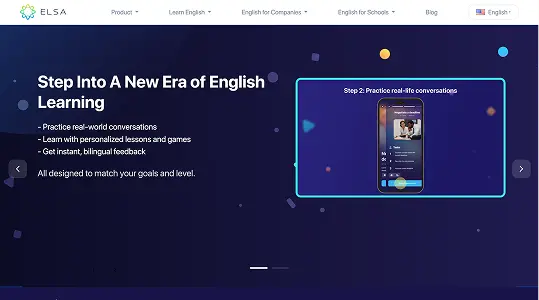
ELSA Speak focuses on your word pronunciation evaluation and provides feedback about your performance while helping you develop your individual sound skills. This English pronunciation app is especially useful if people often ask you to repeat what you are saying.
Best for: Students who require focused pronunciation coaching to improve clarity.
Key features:
- Pronunciation scoring for words and sentences
- Sound-by-sound drills for vowels, consonants, and stress
- Speaking challenges with guided corrections
- Progress tracking of your most frequent pronunciation issues
Pros:
- Pinpoints the weak sounds
- Builds confidence for calls, interviews
- Easy to fit into short daily practice
Cons:
- Doesn’t teach grammar or reading in depth
- Results can vary with noise and microphone quality
LearnEnglish
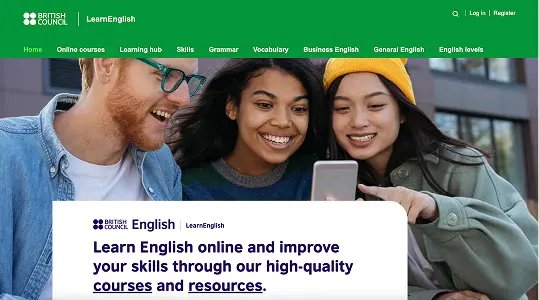
LearnEnglish is an English lessons app from the British Council, and it is designed around practical topics and skill-based practice, making it feel more systematic. Those who are at beginning or intermediate levels will especially benefit from this program, as it helps establish a strong foundation.
Best for: People who need reliable, classroom-style practice.
Key features:
- Skill-based lessons across listening, reading, writing, and grammar
- Short dialogues and everyday scenarios for practical English
- Interactive English lessons with instant checking
- Topic-based practice suitable for consistent mobile learning
Pros:
- Learning content from an official provider
- Practice that supports beginner to intermediate progress
- Clear explanations that cover common mistakes
Cons:
- Speaking practice is limited
- Less personalization compared to AI English learning platforms
Memrise
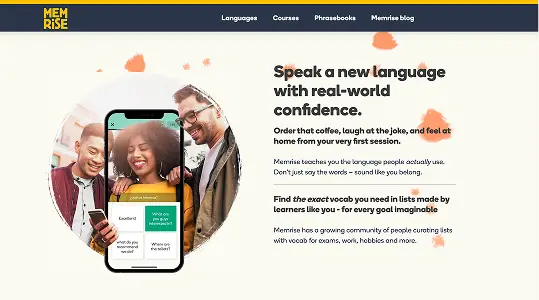
Memrise is geared toward memorization and recall, and this is helpful if you are looking for apps to learn English at home with a simple interface and predictable routine. It is good for A1-B2 levels as a secondary tool in conjunction with a speaking app. You can maximize the outcomes by using new phrases in your own sentences right away.
Best for: Learners who want to build everyday vocabulary and phrases.
Key features:
- Spaced repetition cycles of English for beginners
- Topic-based phrase learning for common situations
- Quick daily review sessions that fit busy days
- Some courses include short native-speaker style clips (varies)
Pros:
- Improves speed of recall in real conversations
- Easy to stack with another app
- Helps you learn how to use everyday English
Cons:
- Minimal writing and free speaking production
- Memorization can stay “inactive” without sentence practice
Busuu
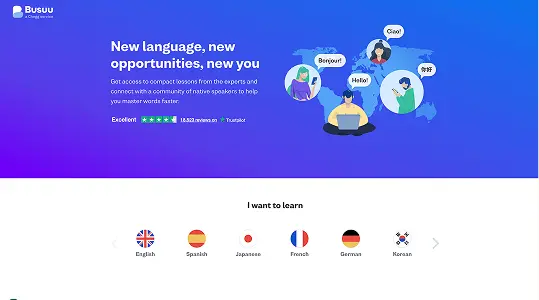
Busuu offers structured lessons with writing and speaking exercises that can be shared with the community for feedback. For A1 to B2 level learners seeking guidance and a reality check on their work, it can be helpful.
Best for: People who are looking for a guided path plus occasional human corrections.
Key features:
- Level-based course progression with placement options
- Writing and speaking prompts tied to practical topics
- Community corrections on selected drills
- Review sessions that help repeat weak areas
Pros:
- Human feedback helps you spot errors
- Balanced mix of vocabulary and usage
- Encourages full-sentence production
Cons:
- Feedback quality can vary across users
- Many advanced features are paid
HelloTalk
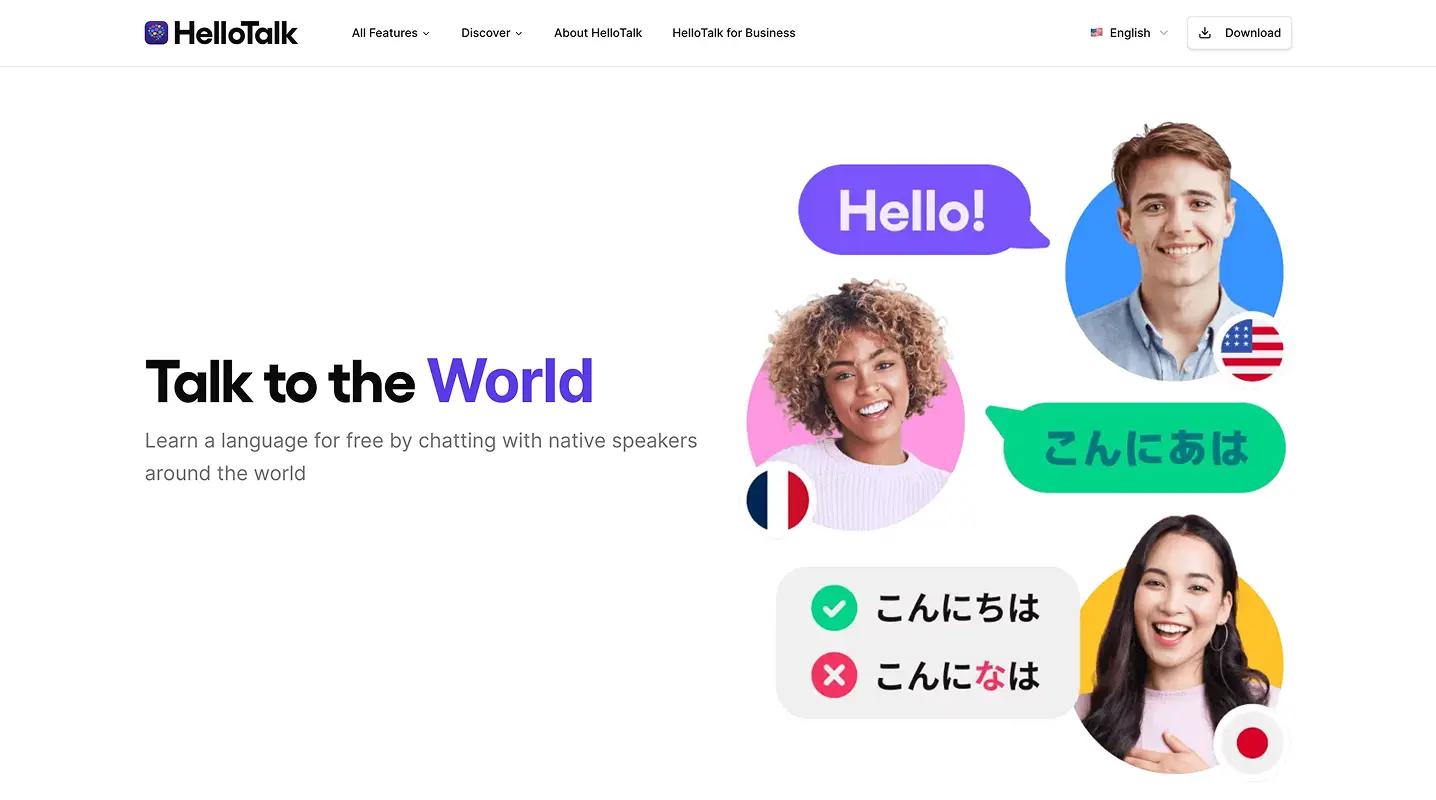
HelloTalk is an English speaking application that is meant for interaction with real people and is helpful in developing fluency in natural conditions. People at any level and goals can find it useful, especially when partners are chosen correctly.
Best for: Students who want real conversation practice through chat and voice messages.
Key features:
- Text chat plus voice notes and calls for speaking practice
- In-app correction tools to refine messages
- Translation support tools (availability varies by setting)
- Community posts for low-pressure practice
Pros:
- Real conversations
- Exposure to informal phrasing
- Flexible pace and topics
Cons:
- Not a structured curriculum
- Easy to waste time without topic goals
Tandem
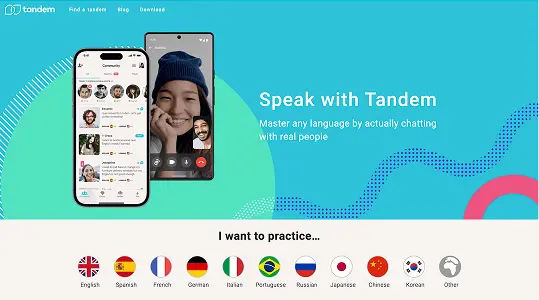
Tandem is centered on language exchange through real conversation practice, and it is more effective for learning spontaneous replies than prepared ones. It is one of the English speaking apps that is comfortable for use starting from A2 and above, as you are able to handle conversations and replies without translating them.
Best for: Learners who are looking for steady speaking practice with partners.
Key features:
- Partner discovery by language and interests
- Messaging, voice notes, and calls for conversation practice
- Correction tools for improving phrasing in context
- Profile filters that help you find suitable partners
Pros:
- Builds English fluency in real-time
- Helps you adapt to different accents
- Trains thinking in English instead
Cons:
- Partner availability can be unpredictable
- Requires initiative to keep practice focused and regular
Cake
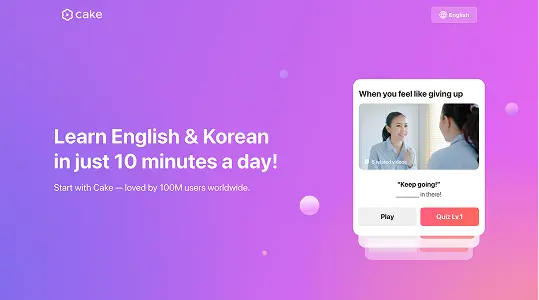
Cake is an English practice app with its short video clips and repeat-after-me approach, which helps you pick up the rhythm and common phrases. It can be particularly useful at the A2-B2 level if you can read English in textbooks but struggle with spoken English.
Best for: People who need listening practice.
Key features:
- Short videos built around daily expressions
- Replay tools designed for imitation and shadowing
- Bite-sized practice that fits micro-learning routines
- Speaking prompts that encourage repetition
Pros:
- Improves listening comfort
- Teaches common expressions
- Easy to stay consistent with quick sessions
Cons:
- Less systematic grammar progression
- Feedback is lighter than dedicated pronunciation tools
Quizlet
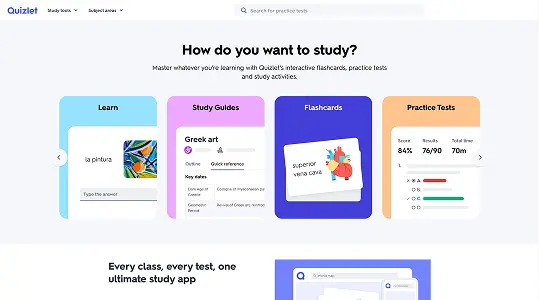
Quizlet is one of the top English learning apps that becomes powerful when you create your own sets using the things you’re exposed to, such as lessons, podcasts, meetings, and reading material. It is useful for all levels because you can create your own content.
Best for: Learners who wish to find a customizable system to review vocabulary for exams, work, or specific topics.
Key features:
- Create, organize, and share flashcard sets
- Multiple study modes for recall and testing
- Audio pronunciation for many terms
- Folders/tags to separate topics like IELTS, work, travel
Pros:
- Excellent for targeted specific vocabulary
- Helps you retain collocations and full phrases
- Works as a review engine
Cons:
- Doesn’t train speaking
- Results depend on how well you design your sets
Review this summary table if you are short on time to choose an app in 30 seconds:
|
App |
Free version |
Speaking practice |
Level |
|---|---|---|---|
|
Duolingo |
Yes |
Limited |
A1-B1 |
|
Babbel |
Limited/Trial |
Some prompts |
A1-B2 |
|
ELSA Speak |
Limited/Trial |
Yes (AI) |
A2-C1 |
|
LearnEnglish |
Limited/Trial |
Limited |
A2-B2 |
|
Memrise |
Yes |
Limited |
A1-B2 |
|
Busuu |
Limited/Trial |
Some prompts |
A1-B2 |
|
HelloTalk |
Yes |
Yes (people) |
All |
|
Tandem |
Yes |
Yes (people) |
A2-C2 |
|
Cake |
Yes |
Guided repetition |
A2-B2 |
|
Quizlet |
Yes |
No |
All |
In many cases, the ideal option for you would be a hybrid one. You can use an app for practicing and building your vocabulary, and then look for opportunities to have a conversation with someone, possibly through an exchange app or a language tutor.
How to choose the best English learning app
The choice of app is less confusing when we stop asking “Which is best?” and ask “Which will yield the behavior I will reproduce?” Your goal, level, and patience with structure should determine the choice, as the most useful resource is the one you will use.
Define your goal
Select an app that helps you practice the skill you will be assessed on. For example, if your goal is good essay writing, focus on grammar, reading and prompts. If you want to prepare for exams, listening workouts with a timer, vocabulary related to academics, and review exercises will be a better option.
Determine a small gain you will be able to notice in a week. For example, “I can answer five interview questions smoothly” or “I can summarize a short article orally.”
Check your level
Match the difficulty of the lessons with your “80% zone.” You should understand most of the material but still learn something new. Too easy, and you plateau. Too hard, and you quit or memorize without comprehension.
Track your CEFR range (A1 to C2) to choose realistic materials:

Use placement tests when available and then check with “real” material. Otherwise, you may not be able to understand whether you chose the best app for learning English.
Look for speaking practice features
If speaking is important, the app should require you to force output. Look for shadowing, pronunciation evaluation and/or conversations where you need to produce sentences.
Also, pay attention to the quality of feedback. For repetition, AI apps to learn English are fine, but for natural phrasing and tone, human assessment works better. If you are shy, start with voice notes, and if you are more confident, you can move on to actual conversations.
Free vs. paid apps
Use the free option as a trial before paying. If you would use it naturally four times a week, it might be worth paying for. If you use it for two days and quit, it’s not the price – it’s the app’s style not fitting.
Gamified vs. structured learning
Gamified apps to improve English are good for when you need momentum, and systematic resources are good for when you need clarity.

Pay attention to what you resist. Do you procrastinate because you’re overwhelmed by the number of choices? Then structured apps will be good for you. Do you avoid studies because you find them too heavy? Then gamification will help you concentrate.
Apps vs English courses: what works better?
Apps are good for repetition and quick feedback loops, whereas courses are good for accountability and personal explanations.
Look at this table to understand the difference between these two approaches:
|
Apps |
English courses |
|---|---|
|
Flexible schedule |
Structured weekly plan |
|
Usually cheaper |
More expensive |
|
Self-paced progress |
Guided by a teacher |
For intermediate English learners who do professional writing or exam preparation, courses will speed things up because a teacher can spot things that you can’t see on your own. English learning apps for adults will still be useful in between lessons, but the course will be your guide.
Tips to learn English faster with apps
Learning faster does not mean progressing through levels quicker; it means reducing forgetting and increasing output. Making small changes in your use of apps can result in significant improvements in a few weeks, even with limited time available.
Tip 1: Set a daily goal
Ten minutes that you can stick to is better than an hour that you can’t. Connect your practice to a trigger like coffee or time on a bus to work to avoid relying on motivation.
- 15–20 minutes per day for review
- 5 new words daily used in your own sentences
- 3 short exercises per week
Set a goal that is skill-based. For example, make it three spoken sentences, one short voice note or one dialogue that you can summarize.
Tip 2: Focus on speaking, not only games
You will improve English speaking skills faster if you practice the same useful phrases until they become natural to you. The phrases should be ones you actually need, and then you should shadow them, record them and compare them.
If your motivation is low, make the goal smaller but keep the action. This is more about protecting your sense of self as a learner. The more you wait, the more those small repetitions will add up to confidence, since you’re working on performance.
Tip 3: Repeat and review regularly
Reviewing should be done on purpose. Set aside one day a week to recycle old dialogues, pronunciation practice and “almost-known” words. This is the time to develop English fluency because you’re transferring information from “passive memory” to “automatic recall.”
- Do a weekly review day with no new lessons
- Reuse old vocabulary in fresh sentences and short stories
- Keep a running list of “mistake patterns” you want to fix
To monitor progress, use a weekly note on your phone with three things you can now say easily, one thing you still struggle with and one thing you used in real life this week.
Common mistakes when using apps to learn English
If you have a desire for novelty, inject it into your routine instead of changing applications.
Ask yourself: Have I used an application for a long enough period to see the same mistakes vanish?
Skipping the placement test
Skipping placement puts you into material that is too easy or too hard, and both of these waste time, as taking more complex lessons won’t help you learn English fast.
Take it seriously and adjust it after a week of real use. If the lessons seem like you’re on autopilot, move up. If you’re not making it, move back and make the basics stronger.
Ask yourself: Does today’s lesson challenge me without leaving me feeling lost?
Unrealistic expectations
The best app to learn English can certainly help you move faster, but they won’t reduce the time it takes for your brain to create these automatic connections. If you expect fluency in weeks, you’ll perceive normal struggles as failures.
Set milestones based on actual situations you want to master: ordering food, explaining what you do for work, answering follow-up questions or summarizing popular movies in English.
Ask yourself: Can I think of one actual situation I handle more easily than last month?
No progress tracking
You cannot improve without tracking because you will be relying on your feelings, and they are subject to change. You might be doing better without realizing it and still feel like you are not improving or vice versa.

Just set aside a minute each week and record yourself. Then, after a month, review your recordings and listen for advancement in clarity and speed.
Self-check: Do I have any evidence of improvement in my English language skills?
Final thoughts
The best apps to learn English in 2026 will suit your personal learning needs. Some tools build habits through gamified repetition and others push you into active use. Your results depend on matching the tool to your outcome.
Today’s next step is simple: pick one app from the list, decide on the single skill you want to improve this month and schedule your first session. Your English skills will start to show progress through the practice of a small specific plan.
Frequently asked questions
Yes, you can reach strong fluency with the best apps to learn English for beginners if they include meaningful listening and regular feedback. The apps provide you with learning materials you can repeat at any time, thus offering vital support for learners who lack access to classrooms.
The extent of your progress will depend on your current proficiency level and your weekly practice time and the amount of speaking you do. The best free apps to learn English in 2026 may help you build basic foundational skills in two to three months with consistent daily practice.
Yes, they are effective because the best applications enable users to repeat essential vocabulary while learning from their errors. Brief sessions help learners practice in small chunks that you actually return tomorrow.