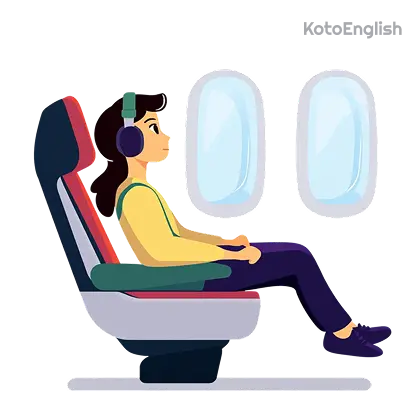
Seat – a place where a person can sit, such as a chair, sofa, cinema chair, train seat, or office chair. We use this word often when talking about travel, meetings, events, transport, restaurants, and public places.
How to Pronounce “Seat”?
 Audio (UK):

 Audio (US):
It is a one-syllable word, so stress falls on the entire word: SEAT. The vowel sound is long /iː/, similar to the vowel in “see”, “need”, and “team”. Do not confuse this vowel sound with the one in “sit” /sɪt/ since “seat” is a noun, whereas “sit” is a verb.
Level up your English with Koto!
Countability & Article Rules for “Seat”
Being a countable noun, a “seat” can be used with articles like a, the, numbers, and plurals. This is advantageous to travelers, diners, and even at events, where one refers to either one “seat”, multiple “seats”, or a certain “seat”.
|
Form |
Example |
|---|---|
|
Singular |
I found
|
|
Plural |
There were no
|
|
Definite article |
|
|
Number + noun |
We booked
|
|
Possessive form |
The
|

Common Verbs Used Naturally With “Seat”
Native speakers frequently employ “seat” along with a few other useful verbs. Remember that these collocations should be memorized as such, as you will encounter them in airports, restaurants, offices, movies, classrooms, and customer service encounters.
|
Verb + seat |
Meaning |
Example sentence |
|---|---|---|
|
|
sit down |
Please
|
|
|
look for a place to sit |
We arrived late and struggled to
|
|
|
reserve a seat in advance |
He
|
|
|
keep a seat for someone |
Can you
|
|
|
invite someone to sit |
A passenger
|
|
|
leave your seat for someone else |
He
|
|
|
move from one seat to another |
We
|
|
|
keep a seat free for someone |
Could you
|
Popular Collocations with “Seat”
Collocations make your English sound smoother because they show how words naturally work together. With “seat”, many useful phrases come from transport, events, offices, and public spaces.
|
Collocation |
Meaning |
Example |
|---|---|---|
|
|
a seat that can be used |
There are no
|
|
|
a seat that feels good |
The hotel lobby had several
|
|
|
a seat with no one in it |
I noticed an
|
|
|
the number of your seat |
Your
|
|
|
a safety belt in a vehicle |
Please fasten your
|
|
|
a booking for a specific seat |
The ticket includes a
|
|
|
the seat next to the driver |
My bag is on the
|
|
|
a place at a meeting table |
We need one more
|
Common Mistakes with “Seat” and Fixes
There are many cases in which students use the words “seat,” “sit” and “chair” interchangeably. However, the easiest method of fixing this problem would be to remember that “seat” refers to a spot, while “sit” refers to an action.
|
Why? |
||
|---|---|---|
|
Please seat down.
|
Please sit down.
|
Use “sit down” for the action. |
|
Please take a sit.
|
Please take a seat.
|
The fixed phrase is “take a seat”. |
|
I need to sit a seat on the plane.
|
I need to book a seat on the plane.
|
Use “book” or “reserve” when arranging a seat. |
|
There are no seat left.
|
There are no seats left.
|
Use the plural form after “no” when you mean more than one possible seat. |
|
She sat on the seat number 12.
|
She sat in seat number 12.
|
Use “in seat 12” for assigned places in transport or events. |
Translations of “Seat” in Other Languages
While translations will assist you in comprehending the general sense, you should not translate everything in the English sentence word-for-word. For instance, “take a seat” might have another way of saying that in another language.
|
Language |
Word for “Seat” |
|---|---|
|
|
asiento |
|
|
siège / place |
|
|
Sitz / Platz |