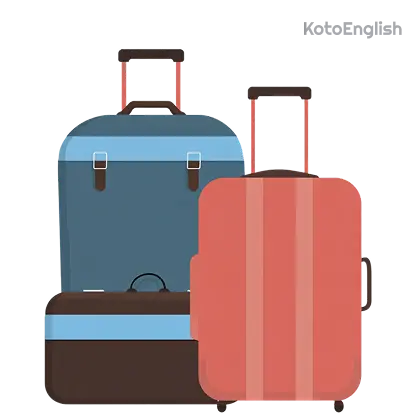
Case – in the realm of travelling, it refers to a hard or semi-hard box in which one can pack or transport their luggage. “Case” forms part of many popular travel-related nouns in English: the “suitcase”, “briefcase”, “camera case”, and “phone case”.
Getting acquainted with all the “case” compound words, fixed expressions related to the “case” words, and their collocations is the core vocabulary knowledge for discussing packing, travel preparations, and airport English.
How to Pronounce “Case”?
 Audio (UK):

 Audio (US):
One syllable: /keɪs/. The vowel is the diphthong /eɪ/, identical to that found in the words “face,” “place,” and “space.” This is a long, sliding vowel moving from /e/ to /ɪ/; it needs to be fully pronounced and not clipped off abruptly. The end /s/ sound should be crisp and voiceless.
Level up your English with Koto!
The Travel “Case” Word Family: Learn Six at Once
The most efficient use of the travel sense of “case” is the study of the entire family of compounds built on it. The common point for all of these compounds is “case,” which serves as the second part, and is defined in the same way: a protective receptacle used to hold something.
|
Compound |
What It Carries |
Example |
|---|---|---|
|
|
clothes and personal belongings for a trip |
She packed a carry-on
|
|
|
work documents, a laptop, business materials |
He arrived at every meeting with the same worn
|
|
|
a camera body and lenses |
The
|
|
|
a mobile phone, protecting it from damage |
She had gone through four
|
|
|
spectacles or sunglasses |
He couldn’t find his
|
|
|
a pillow (protective cover) |
The hotel provided fresh
|
|
|
rings, necklaces, and small valuables for travel |
She kept her
|
|
|
documents and thin items (formal, older term) |
The diplomat carried a locked
|
Plural, Article & Possessive Forms of “Case”
“Case” is a regular countable noun in each of its travel senses. The examples below illustrate every usage you may require in discussing packing, check-in at airports, and lost luggage, whether in the most informal discussion or on the most formal travel claim form.
|
Form |
Example |
|---|---|
|
Singular: a case |
She checked
|
|
Plural: cases |
Both
|
|
Plural possessive: cases’ |
The
|
|
With “the”: the case |
|
|
With possessive pronoun: my/her/their |
|
Collocations: How Travellers Talk About “Cases”
When “case” is used to mean luggage (a suitcase), it always goes with certain vocabulary that is used specifically in travel. You will see these phrases used all the time in airport announcements, in blogs about travelling, when airlines communicate with you, and when people talk about vacations.
Verb + “Case” Collocations
|
Phrase |
Explanation |
Example |
|---|---|---|
|
|
put belongings into a suitcase |
She
|
|
|
remove belongings from a suitcase |
The first thing he did at the hotel was
|
|
|
hand luggage over to an airline for transport |
They
|
|
|
retrieve luggage after a flight |
Passengers should
|
|
|
have luggage misplaced during travel |
The airline
|
|
|
move a suitcase using its wheels |
He
|
|
|
pick up a suitcase |
She struggled to
|
|
|
report and seek compensation for lost or damaged luggage |
After noticing the damage, he immediately
|

Adjective + “Case” Collocations
|
Phrase |
Explanation |
Example |
|---|---|---|
|
|
suitcase small enough for cabin luggage |
A
|
|
|
suitcase with a rigid exterior |
The
|
|
|
case made from flexible material |
A
|
|
|
case larger than standard size limits |
The airline charged an additional fee for the
|
|
|
old suitcase showing signs of heavy use |
Her
|
|
|
case marked with initials |
The
|
|
|
case designed to weigh less |
A
|
Travel “Case” in Spanish, French, and German
Discover how to properly spell and pronounce this word in other languages. Listen to each translation and try to repeat.
|
Language |
Translation |
|---|---|
|
|
maleta |
|
|
valise |
|
|
Koffer |