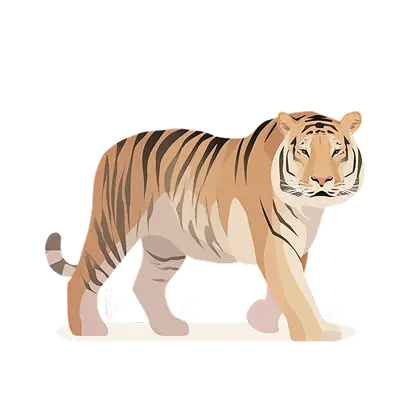

Tiger (noun) — a large wild cat with a muscular body and a mass of orange fur with black stripes and a white underside. They are great hunters and good swimmers.
How to Pronounce “Tiger”?
 Audio (UK):

 Audio (US):
There are two syllables in the word, ti (like tie) and ger (with soft g like j in jam).
Level up your English with Koto!
Examples: How to Use “Tiger” in a Sentence?
When used in speech, a definition is easier to remember. Examine the following sentences to understand how “tiger” works in actual communication.
What Are Synonyms for the Word “Tiger”?
Few words can serve as direct substitutes for “tiger,” yet you can enrich your writing by naming specific types such as the Bengal tiger or the white tiger. There is also a figurative meaning of the word to refer to a person who is daring, fierce, or brave.
Related nouns: stripes claws whiskers roar
Synonyms (contextual): big cat
Common collocations: wild tiger Bengal tiger tiger cub tiger skin
“Tiger” Word Formation and Description in Context
Knowing phrases that have various parts of speech will enable you to explain how a tiger appears, how it moves and where it is located.
With adjectives: small tiger big tiger old tiger young tiger
With verbs: tiger drinks tiger roars tiger eats tiger runs
With nouns (noun + noun): tiger toy tiger teeth tiger eyes
Idioms and Phrases with “Tiger”
Terms including a“tiger” in English indicate cultural conceptions as well as the characteristics of the animal, such as courage or power. Learn how to use them in your writing by seeing the definitions and examples.
-
As wild as a tiger — a term used to describe someone who is fierce, brave or prepared to do anything whenever.
Marcus went into the debateas wild as a tiger , full of himself and no one could stop him. -
Paper tiger is a phrase to describe something or someone that seems dangerous when, in fact, it is weak or harmless.
This company appeared threatening, yet, in fact, it was just apaper tiger .

-
Ride a tiger — to be in a dangerous or perilous position where escaping is hard.
Going into that business without experience was likeriding the tiger ; a single slip can get everything spoiled. -
Eye of the tiger — phrase popularized by a song and a movie Rocky, means the utmost daring, determination, or concentration.
Sindy was practicing daily with theeye of the tiger as she was determined to be a champion.
Quiz Time: Test Your Knowledge of “Tiger” Meaning
Check your familiarity with the term “tiger” by doing these exercises, which aim to demonstrate its different applications.
Enjoy personalized learning!
“Tiger” Word in Other Languages
Originating from the Latin tigris and older roots in Greek and Persian, the word tiger has kept a familiar shape in most languages. Explore its spelling in French, Spanish, and German.
| Language | Word for “Tiger” |
|---|---|
 Spanish
 |
Tigre |
 French
 |
Tigre |
 German
 |
Tiger |
Let’s Explore Fun Facts About “Tiger”
Behind every mighty roar, there’s a story. Here are some tiger facts that might just make you see them in a new light.
-
Tigers are able to roar so that the ground shakes.
The roar of tigers can be heard as far as 3 kilometers. Not so much to show off, it is a signal to competitors and means to establish a position. -
They are nocturnal predators, whose vision is of the highest quality.
Tigers like hunting at night, where they see six times better than human beings. That is why they are sneaky predators and attack when nobody anticipates it. -
They have a stripe as distinctive as the fingerprint.
Each tiger is striped in a unique pattern, and there are no two exactly alike. The stripes are the camouflage in high grasses and any tiger can be easily recognized by the researchers similar to a natural barcode. -
Video games and films preserve the spirit of the tiger.
Thanks to Shere Khan in The Jungle Book and to the majestic white tiger of the Life of Pi, tigers have left their pawprints on pop culture. They are represented in most games as a beacon of power and strength and their reputation continues to be as loud as ever in the virtual jungle.
Memorable Quotes with the Word “Tiger”
These famous quotes help define a “tiger,” showing how literature and culture portray its strength, courage, and wild spirit.
— Chalrie Sheen
Explanation: Here, “tiger blood” is used as a metaphor for exceptional bravery, strength, and invincibility. The actor is stressing that, in contrast to regular people, he feels special, courageous, and unstoppable.
— Mao Zedong
Explanation: According to this statement, you should exercise caution and maintain a safe distance when interacting with a strong or harmful force. Instead of rash confrontation, it advocates for prudence and deference.
— Confucius
Explanation: Confucius’ quote means that the harm caused by a cruel or unjust government can be greater and more dangerous than that of a wild animal. It warns that human oppression can have far-reaching and lasting consequences.