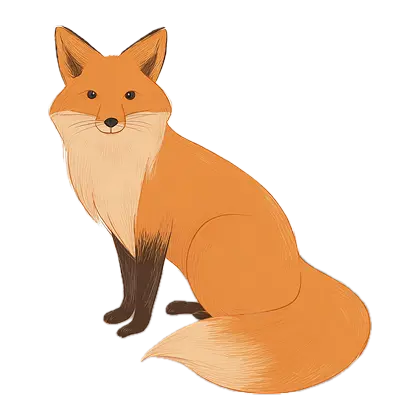
Fox (noun) — a mammal from the Canidae family. The red fox is the most common species, with pointed ears and a bushy tail. They are very intelligent and adaptive. Foxes are found in various environments, including tundras, deserts, forests, and cities.
How to Pronounce “Fox”?
 Audio (UK):

 Audio (US):
Spell clear f, then the letter o, similar to one in the word “pot,” and x, the combination of k and s.
Level up your English with Koto!
Examples: How to Use “Fox” in a Sentence?
Take a look at how this word is applied in different contexts to understand how to write it in your own sentences:
What Are Synonyms for the Word “Fox”?
There are no suitable words you can use instead of “fox”; however, you can find a lot of connected terminology to describe the animal.
Related nouns: coat fur den brush
Synonyms (contextual): none, it is specific
Common collocations: fox stalks fox observes cunning fox fox tail fox den
“Fox” Word Formation and Description in Context
It is much easier to use “fox” correctly when you know with which words it collocates perfectly. Below, you will find some common variations:
With adjectives: sly fox wild fox red fox Arctic fox intelligent fox
With verbs: fox hunts fox digs fox sneaks fox marks fox climbs
With nouns (noun + noun): fox territory fox coat fox population
Idioms and Phrases with “Fox”
Most idioms with “fox” are connected to the sly nature of these animals. Read the definitions below and instances of usage to be able to apply these phrases in your writing:
-
As sly as a fox — a phrase used to compare a person or an animal with foxes when they have cunning behavior.
This guy isas sly as a fox ; he always finds a way to cheat on exams. -
A fox in the henhouse — refers to a person who can cause confusion or deceive others.
Leaving an intern with an important task is like puttinga fox in the henhouse .


-
To fox someone — means to trick or confuse someone, applied to people and concepts.
English grammar rules oftenfox those who are only starting to learn the language.
Test Your Knowledge of Fox Meaning
Are you ready to test your understanding of what “fox” means with engaging and interactive activities? Check how well you’ve learned collocations and the definition.
Enjoy personalized learning!
“Fox” Word in Other Languages
Maybe learning how to spell “fox” in the most used European languages will give you some new insights into this word.
| Language | Word for “Fox” |
|---|---|
 Spanish
 |
Zorro |
 French
 |
Renard |
 German
 |
Fuchs |
Did You Know It? Fun Facts About “Fox”
What routine do foxes follow? What is the meaning of “fox” in different cultures? You’ll discover answers to these questions and learn even more fascinating facts by reading further:
-
Foxes are night hunters
Nature gave these animals everything to enable them to hunt at night. Their vision is similar to the one that cats have. Foxes also have strong hearing and a sense of smell, allowing them to find prey even in the darkness. -
They appear in many myths across the world
In China, there are stories about nine-tailed foxes. In Japan, people tell fairytales about Kitsune, fox spirits that can shape-shift into humans. In Korea, there are legends about Kumiho. They are cunning, smart, and can be protective or evil. -
Foxes don’t look for a company
Unlike wolves and lions, foxes don’t always group to hunt. It is common for them to be independent and leave their parents as soon as they grow up. By hunting alone, they avoid competition. -
Urocyon littoralis is the rarest kind of fox
According to the Guinness World Records, in California lives the rarest group of foxes. There are about 1,5000 specimens of Urocyon littoralis. Their number is decreasing due to parasites and conflicts with other predators.
Famous Quotes Featuring “Fox”
When knowing how to define “fox,” you may want to read some apt sayings of writers and famous people (including Disney characters) to see how this word can set the mood of a scene:
— Nick Wilde, “Zootopia”
Explanation: This line is opposite to motivational sayings that tell us that we can be whoever we want to be. The main character of the cartoon believed that a creature can’t change its nature.
— Napoleon Bonaparte
Explanation: There are many variations of such a phrase that tell us that sometimes we need to be sly to achieve what we want, and sometimes we need to be brave to protect what we have.
Explanation: In this quote, said by the character that was a fox, the French author and pilot highlighted that we need to be attentive to those who place their trust in us.