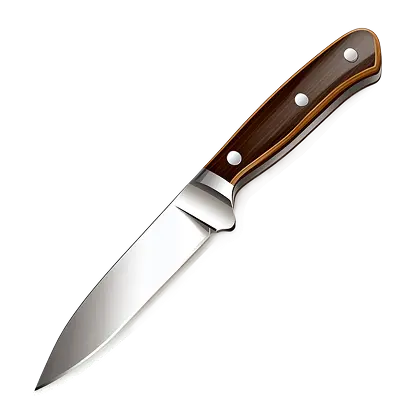
Knife (noun) — A cutting instrument consisting of a blade, usually of metal, fixed into a handle, used for slicing, chopping, or stabbing. Knives vary in size, shape, and purpose, from kitchen utensils to tools, weapons, or ceremonial objects.
How to Pronounce “Knife”?
 Audio (UK):

 Audio (US):
This noun is pronounced with the “k” completely silent. The “i” is a long vowel sound (like in life), and it ends with a clear “f” sound.
Level up your English with Koto!
Examples: How to Use “Knife” in a Sentence?
Take a look at the usage examples of this word to boost your speaking and writing skills in terms of creating basic language structures.
What Are Synonyms for the Word “Knife”?
Discover similar words by meaning to “knife” to expand your vocabulary and become more flexible while using English.
Related nouns: blade dagger scalpel sword cutter utensil edge weapon
Synonyms (contextual): cutter blade
Common collocations: sharp knife kitchen knife knife attack butter knife
“Knife” Word Formation and Description in Context
Learn more about how to use this word with other parts of speech in order to create unique and meaningful grammatical and lexical expressions.
With adjectives: new knife blunt knife folding knife high-quality knife
With verbs: sharpen a knife clean the knife chop with a knife cut with a knife
With nouns (noun + noun): combat knife steak knife pocket knife bread knife
Idioms and Phrases with “knife”
What does “knife” mean? And yes, you are already capable of answering this question, but what about learning even more to uncover interesting meanings behind this word in various contexts?
-
A knife in the back — A betrayal by someone you trusted, often done secretly and hurtfully.
Finding out my business partner stole from me felt like aknife in the back. -
Bring a knife to a gunfight — To enter a situation poorly prepared or at a major disadvantage.
Trying to compete with those industry giants without any marketing budget is like bringing aknife to a gunfight. -
On a knife-edge — In a very tense or dangerous situation where the outcome could go either way.
The election results are on aknife -edge, with just a handful of votes separating the candidates.
Test Your Knowledge of Knife Meaning — Quiz Time!
To define a knife even further, we invite you to participate in our interesting knowledge check, where you will demonstrate what you already know and perhaps learn something new!
Enjoy personalized learning!
“Knife” Word in Other Languages
How do you spell “knife”? You learned about spelling and pronunciation in previous sections, but what about this word in other widely spoken languages?
| Language | Word for “Knife” |
|---|---|
 Spanish
 |
Cuchillo |
 French
 |
Couteau |
 German
 |
Messer |
Did You Know It? Fun Facts About “Knife”
The definition of “knife” may seem simple and understandable at first glance. Still, we invite you to explore its full historical and cultural context to gain a broader understanding of the topic.
-
Knives mark the dawn of human innovation
Knives are some of the oldest tools ever made by man and have been around for more than 2.5 million years. Stone was considered a knife in those days, used for cutting food, hunting, and defense — a cutting-edge means for survival. -
The Swiss Army knife became a legendary multitool
The Swiss Army knife is a classic example of a multi-tool. It was originally designed for use by the Swiss soldiers at the end of the 19th century and is equipped with numerous tools, such as blades, screwdrivers, scissors, and can openers, all nestled into a tiny device that can really don many hats. -
Legendary blades like the Viking seax carried powerful meaning
A Viking seax was a distinctive knife having one side edged, a weapon of Norsemen and the commoners. It was a practical tool that also showed power and identity; it was abundantly decorated to reflect the owner’s status and culture — truly a blade that really spoke louder than words. -
Knife edges are engineered for different tasks
Knife blades can be serrated (like sawed), straight-edged, or wavy. Each edge type is fit for a particular application — for instance, serrated knives excel at cutting bread; straight edges are for slicing meat, with each will be just right in its function. -
Graphene knives represent the future of sharpness
Technologists have managed to produce some of the sharpest knives ever known using graphene, an ultra-thin layer of carbon atoms. If we put it in other words, these knives can cut through almost anything at a molecular level. That is where we can say that these cut-throat knives cut through their competition.
Famous Quotes Featuring “Knife”
The word “knife” has gained a lot of attention as a part of different quotations from public figures and has shown its impact on their mindsets, just as it did with us.
— Benjamin Franklin
Explanation: Franklin is emphasizing that quality starts with the foundation. If a knife cannot be strong because it is made from inferior steel, success or good results cannot come from poor foundations or qualities, or poor resources.
— Mors Kochanski
Explanation: This further dictates that skill is more important than tools. Once trained and knowledgeable, a single multi-use tool such as a knife could truly stand up to rough circumstances, especially in survival situations — proof that it’s not the size of the dog in the fight, but the fight in the dog.
Explanation: King states that natural talent is never truly enough to attain success. Without discipline, effort, and hard work, talent becomes like a dull knife unable to cut straight: strike while the iron is hot.
— Richard Marcinko
Explanation: With a little humor, Marcinko demonstrates how much he treasures the knives by equating them to credit cards. He said they became essential tools in all situations and hence must always be available. But we kindly remind you not to take knives with you everywhere you go, because it can be dangerous for you and other people.