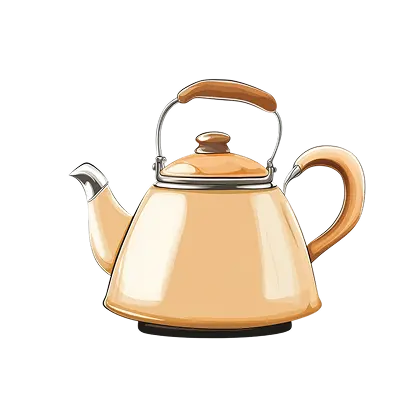
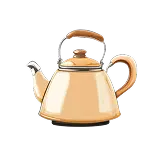
Kettle (noun) — is a kitchen tool used to boil water for making tea, coffee, or other drinks. It can be made of various materials, including plastic, copper, stainless steel, glass, ceramic, and more. Some kettles are electric, while others are designed for stoves and are resistant to high temperatures.
How to Pronounce “Kettle”?
 Audio (UK):

 Audio (US):
pronounce k like in cat, ɛ — bed, clear t and l with a bit of schwa sound.
Level up your English with Koto!
Examples: How to Use “Kettle” in a Sentence?
You know how to define a kettle, but using it confidently requires you to read this word in different sentences to understand what ideas you can share with people by using it:
What Are Synonyms for the Word “Kettle”?
If you need to write a text and are looking for some words to use instead of “kettle”, you have several options based on the context you need:
Related nouns: heater lid handle base boiler steam
Synonyms (contextual): teapot electric jug
Common collocations: boil the kettle empty the kettle hot kettle put the kettle on
“Kettle” Word Formation and Description in Context
You can find many collocations with verbs, nouns, and adjectives that will help you describe such qualities as temperature, purpose, or the actions you can do with them:
With adjectives: hot kettle empty kettle full kettle old kettle boiling kettle
With verbs: turn off the kettle heat the kettle turn on the kettle refill the kettle
With nouns (noun + noun): ceramic electric kettle copper kettle
Idioms and Phrases with “Kettle”
If you meet these phrases in a text, you may not understand what “kettle” means, because they are idioms and should be taken as separate units. Read their definitions and examples to know how to use them:
-
A watched kettle never boils — this is a proverb to describe a process in which waiting takes longer when you pay too much attention to it.
Put your phone down. A watchedkettle never boils. You’re just wasting time updating the page every second. -
A different kettle of fish — the phrase can be used in a situation where something differs completely from the nature or description of a thing you have just discussed.
I’m considering booking an apartment on my own instead of renting a room in a hotel. However, I understand that it is a differentkettle of fish and I need to check everything.
Test Your Knowledge of Kettle Meaning – Quiz Time!
The collocations and phrases related to “kettle”, along with the idioms we gathered above, will stick to your memory as soon as you practice those words with diverse exercises:
Enjoy personalized learning!
“Kettle” Word in Other Languages
You are aware of how to spell “kettle” in English, but below you will find more variations of this word in other popular languages:
| Language | Word for “Kettle” |
|---|---|
 Spanish
 |
Tetera |
 French
 |
Bouilloire |
 German
 |
Wasserkocher |
Did You Know It? Fun Facts About “Kettle”
How old do you think kettles are? Where have they been found? What records were achieved by using them? What are the true capabilities of modern kettles? This collection of fascinating facts will give you the answers to these questions:
-
Electric kettles are older than 100 years.
The Carpenter Electric company from Chicago created the first electric kettle much earlier than you probably think. It happened in 1891, and it took approximately 12 minutes to boil water in it. Of course, it didn’t turn off on its own and wasn’t as stylish, but it was the starting point. -
Kettles were used in ancient Mesopotamia.
The designs are not the same as what we have now, but they had handles that were used to heat water. The materials they were made of were mostly copper and bronze. Kettles were discovered by archaeologists and are dated to 2500-3000 BC. -
The biggest kettle exhibition included 1,089 working tools.
The Irish Men’s Shed Association aimed to break the Guinness World Record by bringing more than 1,000 kettles to their exhibition. Their primary goal was to collect the exact number of 1,000 kettles; it would be enough, but they gathered even more. -
Smart kettles can be controlled by voice assistants.
Modern kettles are not limited to boiling water. Owners can schedule time to come home and have hot water to make some tea. Functions, such as powering from solar energy, alerts about cleaning, and AI integration, completely change our understanding of kettles.
Famous Quotes Featuring “Kettle”
Kettles, by heating water, serve as inspiration for authors who like vivid descriptions that remain in the memories of readers for a long time. Let’s look at how deep the meaning of “kettle” is:
Explanation: A well-known speaker once noted that we shouldn’t give up on our ambitions and dreams, but we need to be mindful of how we achieve them and keep sustainability in mind.
Our not repairing made it worse.
We haven’t had any tea for a week…
The bottom is out of the universe.”
— Rudyard Kipling
Explanation: They are lines from a children’s book that hides a bigger truth behind the lines. When problems are small, we ignore them, but they tend to escalate into bigger issues and consequences that we are not always able to deal with.
— Haruki Murakami
Explanation: It is so easy to describe someone’s temper by comparing it to the quality of a kettle. If you boil, it becomes hot. However, for a person, it is not easy to let the feeling go.