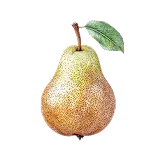
Pear (noun) — a sweet juicy fruit that grows on trees and can come in green, red, and yellow colors. It can be eaten raw, baked, or used in desserts.
Pears contain a lot of vitamins. The tree they grow from is called a pear tree. There are about 3000 varieties of this fruit.
How to Pronounce “Pear”?
 Audio (UK):

 Audio (US):
Say a soft p sound, and proceed with the vowels ea that resemble bear and chair. The latter letter is silent or soft as well.
Level up your English with Koto!
Examples: How to Use “Pear” in a Sentence?
Pears can be part of family traditions, delicious treats, and healthy habits, as they are in the instances we gathered below:
What Are Synonyms for the Word “Pear”?
As the meaning of pear is concrete and can’t be replaced by any other words, it doesn’t truly have direct synonyms. However, learn more about associated terms:
Related nouns: fruit tree
Synonyms (contextual): None (it is specific)
Common collocations: ripe pear sweet pear juicy pear pear three eat pear grow pear
“Pear” Word Formation and Description in Context
How do you spell pear in phrases? The following frequent words will help you use this word correctly in different ways to express your thoughts more clearly:
With adjectives: ripe pear fresh pear yellow pear green pear soft pear
With verbs: eat a pear cut a pear slice a pear cook a pear buy a pear pick a pear
With nouns (noun + noun): pear tree pear juice pear salad pear skin pear dessert
Idioms and Phrases with “Pear”
In some handy phrases, you define pear in a completely different way. It can lose its sweetness and can even turn into a sour idiom that highlights failures and mistakes. Let’s take a look at the most common ones:
-
Go pear-shaped — means that something happens not in the way you planned it or it fails.
My musical career wentpear -shaped when I decided to write my own songs. -
Pear for your heirs — refers to long-term planning to emphasize that we need to consider future generations when we plan something.
When you think about the environment, you actually plantpears for your heirs.
Test Your Knowledge of Pear Meaning – Quiz Time!
You’ve learned many interesting things about pears, including their definition, usual expressions, and idioms. Let’s practice your knowledge with these easy exercises to remember them better:
Enjoy personalized learning!
“Pear” Word in Other Languages
You know how to say pear in English; what about some other languages? We collected some other translations for you:
| Language | Word for “Pear” |
|---|---|
 Spanish
|
Pera |
 French
|
Poire |
 German
|
Birne |
Did You Know It? Fun Facts About “Pear”
Alongside matchless taste, smell, and texture characteristics, pears will astonish you with the historical and physical facts in which they play the main role. We invite you to find out how old pears are and many other incredible things:
-
Pears become ripe after you pick them from the trees.
You don’t wait until they get ripe and then pick them. Pears can ripen even if they were collected before they turned into juicy and soft fruits. That’s why in shops they can be too hard. -
People who lived in ancient China and Europe could taste pears as well.
People have refined pears for over 4000 years, creating more types of this fruit and improving its taste. According to the Guinness World Records, the oldest tree was 458 years old. -
If you put a pear into water, it will float.
Just like with apples, pears won’t drown immediately when you wash them. It happens because these fruits have airy pockets inside that don’t allow them to go down. -
Pears belong to the same family as apples.
If we look at the fruit family tree, we will see that apples and pears are relatives, as both are from the rose family. Apart from them, cherries, peaches, plums, and many other berries are part of this group.
Famous Quotes Featuring “Pear”
What have people already said about pears? What does it mean in thoughtful sayings that go beyond tastes and sweetness? Read the spot-on phrases:
— Meridel Le Sueur
Explanation: The American novelist mentioned that pears need other fruits to ripen. Otherwise, they will just become rotten. The same applies to people who need each other to grow and blossom.
— Virginia Woolf
Explanation: In this poetic and charming way, the legendary author of The Waves noted that we grow like pears and that our brains will mature enough by some point in time in the future.
— Anthony T. Hincks
Explanation: That’s how an emerging writer highlighted that the unique feature of a pear that differentiates it from other fruits is its advantage, not its flaw.