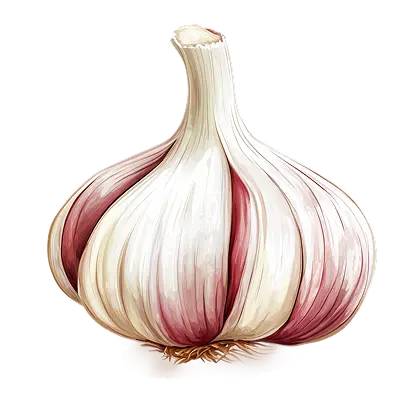
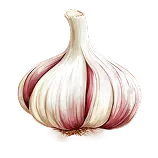
Garlic (noun) is a bulb consisting of several smaller parts that have a sharp, specific taste and a distinct aroma, for which it is especially prized in cooking, used both raw and in stewed or fried form.
Garlic has occupied a special place in medicine for many centuries due to the allicin it contains, which gives it properties that help fight harmful fungi and bacteria.
How to Pronounce “Garlic”?
 Audio (UK):

 Audio (US):
The first syllable should be emphasized with stress and the open “a” sound should be slightly extended. And do not add any sounds between these syllables!
Level up your English with Koto!
Examples: How to Use “Garlic” in a Sentence?
To become more familiar with the word garlic in its context of commonly used words and to know how to use it correctly, explore the following phrases.
What Are Synonyms for the Word “Garlic”?
This term is quite difficult to find exact synonyms; however, due to its shape, the word garlic is often substituted for bulb or clove. Despite that, they should not be used as absolute replacements.
Related nouns: clove bulbherb seasoning
Synonyms (contextual): This noun is specific.
Common collocations: peel garlic crush garlic chop garlic garlic bread garlic sauce
“Garlic” Word Formation and Description in Context
Now that you’re all about the meaning of garlic, let’s dive into how it’s usually thrown around in everyday lingo, especially when it comes to cooking!
With adjectives: fresh garlic crushed garlic minced garlic roasted garlic
With verbs: peel garlic chop garlic crush garlic add garlic roast garlic
With nouns (noun + noun): garlic clove garlic bread garlic sauce garlic powder garlic smell
Idioms and Phrases with “Garlic”
We have some interesting phrases that show this vegetable from a slightly different side and will convince you that garlic is not as trivial as you thought! Want a couple of cool phrases? They are already posted below!
-
Chicken feathers and garlic skin — when talking about something that has no value, like the peel left over from garlic.
It’s stupid to quarrel over such nonsense; it’s truly chicken feathers andgarlic skin. -
You got garlic in your soul — used to describe a person who is unpleasant, mean, and lacking in kindness.
I don’t want to deal with you, you’ve got agarlic in your soul!
Test Your Knowledge of Garlic Meaning – Quiz Time!
Now you are aware of the garlic description. We filled you in on the definition, so let’s challenge your brain with some exercises to nail down the writing!
Enjoy personalized learning!
“Garlic” Word in Other Languages
Do you know how to say garlic in other languages? We collected some variations below:
| Language | Word for “Garlic” |
|---|---|
 Spanish
 |
Ajo |
 French
 |
Ail |
 German
 |
Knoblauch |
Did You Know It? Fun Facts About “Garlic”
This go-to ingredient you find in every kitchen is key for sauces and savory recipes all around the world, plus it’s got some interesting backstory in both cooking and health habits.
-
For millennia, garlic has been utilized in cooking and for its therapeutic properties.
Historical facts that have reached us convince us that garlic was known in Ancient Egypt, and even the builders of the pyramids used it to increase strength and endurance. I wonder if it is called the same as garlic in English. -
The pungent smell and beneficial properties that garlic is so famous for are given to the vegetable by a compound called allicin.
However, to benefit from allicin’s antibacterial, antiviral, and antifungal properties, the garlic will need to be chopped, crushed, or chewed. -
According to the UN Food and Agriculture Organization China is the world’s top garlic producer.
In 2022, China produced 21,337,798 metric tonnes of garlic, which represented 73% of the world’s total production. -
Garlic was even used as a performance enhancer in the ancient Olympic Games.
Greek athletes consumed it as one of the earliest recorded “sports supplements.
Famous Quotes Featuring “garlic”
Let’s make the description of garlic more accomplished by exploring how often it is mentioned in the sayings of famous scientists and eminent people.
— Alice May Brock (of ‘Alice’s Restaurant’ fame)
Explanation: This expression, written by an American restaurateur, artist and author, fully reveals the vast influence of garlic as a seasoning in any cuisine of the world, no matter how complex or sophisticated.
— Felice Leonardo (Leo) Buscaglia
Explanation: The professor, motivational speaker and writer certainly knew a thing or two about such things, because he was known as “Dr. Love” and with this phrase he wanted to emphasize that even such small and insignificant things at first glance can add color to the gray everyday life.
Explanation: If this eminent author compares garlic as a hot spice with the amazing events in life that make our existence interesting and rich.