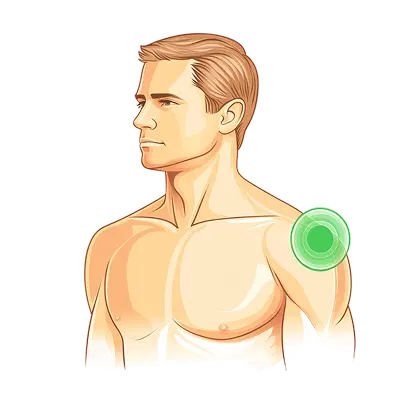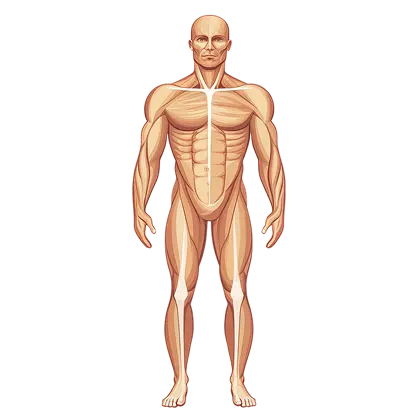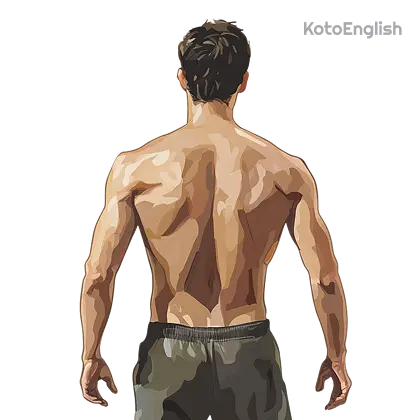

Back (noun) — the rear surface of the human body, extending from the neck to the lower end of the spine, opposite the chest and abdomen. It consists of the spine, muscles, and skin.
How to Pronounce “Back”?
 Audio (UK):

 Audio (US):
Keep your lips slightly apart, start with a soft b sound, hold the short a like in “cat,” and finish sharply with a crisp k.
Level up your English with Koto!
Examples: How to Use “Back” in a Sentence?
Let’s move on to the next step, explore a broader perspective on how this word is used, and strengthen your skill in forming similar sentence patterns with back.
What Are Synonyms for the Word “Back”?
Discover various synonymous expressions with “back” to boost your understanding of language and strengthen your vocabulary with similar lexical entries.
Related nouns: spine backbone vertebrae lumbar
Synonyms (contextual): rear dorsum
Common collocations: lower back back pain straight back muscular back
“Back” Word Formation and Description in Context
This word may be used with other parts of speech to create new phrases, collocations and lexical-grammatical units that have different meanings and purposes.
With adjectives: curved back naked back broad back tiny back
With verbs: arch your back straighten your back scratch your back
With nouns (noun + noun): back muscles back massage back support
Idioms and Phrases with “Back”
What does “back” mean? It may appear in different contexts and bear various descriptions according to them. In this section, you will become more familiar with the idiomatic meanings that this word can offer.
-
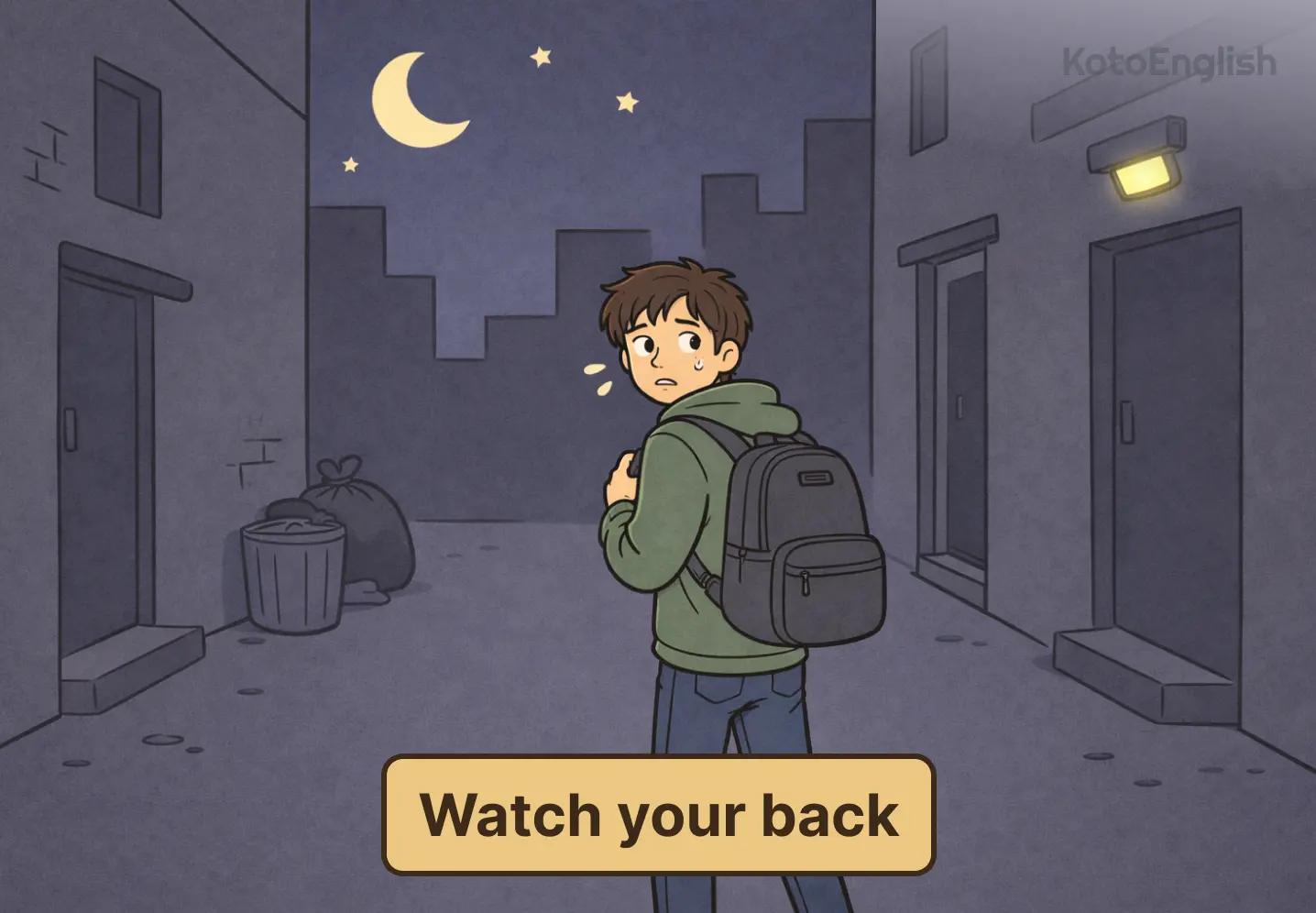
Watch your back — to be cautious or on guard, especially because someone might try to harm you.
In the cutthroat world of politics, you’ve got towatch your back if you want to survive.
-
Back-to-back — happening one right after another without interruption.
The team played twoback-to-back matches and still managed to win both. -
Break one’s back — to put in a tremendous amount of effort, often to the point of physical or mental exhaustion, in order to achieve something.
Shebroke her back trying to meet the tight project deadline, but it was worth it in the end.
Test Your Knowledge of “Back” Meaning
Now it is easy for you to define a back, but what if we say that we have some more interesting tasks for you that will give you a complete definition? Check what you know and get even more at the finish!
Enjoy personalized learning!
“Back” Word in Other Languages
Learn how to spell “back” and how to pronounce it as a native speaker of other popular languages across the world, especially in Europe.
| Language | Word for “Back” |
|---|---|
 Spanish
 |
Esplada |
 French
 |
Dos |
 German
 |
Rücken |
Did You Know It? Fun Facts About “Back”
In medical and anatomical terms, the definition of “back” is very complicated, since it is a very big and complex part of the musculoskeletal system. Let’s discover its importance and learn something new.
-
The back is the body’s central support structure
Our back contains the spine, providing support to the whole upper body and maintaining posture. It acts as a central structure linking the head, arms and legs. With no sturdy, flexible back to support us, most of our daily actions would become very difficult or nearly impossible, for it really is the backbone of every motion. -
The spine is a complex chain of bones
The human spine consists of 33 vertebrae that are stacked atop one another much like building blocks. These vertebrae are divided into cervical, thoracic, lumbar, sacral and coccygeal regions. This arrangement affords the flexibility and protection for the spinal cord that lies within it. In other words, sometimes strength lies in the weakest link of the chain. -
Muscles in the back are key to movement
The back consists of more than 50 muscles, including large ones such as the latissimus dorsi and trapezius. Movement is the cooperative activity of these muscles: they aid bending, twisting, lifting and maintaining posture. The stronger you get in your back, the less chance there will be of getting injured and the less burden will have to be laid on other parts of your body. -
The back plays a vital role in nervous system function
Running through the vertebrae, the spinal cord sends signals from the brain out to the body. Any injury to the back can affect muscular movement, sensation and even organ function. The back is important for support and communication of the entire body; after all, it is the one medium synchronizing all the elements in motion. -
The back is vulnerable but resilient
Despite its complexity, the back is prone to strains, herniated discs and posture-related issues. Exercising, stretching and maintaining good ergonomics keep it strong and problem-free. It is this resilience that helps humans to take part in a wide range of physical activities throughout life.
Famous Quotes Featuring “Back”
As you already know, the word “back” is a vital part of the human body and an interesting lexical unit, so we invite you to take a closer look and see what place this word has found in popular quotations!
Explanation: You can see the indication that envy or insecurity can fuel gossip and slander. When people talk about you behind your back, it could be proof that you are indeed playing your cards right while they are stuck in the same old rut.
— Terry Hayes
Explanation: This implies that profound changes sometimes do take place without us noticing them on the very instant they unravel. Life evolves subtly and by the time we notice, the situation has already shifted — it’s all happening under the radar, while we’re caught napping.
— Robert Breault
Explanation: Quotation by Robert Breault brings forth the connotation that physical strain or pain usually outlasts any memory in the head.