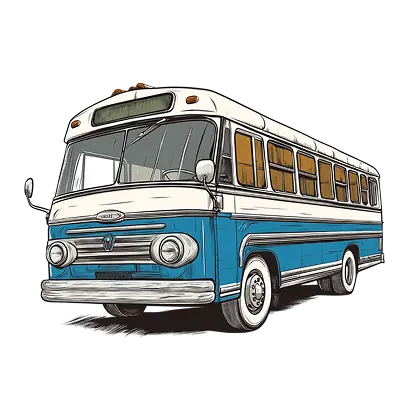
Bus (noun) — is a large vehicle that carries passengers from one place to another. It usually follows a set route for a fee and adheres to a set schedule. This is one of the most common types of transportation in public road transport.
How to Pronounce “Bus”?
 Audio (UK):

 Audio (US):
to pronounce the word “bus” in English correctly, you should pronounce the short “u” sound, as in “put,” and the clear “s” sound. Avoid pronouncing the “u” like the “a” in “father.”
Level up your English with Koto!
Examples: How to Use “Bus” in a Sentence?
Each of us uses a bus at least sometimes to get from point A to point B. And in everyday life, there are very often situations when you need to know exactly how to define bus in speech, so let’s learn how to do it correctly:
What Are Synonyms for the Word “Bus”?
There is no direct synonym for the word “bus,” but there are words and phrases that can be used to replace it in everyday life to avoid repetition, and some of them are presented below:
Related nouns: car machine automobile motor coach
Synonyms (contextual): vehicle minibus
Common collocations: bus conductor bus depot bus driver bus route
“Bus” Word Formation and Description in Context
The word bus is quite common in speech because it denotes an object that almost every person uses. Therefore, it will be useful to learn what does bus mean to correctly combine this word with other parts of speech to express your thoughts more fully.
With adjectives: crowded bus school bus public bus local bus
With verbs: catch a bus ride a bus get on the bus run for the bus
With nouns (noun + noun): bus stop bus station bus fare bus service
Idioms and Phrases with “Bus”
You may think that a bus is just a public transport, but over many decades of using “bus” in English, people have given it some other connotations, which can be seen in the established expressions and idioms with this word.
-
Throw someone under the bus — to harm another person in order to obtain a benefit for oneself.
I’m not going to throw my friend under thebus just because he was unfair to me a long time ago. -
A face like the back end of a bus — a particularly ugly or unattractive face. (Heard primarily in Britain and Ireland).
It’s not like he has a face like the back of abus , especially since he’s a very nice and smart guy. -
Miss the bus — to lose the chance or opportunity to do something.
If you don’t call the recruiter back right away, you will miss thebus . -
The wheels came off the bus — some plans or projects that didn’t go as planned or fell apart, especially after some unexpected problem or obstacle arose.
At the start of the season, Mark was fully prepared for the marathon, but after a knee injury, the wheels came off thebus .
Test Your Knowledge of Bus Meaning – Quiz Time!
We have already shown you several facets of this type of transport, and you already know how to spell bus. Now it is time to check how well you understand the definition of the word bus in sentences and different expressions.
Enjoy personalized learning!
“Bus” Word in Other Languages
This type of transport operates in almost all cities in the world, so why not learn how to say bus in the most popular languages?
| Language | Word for “Bus” |
|---|---|
 Spanish
 |
Autobús |
 French
 |
Bus |
 German
 |
Bus |
Did You Know It? Fun Facts About “Bus”
It can be assumed that the bus is one of the oldest types of public transport, and therefore, over the years of its existence, it has become the subject of many interesting facts.
-
The word “bus” comes from the word “omnibus.”
“Omnibus” is the dative plural of the Latin word “omnis” and means “for all” or “containing two or more independent objects.” The people of Nantes, France, called this means of transport an “omnibus” because one of the first bus stations was located next to a hat shop called “Omnes Omnibus” owned by a certain Mr. Omnes. -
The world’s longest commercial bus route lasts 102 hours.
The TransOceania route covers a whopping 6,000 kilometers and crosses two countries from the Pacific to the Atlantic Ocean. It stretches from Lima in Peru on the Pacific Ocean to Rio de Janeiro in Brazil on the Atlantic Ocean. -
School buses weren’t always yellow!
It was not until a 1939 convention to improve school buses that the uniform style of school buses was chosen as the uniform color we know today. Yellow became the favorite because it allowed the black letters to be seen best in the morning sun. -
The United Kingdom did not invent the double-decker bus.
While double-decker buses are common in the UK, and have even become an international symbol of the country, it was actually France that pioneered the double-decker bus. The first double-decker buses appeared in Paris and were pulled by horses, and in 1906, the first motorized double-decker bus was created, called the Schneider Brillie P2. -
At least one jet bus exists today.
Paul Stender, also known as “Jet Car Paul,” is a vehicle expert. One of his creations was a school bus powered by a Phantom jet engine that could reach speeds of 387 mph and shoot 80-foot flames. Unfortunately, the engine takes up so much space that there is only room for three passengers.
Famous Quotes Featuring “Bus”
We use buses to get from one point to another faster, and we don’t even notice that such a simple means of transportation has long taken its place in the sayings of famous people, in which they gave their own, unique description of the bus.
Explanation: This quote perfectly reflects the author’s position on the need to consciously formulate your speech, because empty chatter sooner or later leads to wasted time and disappointing results.
— Tom Wolfe
Explanation: Every person in life constantly makes decisions and choices. It is impossible to remain in two opposite positions at the same time, even if this choice does not seem easy.
Explanation: In this statement, the English artist, theatre designer, and photographer played with words in an amazing way, emphasizing the difference between art and design.