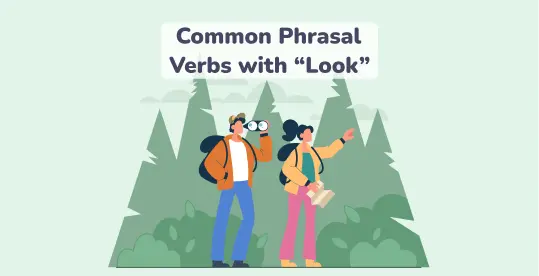
What are phrasal verbs?
Phrasal verbs are the logical combinations of a verb and one or more particles (prepositions or adverbs) that together create a new meaning which is entirely different from the meaning of the original verb alone.
The particles are usually divided into:
For example, “give up” is equivalent to quitting — something you could never guess just from “give” or “up” separately. The English language is full of these cunning constructions, and they are often the very reason why the conversational language sounds natural as opposed to something formal.
Native speakers frequently “run into” friends, “look after” pets, and “put off” tasks without even thinking about it.
On the other hand, for learners, phrases with “look” or other phrasal verbs can be extremely irritating since their meanings are hardly ever literal and must usually be memorized in context. Getting them right is one of the most obvious signs of developing fluency while learning English.
Why are phrasal verbs important in English?
Phrasal verbs are the ones that people usually rely on when communicating in daily life — research indicates that they show up about 2,000 times per million words in informal English in sentences with “look”, which is much more than their formal one-word equivalents.
They are the first choice in friendly chats, business emails, news articles, and the entertainment industry, so you can’t avoid them at all.
There is another cause for their usage: emotional power “fired” is very hard, but “let go” is an example of a gentle verb. Speakers can even express the same idea with different levels of clarity. “Figure out” sounds like a search for the answer, while “calculate” denotes a precise number.
One of the major advantages of English is that it continually produces new phrasal verbs (such as “log in,” “scroll through,” or “swipe right”), so mastering their usage will help you understand even the words that dictionaries have not yet recognized.
List of 25 common phrasal verbs with “look”
Here are the 25 English phrasal verbs with “look” that we are going to be examining today:
- Look around
- Look after
- Look ahead
- Look away
- Look at
- Look back
- Look forward
- Look down on
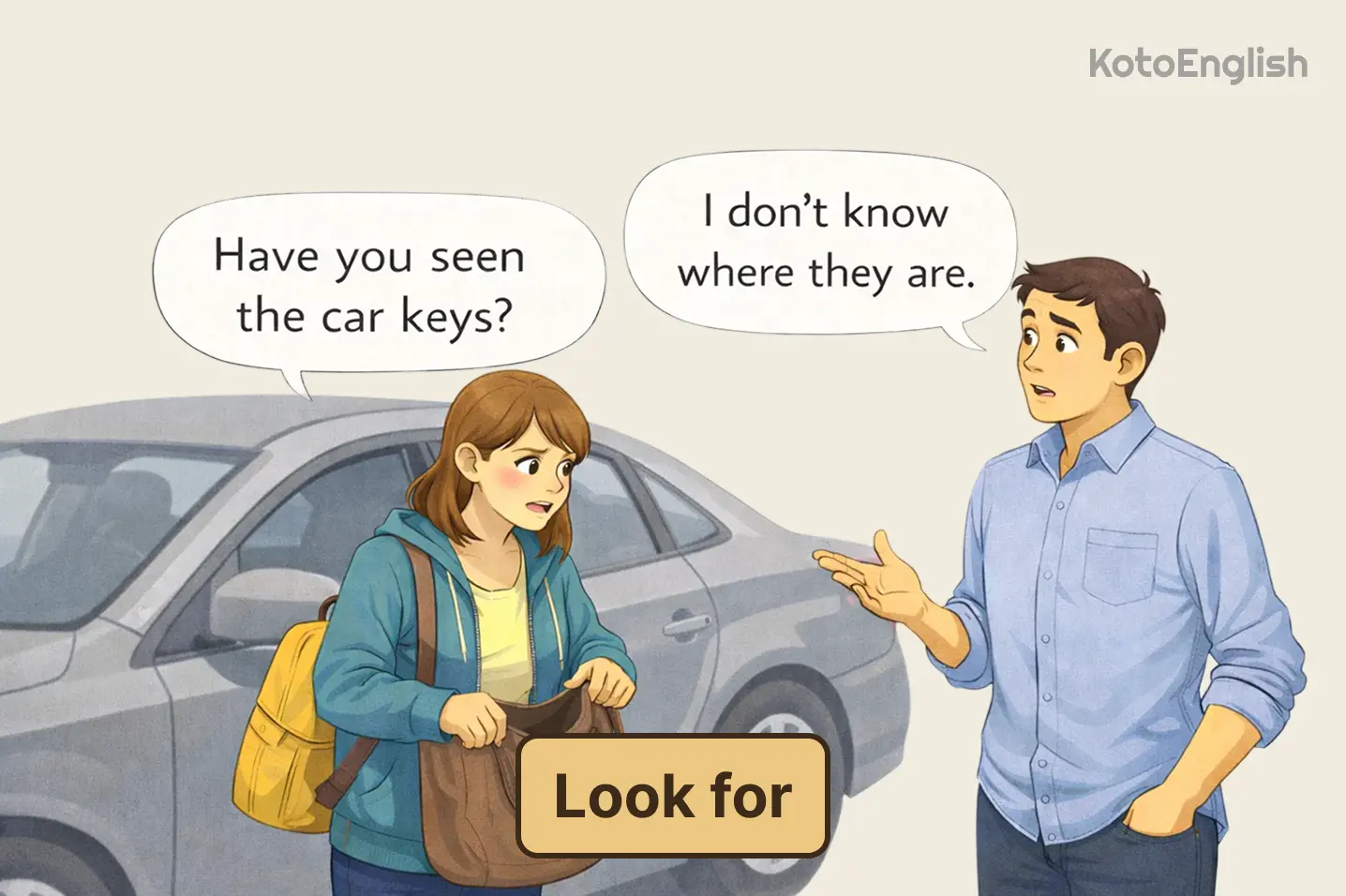
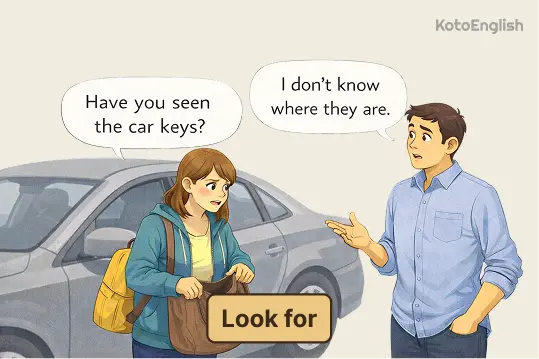
- Look for
- Look in on
- Look into
- Look on
- Look on as
- Look out
- Look out for
- Look over
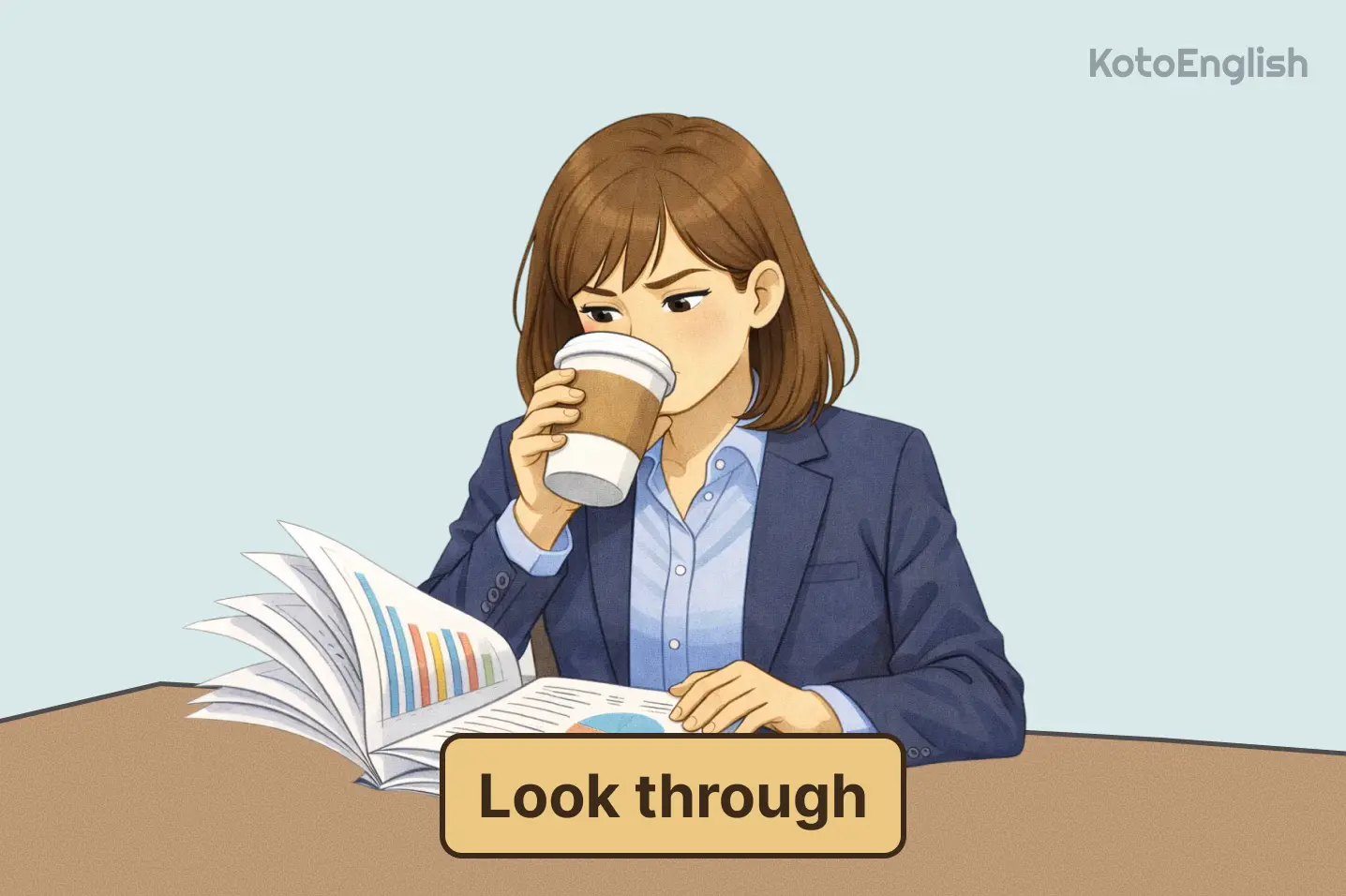
- Look through
- Look to
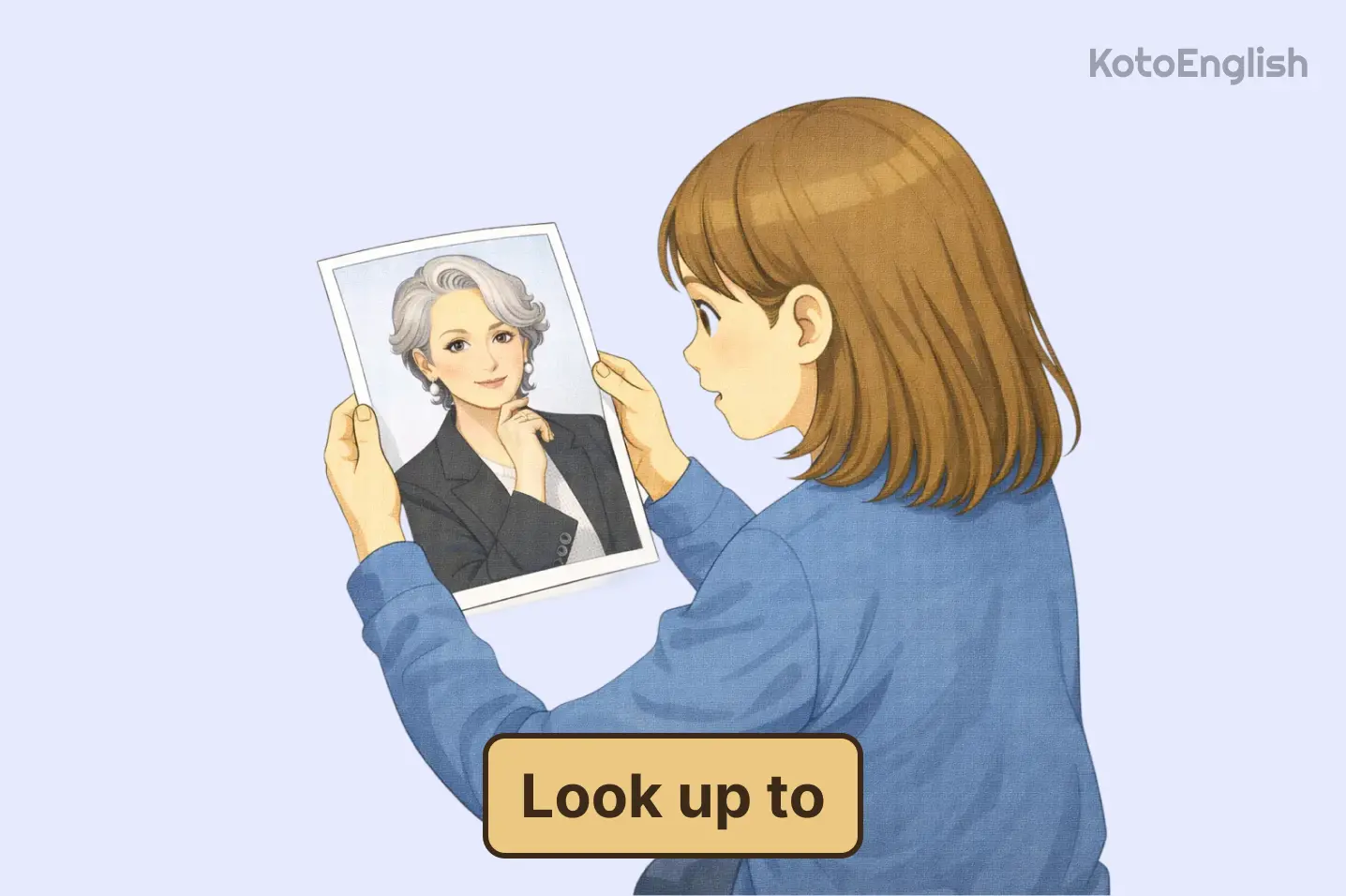
- Look up to
- Look up
- To be looking up
- To look someone up
- Look upon
- Look off
- Look past
Let’s dive right in with the first one!
Look around
When someone is looking around, it means they arrive in an unfamiliar place and examine the area to see what is placed there.
Look after
To look after is a phrasal verb with “look” that can be applied to both living beings and inanimate objects. It means to take care of someone or something to keep them in a safe and good condition.
Look ahead
Looking ahead means being able to think about what will happen in the future and plan out your next moves.
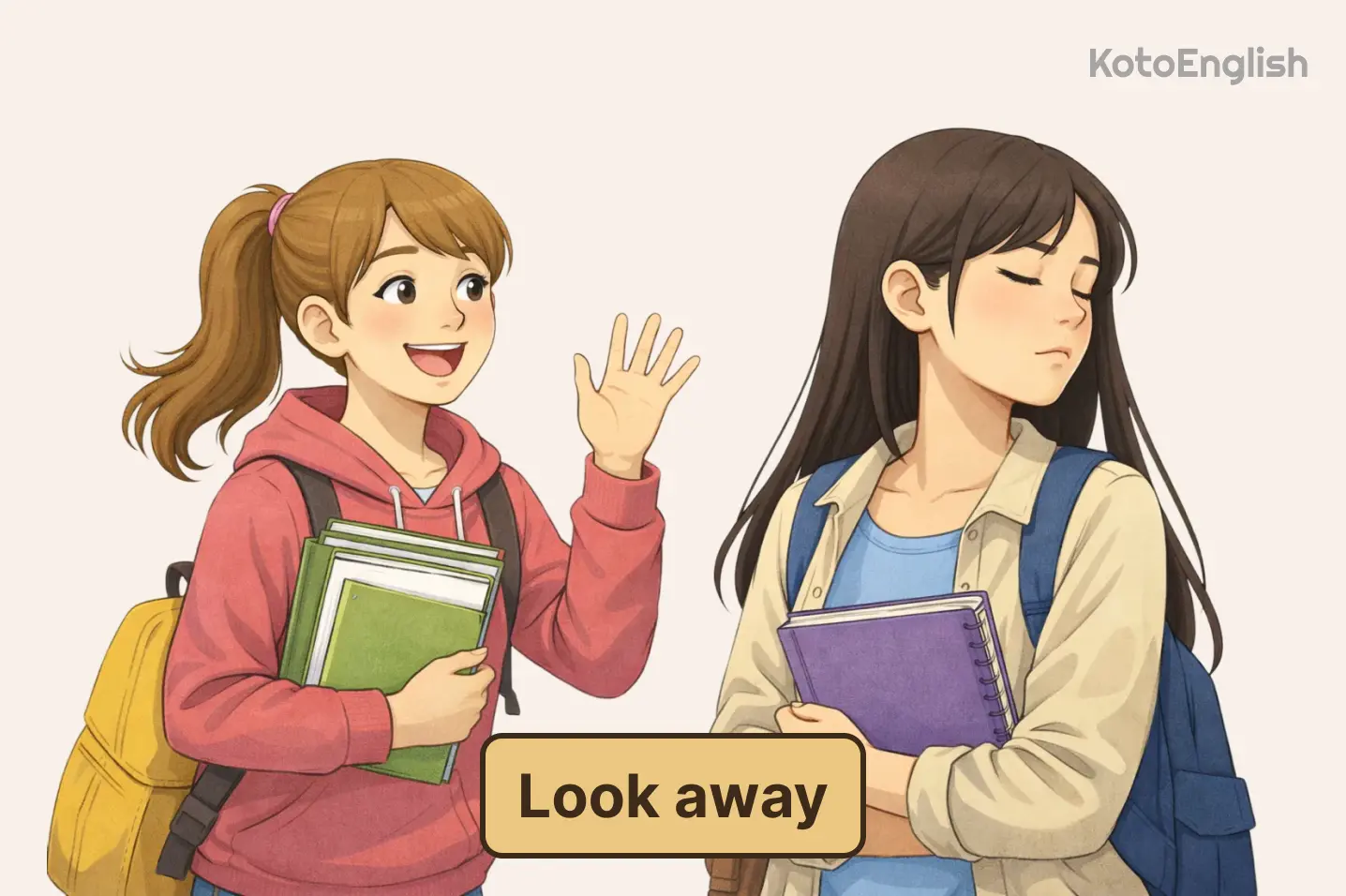
Look away
Looking away simply means turning your face or body from something or someone, averting your gaze.
Look in on
Looking in on someone is a phrasal verb with the word “look” that means paying them a brief visit for any kind of reason, i.e., the person is ill. Usually, it happens when a person is on their way to a different place and has the ability to stop by.
Look into
To look into something or someone refers to collecting facts and examining or investigating a certain situation, like a crime or a problem.
Look on
To look on something or someone essentially means viewing a situation or a person in a specific, often prejudiced, way.
Look on as
When someone is looking on as something happens, it means they are watching a situation unfold but are not taking an active part in it. While this and the previous phrasal verbs with the word “look” are quite similar, many English grammar books explain how and why the phrases are built differently.
Look out
To look out means to keep a watchful eye on something that is happening or is going to happen and remain careful and considerate of your surroundings. What is curious is that the conjoined word “lookout” refers to an act of keeping watch over the area or a person who stands guard.
Look out for
Although only one more preposition is added, this particular construction means taking care of someone and ensuring they are safe and sound.
Look over
Similar “look” phrasal verbs to the aforementioned “look around”, to look over refers to quickly examining the area or an object.
Look through
When someone is looking through something, it means they are quickly reading a book, catalog, article, etc., to find a piece of needed information.
Look in on
Looking in on someone is a phrasal verb with the word “look” that means paying them a brief visit for any kind of reason, i.e., the person is ill. Usually, it happens when a person is on their way to a different place and has the ability to stop by.
Look into
To look into something or someone refers to collecting facts and examining or investigating a certain situation, like a crime or a problem.
Look on
To look on something or someone essentially means viewing a situation or a person in a specific, often prejudiced, way.
Look on as
When someone is looking on as something happens, it means they are watching a situation unfold but are not taking an active part in it. While this and the previous phrasal verbs with the word “look” are quite similar, many English grammar books explain how and why the phrases are built differently.
Look out
To look out means to keep a watchful eye on something that is happening or is going to happen and remain careful and considerate of your surroundings. What is curious is that the conjoined word “lookout” refers to an act of keeping watch over the area or a person who stands guard.
Look out for
Although only one more preposition is added, this particular construction means taking care of someone and ensuring they are safe and sound.
Look over
Similar “look” phrasal verbs to the aforementioned “look around”, to look over refers to quickly examining the area or an object.
Look through
When someone is looking through something, it means they are quickly reading a book, catalog, article, etc., to find a piece of needed information.
Look to
When you look to someone, it means you are seeking the help that the person can provide.
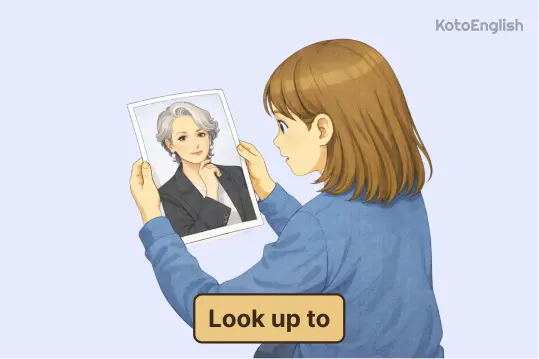
Look up to
Another instance of similar “look” phrasal verbs with different meanings. Looking up to someone refers to having immense admiration and respect for the particular person.
Look up
To look something up is a phrasal verb with the word “look” that refers to researching information through the means of the internet, books, encyclopedias, and other sources.
To be looking up
This particular phrasal verb means that people are recovering and getting better from an illness, some kind of accident, or a problem that occurred.
To look someone up
To look someone up means to visit a person after a long separation.
Look upon
When a person looks upon something, it means they are regarding or considering it in their own manner.
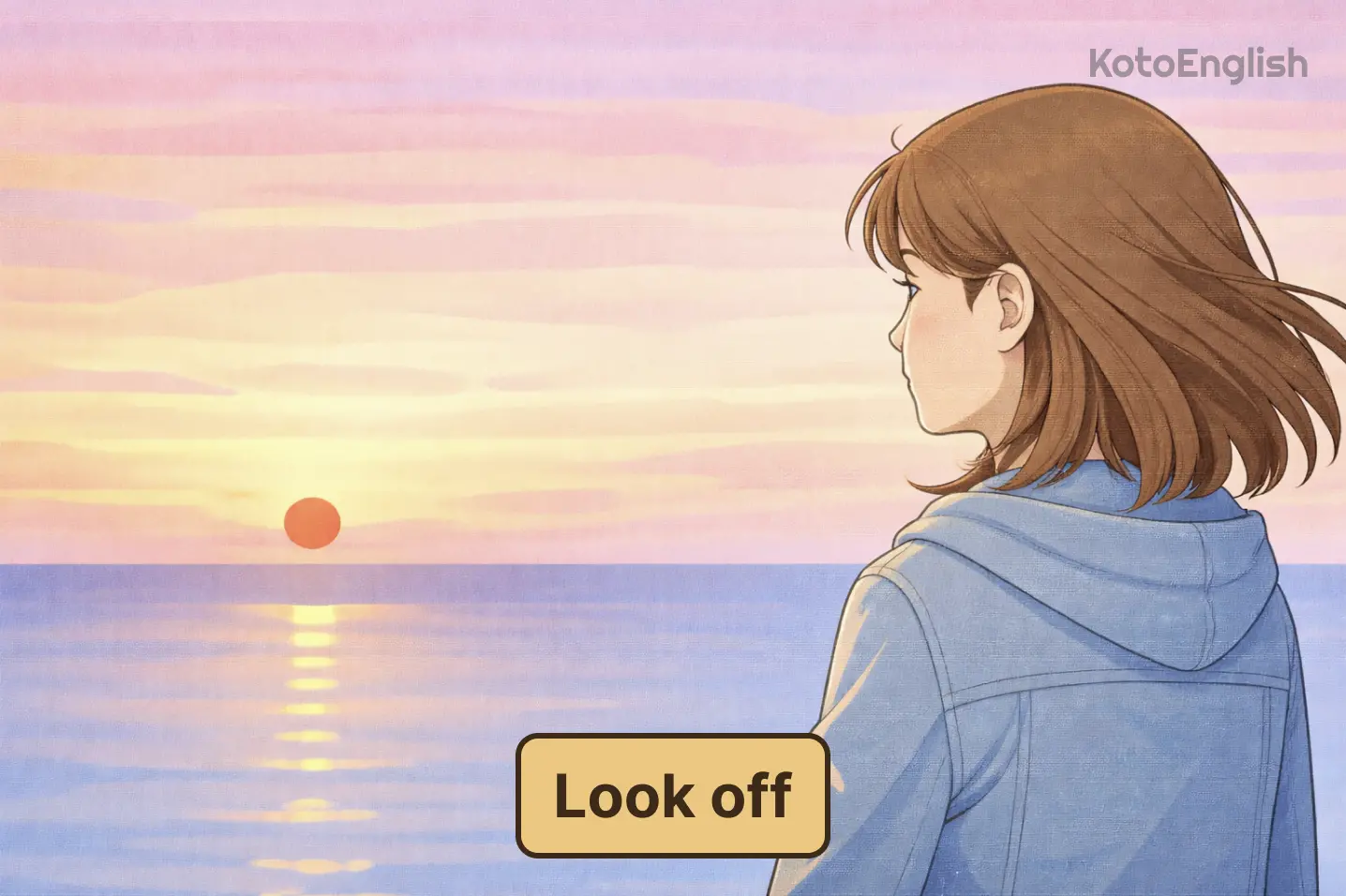
Look off
This avert your eyes or gaze in another direction, often briefly or thoughtfully.
Look past
This particular phrase is used when you ignore something negative or superficial in order to focus on what is more important.
Interesting facts about the phrasal verb “look”
As non-native English learners and ESL students improve their speaking skills and raise their level of knowledge, they come across phrasal verbs. However, the problem lies in the fact that such parts of speech, like phrasal verbs with the word “look”, can be hard to comprehend without initially knowing what they mean.
For example, the words “look” (to see) and “out” (outside of a particular place) have their own distinct meanings. Regardless, when they are combined into a phrasal verb, “look out”, it acquires a whole new definition — to keep a watchful eye for any danger.
Interestingly, another part where non-native speakers can get confused is that phrasal verbs can be used separately in a sentence. They are not always bound to be used together and can be intertwined with other parts of the sentence.
In particular, it is grammatically correct to say:
As a rule of thumb, phrasal verbs can be separated when there is a noun in between. However, it’s not always the case for all phrasal verbs, such as the following one:
Common mistakes learners make
It may seem that phrasal verbs with “look” are simple because the base verb is among the first words any learner will come across.
Yet, this knowledge leads to being overly confident. A slight change of prepositions or taking the context wrongly changes the meaning of what you want to say into confusion, or even worse, unintentional rudeness.
Errors mainly fall into three categories: understanding phrases strictly by their literal meanings, confusing the expressions based on the attitude and not knowing the depth or the intensity of an action in sentences with “look”.
Each mistake type follows a predictable logic, which means each one has a clear fix.
- Interpreting phrases literally
Phrasal verbs are usually thought by learners to have the same meanings as their constituent parts. “Look down on” does not refer to the action of physically gazing beneath; on the contrary, it denotes the act of considering someone inferior.
The same reasoning applies to “look forward to” (wait for something with excitement), which does not relate to looking at a certain area. Train yourself to treat “look” in a phrasal verb as a brand-new vocabulary item with its own definition, completely detached from the individual words.
|
She looks down on her because he is standing on the stairs.
|
She looks down on her because he thinks she is less intelligent.
|
|
He is looking forward to the window.
|
He is looking forward to starting his new job.
|
- Mixing up attitude-based expressions
There are a number of “look” phrasal verbs that show one’s attitude towards a person, and misusing them can send quite an opposite social signal.
To illustrate, “look up to” means to regard someone with admiration, “look down on” means to disrespect, and “look upon” suggests a neutral (or sometimes critical) stance.
If these verbs are exchanged, the net effect might be different: a compliment might become an insult or vice versa. The direction of the preposition indicates the case: “up to” raises the other person, “down on” lowers them.
|
Critics look up to this film as a failure.
|
Critics look upon this film as a failure.
|
|
He looks up to poor people as lazy.
|
He looks down on poor people as lazy.
|
- Misjudging depth and intensity
Not every phrasal verb with “look” has the same difficulty level and the choice of one over the other can lead to a total misunderstanding of the extent of your examination. “Look over” means a quick glance, “look through” entails meticulous reading of each page, and “look into” denotes investigation.
Informing your superior that you “looked over” a contract when they anticipated you to “look into” every single clause could lead to the loss of credibility for you — or even worse.
|
I only had time to look into the menu briefly.
|
I only had time to look over the menu briefly.
|
|
She looked over every page of the 300-page report.
|
She looked through every page of the 300-page report.
|
Practice using “look” phrasal verbs
The process of learning requires more than definition memorization because it teaches you to recognize how different contexts generate new meanings.
The practice of these exercises will help you develop the skill to detect equivalent expressions while understanding their appropriate background and using phrases with “look” correctly in spoken and written communication.
An ongoing practice will reinforce your ability to understand different tones and subtle differences which will transform your knowledge into automatic language proficiency.
Concluding the phrasal verb with “look”
The subject of phrasal verbs is fascinating and challenging at the same time. With how complex yet flexible and diverse they can be, many teachers and scholars recommend the approach of basic memorization of them. After all, trying to give phrasal verbs any logical explanation or interpretation is doomed to be a failure.
In spite of that, such an interesting part of speech can undoubtedly bring more color and depth to our conversations. It also makes the English language more unique and distinct from other languages. Even though other languages and dialects have their own versions of phrasal verbs that reflect their specific cultural nuances, they are certainly different.
In this article, we took a deep dive into the 25 phrasal verbs with “look”, explained the meanings behind them, as well as provided examples in sentences that can be found in informal real-life conversations. The best approach to making sure these phrases stick in your memory is to practice and remember that making mistakes is okay and a part of the learning process.
Frequently Asked Questions (FAQs)
The most frequently used is “look for,” which means the action of attempting to find something. It has found a place in day-to-day communication, from looking for items to looking for chances. The reason for its frequency is its straightforward construction and useful denotation.
They are mostly casual and frequently used in daily spoken and written English. Nevertheless, some of them, like “look into” or “look after,” are deemed appropriate in neutral and semi-formal situations. The degree of formality varies according to the particular phrasal verb and its usage.
Phrasal verbs often sound more casual and versatile than their single-word counterparts. Besides, using phrasal verbs allows one to subtly show the different shades of meaning, the mood, and even the degree of intimacy in conversation.
Yes! People can use them in academic or business contexts when the verbs maintain a neutral or formal tone. For example, reports, emails, and research contexts commonly use expressions such as “look into”, “look at” and “look after.”
“Look” in a sentence as a part of a phrasal verb can have several meanings, which usually include two or three, that depend on the specific context. The intended meaning of a word depends on tone and the words that come before and after it.