
What is the imperative mood?
The imperative form is a grammatical mood in language, used to order, request or advise, among other uses. It is a verb form to order or advise a person to do something. In English, this form uses the base form of a verb without a subject, because the subject of the verb is you.
The imperative mood can be positive or negative in nature. A positive construction asks a person to do something:
On the other hand, a negative imperative mood asks a person to refrain from doing something:
The tone of the imperative in English can differ according to the context in which it is written or spoken. We will discuss different types of imperatives and cases of their use in more detail below in our article.
When do we use the imperative?
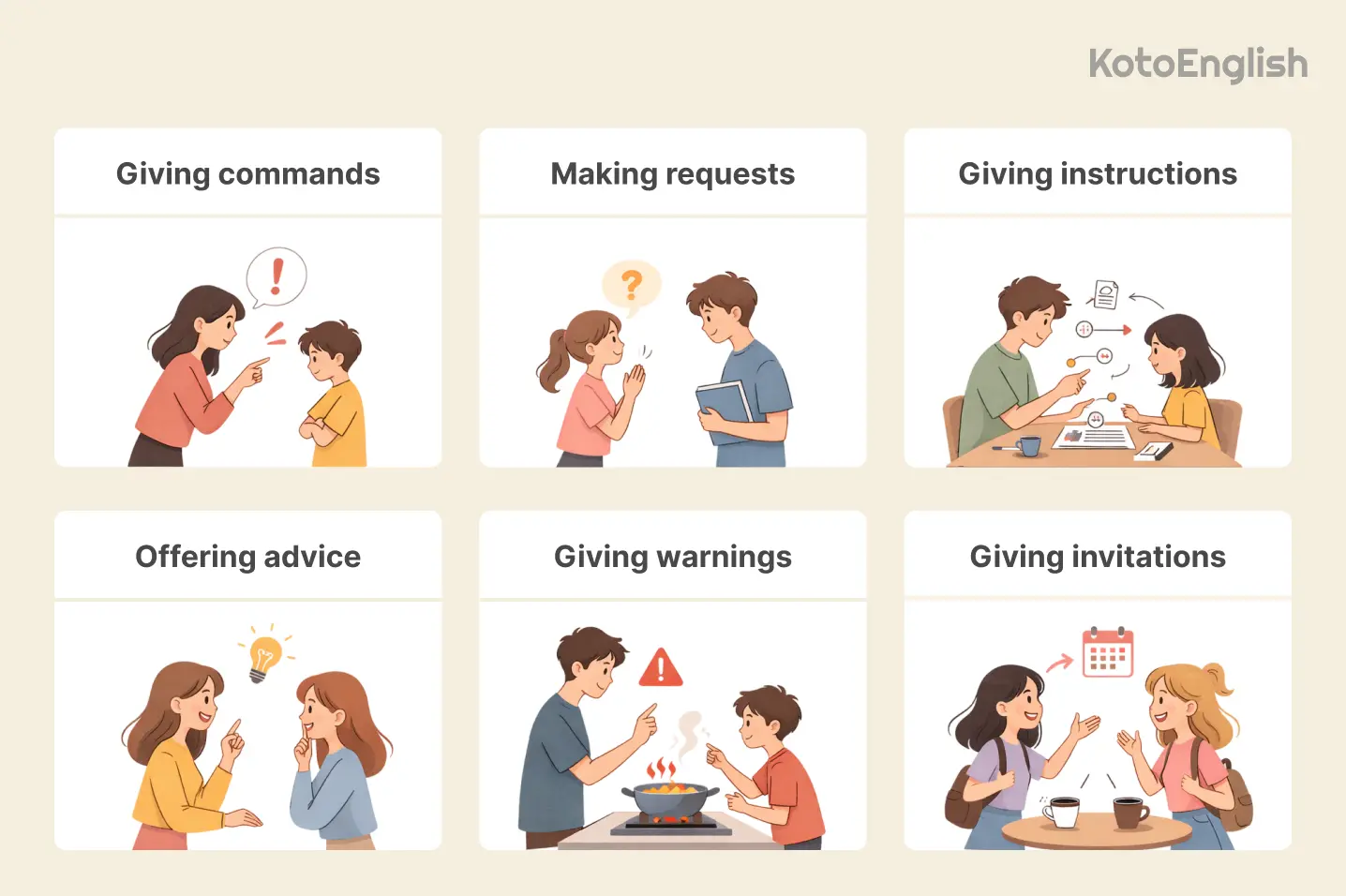
The imperative mood is used when we want the other person to do something. Here, the focus is on the action that needs to be performed, rather than who is performing it, as the word you is always implied. Here are the main situations for the imperative in English, along with the explanations and examples.
- Giving commands
This structure is mostly used for giving commands. Such commands can be short, especially when the situation is critical.
While giving commands, the tone can be quite stern, and the use of an exclamation mark can add more force to the command.
- Making requests
The imperative is used for making polite requests in English, too. We add words like please to sound more polite.
The structure is the same as giving a command, but the tone is softer.
- Giving instructions in English
Instructions and directions are usually given in the imperative form.
This is very common in recipes, exams, and guides.
The imperative form makes it very clear to the reader what to do next.
- Offering advice or suggestions
The imperative construction can be used to offer advice, encouragement, or even suggestions.
The mood used here is often encouraging rather than ordering the person around.
- Giving warnings
The command form may be used to warn someone about something dangerous or risky.
The warnings are often brief to attract the person’s attention.
- Giving invitations
Imperatives are sometimes used to ask a person to do something in a friendly way.
In this case, the tone is friendly rather than formal.
How to form the imperative
The imperative in English consists of the base form of the verb, and there is usually no subject. Let’s look at this more closely:
Base form of the verb
The imperative uses the base form of the verb, which does not change. It is the same for singular and plural. There are no -s endings to be added to the verb, and there are no auxiliary verbs to use in affirmative sentences.
For example:
Another difference is that, unlike other verb forms, the imperative verb form does not change according to the subject’s person or number. We do not add the suffix -s to the base verb in the third person singular, nor do we use auxiliary verbs in positive sentences.
Negative imperative
To advise or order someone not to do something, English uses the verb do not or don’t followed by the base verb form, without any change in the verb form, irrespective of the verb.
Examples include:
The negative imperative sentence is very commonly used in sentences giving orders or instructions, etc. While in formal writing, do not is preferred, in informal writing or spoken language, don’t is much more frequently used than “do not.”
Emphatic imperative (with “do”)
Although imperative sentences normally don’t require auxiliary verbs, the word do is sometimes used before the main verb for a stronger effect. In this case, do is not used to form a question or a negative sentence. Instead, it adds extra force or sincerity to the command or request and highlights the speaker’s intention.
Consider the difference:
This sentence seems cozier and more intimate when do is added. It is frequently employed in courteous invites, words of support, or when the speaker wishes to convey sincere concern.
Imperative with “let”
The verb let is used to create a special type of imperative sentence. Unlike other imperative sentences that give direct orders to you, this type of sentence can include the speaker or another person.
Let’s for suggestions
The phrase let’s in English is an abbreviation of let us and is used to create suggestions that include the speaker and another person. It is used to give proposals that are intended for a group of people and is generally used in spoken language.
For example:
The negative form is let’s not:
This structure helps make suggestions sound inclusive rather than commanding, because the speaker is part of the action.
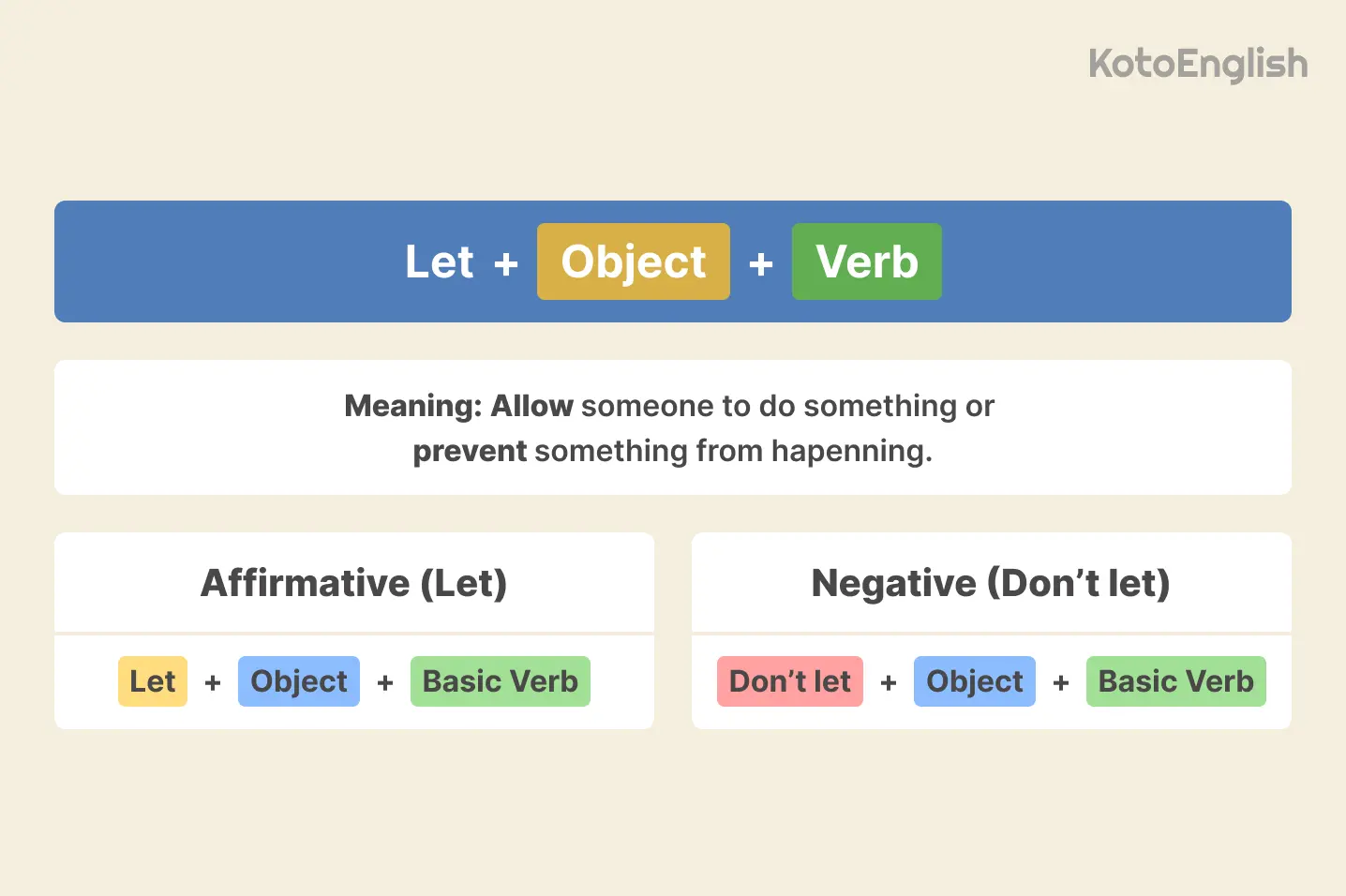
Let + object + verb
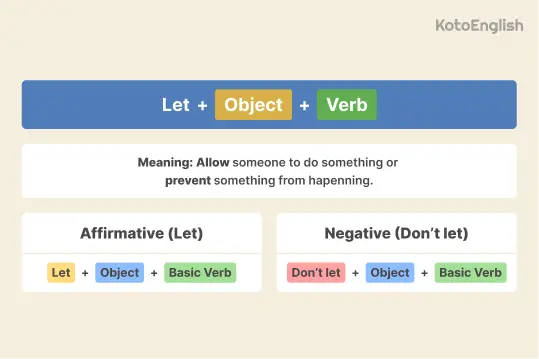
The other imperative structure is let + object + base verb. This structure means allow someone to do something or don’t prevent something from happening.
For example:
The object (him, her, them, me, us) indicates who is allowed to do the action. The negative form is achieved by adding do not or don’t:
This structure is used mainly for giving instructions, permission, and strong feelings (Let me explain!).
Polite imperatives
The imperative in English does not necessarily have to convey a sense of command. It can also convey a sense of politeness and respect. It all depends on the word choices, intonation, and grammatical structure. English provides a number of strategies to make the imperative sound like a request rather than a command.
Using “please”
The easiest way to make the imperative sound polite is to add the word please. It can be placed at the beginning or at the end of the sentence.
For example:
In initial position, please is a little more formal. In final position, particularly in spoken language, please can make the imperative sound more friendly. In either case, it makes the imperative a little less direct and a little more polite.
Softening commands
In addition to please, English uses several strategies to soften imperatives and make them less direct.
For example:
The use of words like just, a bit, or for a moment, for example, might reduce the forcefulness of the command. The tone of voice is also an essential factor: a friendly, calm tone makes the imperative sound polite, whereas a sharp tone with the same words makes it sound strict.
Another way to reduce the forcefulness of a command is by making it an indirect request with the use of modal verbs, as in the following imperative examples:
These, although not technically imperatives, have the same function but with a more polite and formal tone.
In conclusion, it has been seen that polite imperatives do not only involve the use of a specific grammatical form but also involve other small details that influence the way the message is perceived.
Imperative vs other sentence types
The imperative sentence is one of the four main sentence forms in English, along with declarative, interrogative, and exclamatory sentences. All of them have different structures and uses. The imperative sentence is used to influence people’s actions, etc.
Imperative vs declarative sentences
Declarative sentences are the sentences that convey information. Imperative sentences, on the other hand, include commands, orders, and advice.
|
Sentence type |
Example |
Function |
|---|---|---|
|
Declarative |
She finishes work at six.
|
States a fact |
|
Imperative |
|
Gives an instruction |
Declarative sentences generally contain a subject, while imperative sentences start with the verb itself and emphasize the action.
Imperative vs interrogative sentences
Interrogative sentences are generally used for asking questions. Imperatives are generally used for directing someone towards performing an action.
|
Sentence type |
Example |
Function |
|---|---|---|
|
Interrogative |
Did you lock the door?
|
Asks for information |
|
Imperative |
|
Gives a command |
Questions typically begin with an auxiliary verb or question word, while imperatives begin with the base form of the verb.
Imperative vs exclamatory sentences
Exclamatory sentences are generally used for expressing emotions. Imperatives are generally used for directing.
|
Sentence type |
Example |
Function |
|---|---|---|
|
Exclamatory |
How amazing this performance is!
|
Expresses emotion |
|
Imperative |
|
Encourages action |
Although an imperative can terminate with an exclamation mark, its basic function is not the same as the others.
In summary, the main difference is the purpose of the sentences. Declarative sentences are meant for giving information, interrogative sentences are for asking, and so forth.
Imperative in different contexts
The command form can be found in many aspects of our daily lives. Though the form of the imperative construction remains constant, the tone and intention behind it may differ according to the situation.
In everyday conversation
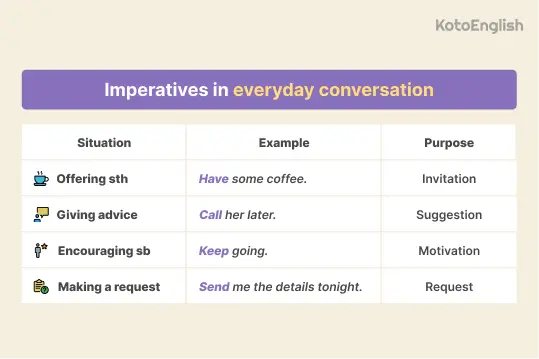
In our daily lives, the imperative can be used in an informal manner. It may convey requests, invitations, advice and even encouragement.
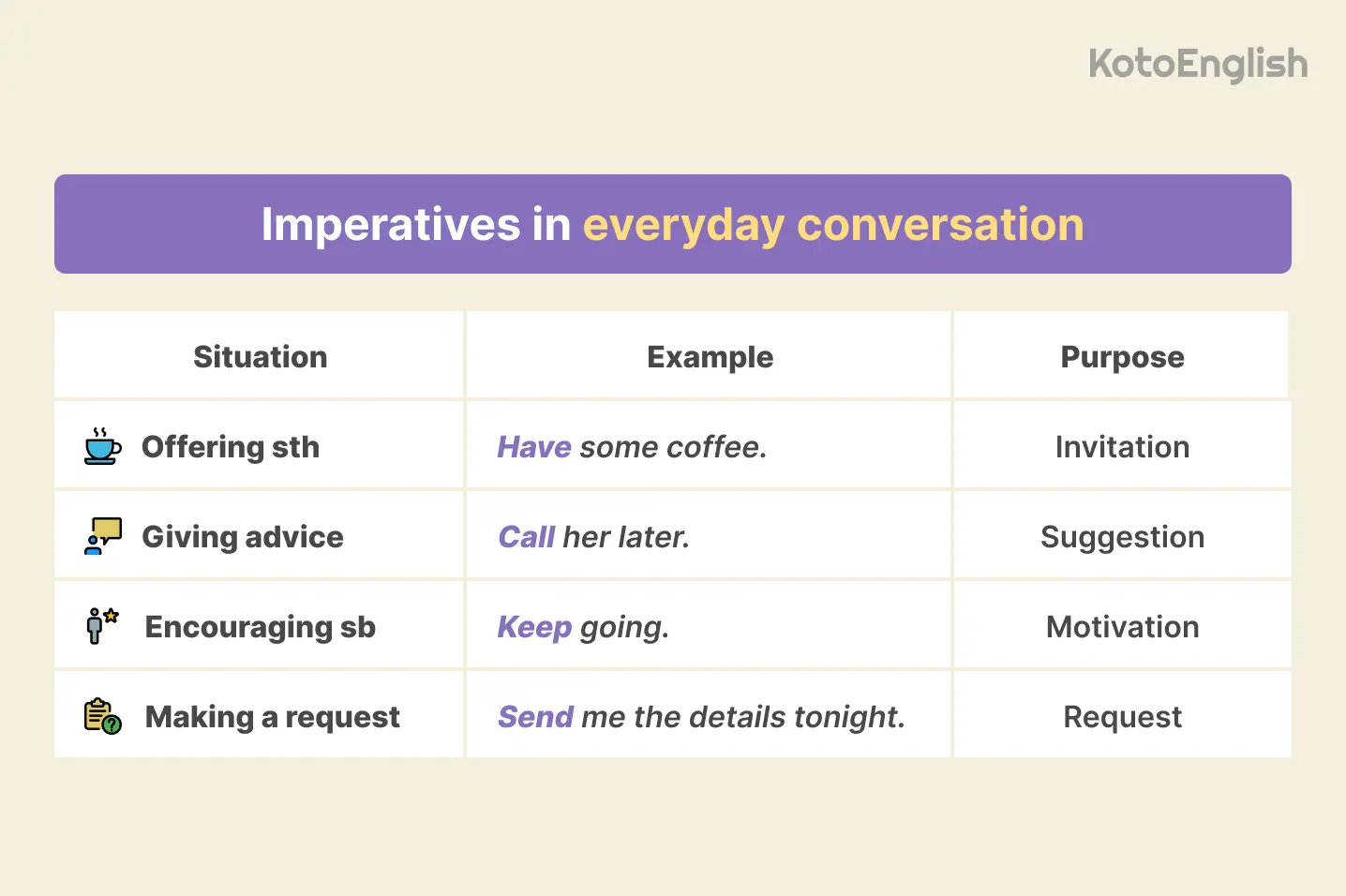
The tone of voice is significant while speaking. The same imperative sentence may convey a polite tone, a loving tone and a strict tone.
In instructions and manuals
The imperative mood is frequently used in written instructions because it effectively explains the actions that need to be performed by the reader.
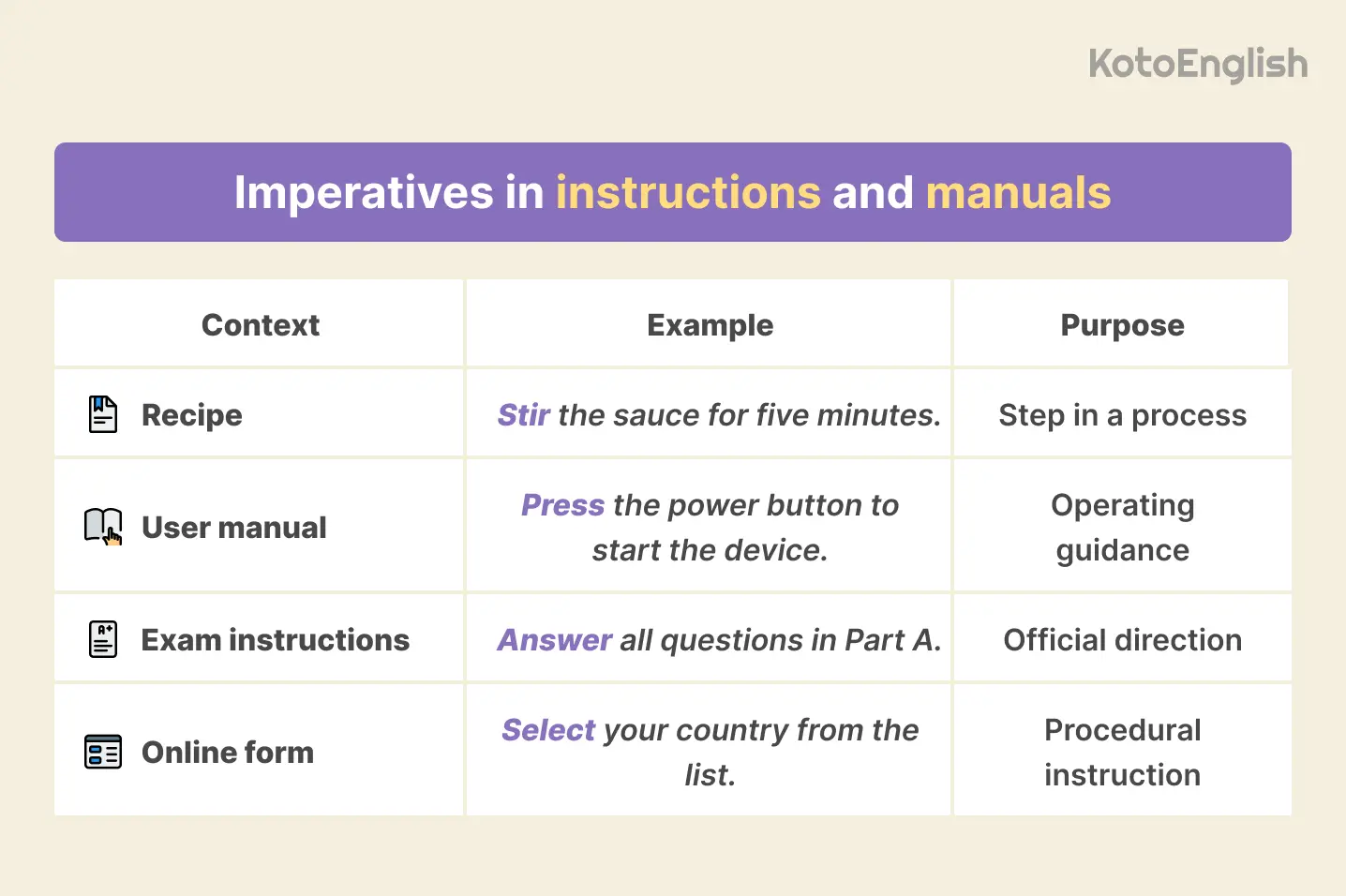
In these contexts, imperatives emphasize the importance of clarity and efficiency rather than politeness.
In signs and notices
Public signs frequently utilize the imperative to convey a message. These sentences tend to be brief because they should be quickly readable.
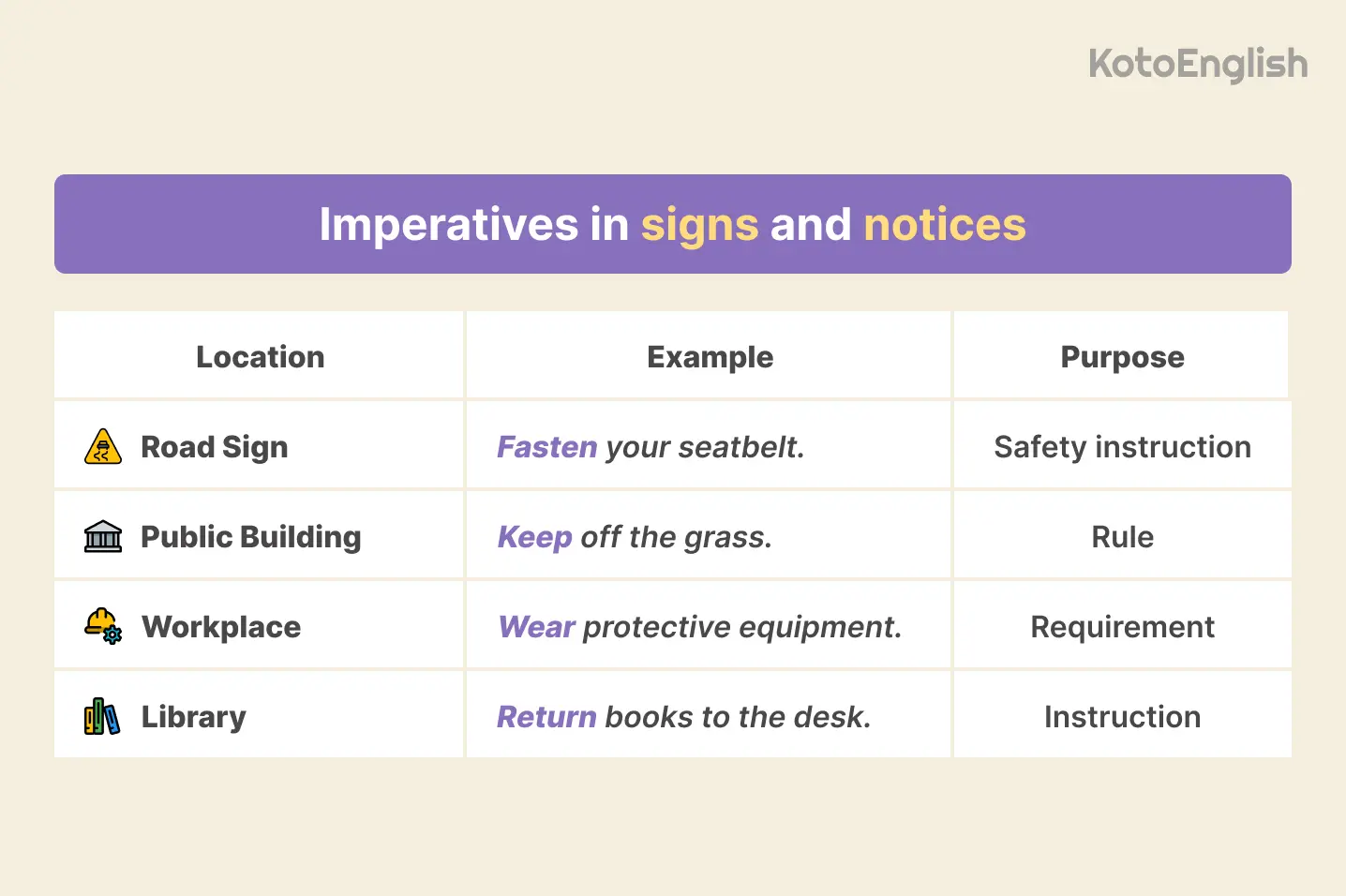
In signs and notices, imperatives sometimes convey rules, warnings, or safety instructions. The brevity of the imperative mood makes the message easy to read.
Common mistakes with the imperative
Learners often find the imperative easy to form, but small structural mistakes are common, especially at lower-intermediate levels. Because imperatives are short and direct, even a small error can make a sentence sound unnatural or grammatically incorrect. Below are some of the most frequent problems and how to avoid them.
Using the subject “you” unnecessarily
In English, the subject you is usually omitted in imperative sentences because it is already understood. Adding it can make the sentence sound too strong, unnatural, or grammatically incorrect in neutral contexts.
|
You tell me the truth.
|
Tell me the truth.
|
|
You be careful.
|
Be careful.
|
In the imperative form, the verb comes first. The subject you is only necessary if you are going to emphasize the verb.
Using the wrong verb form
The imperative always uses the base form of the verb. Learners sometimes add -s, use the past tense, or include “to.”
|
Don’t goes there.
|
Don’t go there.
|
|
To sit down, please.
|
Sit down, please.
|
Imperatives do not change according to person and number. The verb form remains the same as the base form even in negative sentences.
Forming negative imperatives incorrectly
To form negative imperatives, the word do not or don’t is used before the base form of the verb. Sometimes, learners attempt to use ‘not’ alone or misuse not in negative imperatives.
|
Not touch that.
|
Don’t touch that.
|
|
No enter.
|
Do not enter.
|
It must follow the structure of do not/don’t + base verb. The signs on public places sometimes omit this structure (e.g., No entry), but this is not a full imperative sentence.
Overusing exclamation marks
Imperatives sometimes end with an exclamation mark, but overusing them can make the text look aggressive.
|
Send me the file now!
|
Send me the file now.
|
|
Finish this today!
|
Finish this today.
|
Exclamation marks can be used for powerful commands in English or for warning people, while a period can be used for professional writing.
Practice section
Complete these exercises to improve your understanding of the imperative in different situations.
Summary
It may look simple, but the imperative in English has a very important function to perform in order to convey clear and confident communication. It can range from a short spoken dialogue to written ones, and it is imperative to understand how it works in order to make learners sound more natural and purposeful in their use of English.
If you wish to improve your imperative grammar skills and become more confident in real-life communication, the best way to do so is to practice regularly and study English online, where you can use the language in context.
Frequently asked questions (FAQs)
Yes, the imperative is used in formal situations such as giving instructions, guidelines, and business communication. It sounds good and professional in sentences such as “Submit the report by Monday.” In highly formal writing, this is sometimes used in a softened way.
Yes, the imperative form may sound impolite if it is too direct or does not include any polite language. It is a command or instruction, and the language may sound strong or too formal. However, the addition of words like please or a softening of the language may help it sound polite and respectful rather than impolite.
Yes, but mainly for emphasis. Adding you can make the sentence sound stronger or show contrast, for example:
In most situations, you is omitted because it is already understood.