What are conjunctions?
Conjunctions are the spies of language. They sneak into the spaces between words, phrases, and sentences to connect them all. Conjunctions are bridges that join ideas together. Without them, writing would be awkward, speaking would be staccato, and even the simplest of tales would be a jumbled mess of unconnected ideas.
What conjunctions connect
Conjunctions move ideas forward. Instead of attaching isolated words, they connect full thoughts and show how one idea relates to another.
- Word to word: bread and butter, fast but careful. Small connectors may change the meaning and flow of a sentence.
- Phrases to phrases: in the morning or at night, with a wink and a nod. They combine several details into a single, smooth idea.
- Clauses to clauses: She missed the bus, so she had to run. I wanted to stay, but the noise drove me out. In these cases, they show cause, effect, contrast, or choice, turning simple statements into a connected story.
Each type of connection has its own flavor, subtly shaping meaning and emphasis.
Why conjunctions matter
Conjunctions have three major functions that make language more interesting and effective than simple language:
- To guide the reader. These connectors steer the flow of ideas, keeping sentences clear and easy to follow.
- To clarify relationships. They show how words, phrases, and clauses relate, signaling cause, contrast, choice or addition.
- To enhance expression. By creating rhythm and balance, they turn simple statements into lively, memorable sentences.
Small linking words prevent your writing from stalling and make ideas flow like a connected story.
Main types of conjunctions: overview
Conjunctions link words, phrases, and clauses, keeping sentences smooth and ideas connected. They fall into three main categories, each serving a distinct purpose: coordinating, subordinating, and correlative.
|
Type |
Function |
Example |
|---|---|---|
|
Coordinating |
Connect equal ideas |
and, but |
|
Subordinating |
Show dependence |
because, although |
|
Correlative |
Work in pairs |
either…or |
Coordinating conjunctions join words, phrases or clauses of equal weight and often signal addition, contrast, or choice.
Subordinating conjunctions introduce dependent clauses and show how one idea relates to another, indicating cause, time, condition, or contrast.
Correlative conjunctions work in pairs to link balanced sentence elements, emphasizing choices or relationships.
Together, the three types account for the majority of conjunction use, keeping sentences structured and easy to follow.
Coordinating conjunctions (FANBOYS)
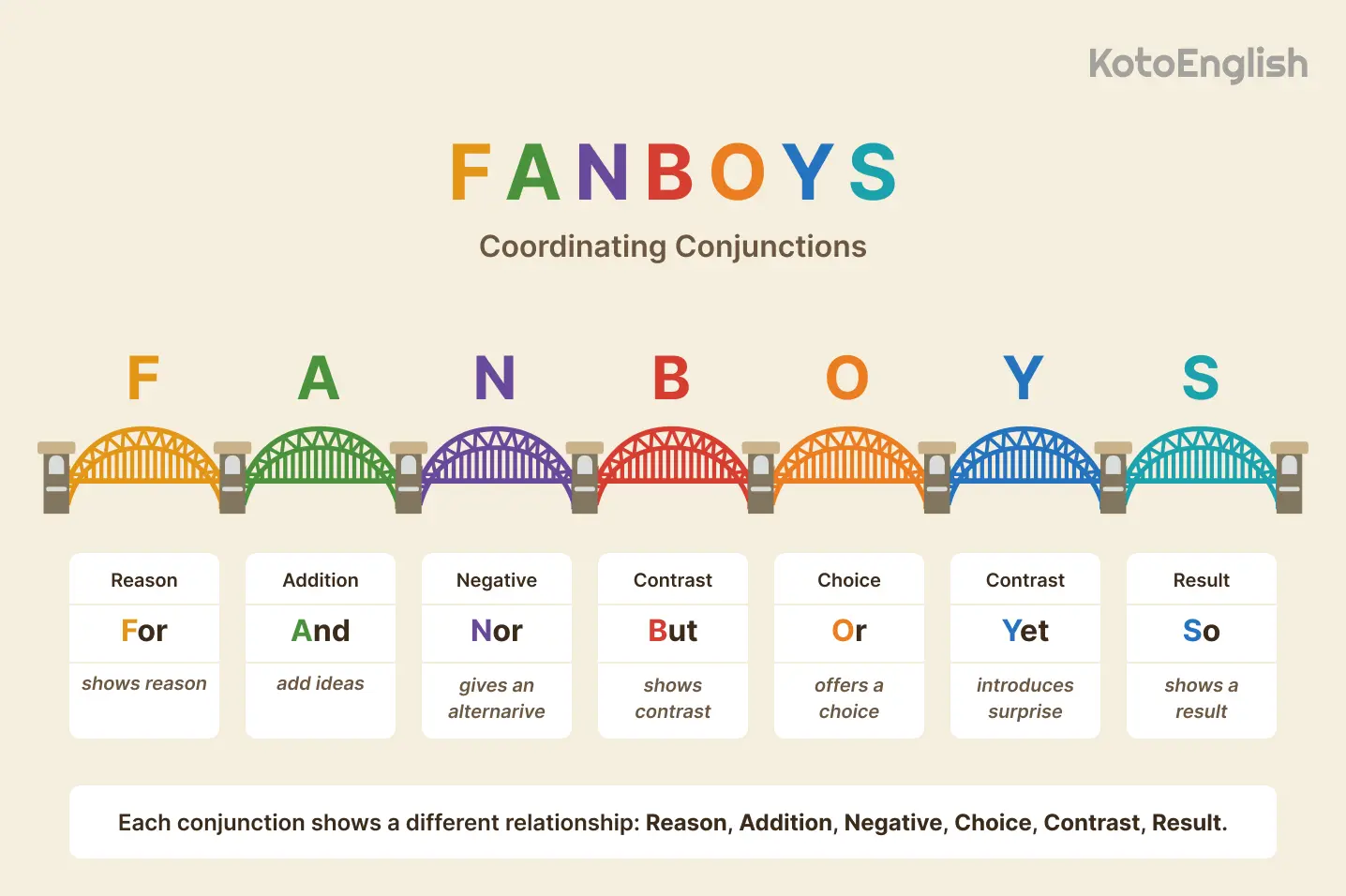
Coordinating conjunctions form the foundation of well-structured English sentences, linking words, phrases, or independent clauses of equal weight. A useful way to remember the most common ones is the acronym FANBOYS, with each letter representing a word that connects ideas in a specific way.
FANBOYS list
The seven coordinating conjunctions in FANBOYS are:
- F – For (shows reason or cause)
- A – And (adds one idea to another)
- N – Nor (presents a negative alternative)
- B – But (shows contrast)
- O – Or (offers a choice or alternative)
- Y – Yet (introduces contrast or unexpected outcome)
- S – So (indicates result or effect)
Each conjunction signals a specific relationship such as addition, contrast, choice, or result.
Common rules with conjunctions examples
- Use FANBOYS to join two independent clauses with a comma
When connecting full sentences, place a comma before the conjunction:
- No comma needed when connecting single words or short phrases
When linking simple elements, the sentence flows naturally without a pause:
- Express contrast, addition, or choice effectively
FANBOYS conjunctions let you show relationships between ideas clearly:
- Combine multiple ideas for variety and impact
Linking several clauses with coordinating conjunctions keeps sentences dynamic and engaging.
FANBOYS add rhythm and clarity to your sentences. They organize ideas so your writing communicates naturally and effectively.
Subordinating conjunctions
Subordinating conjunctions introduce dependent clauses, which are the parts of a sentence that cannot stand alone, and they link these clauses to the main clauses to create complex sentences. They show how ideas relate, indicating reason, time, contrast, or condition.
Subordinating conjunctions list
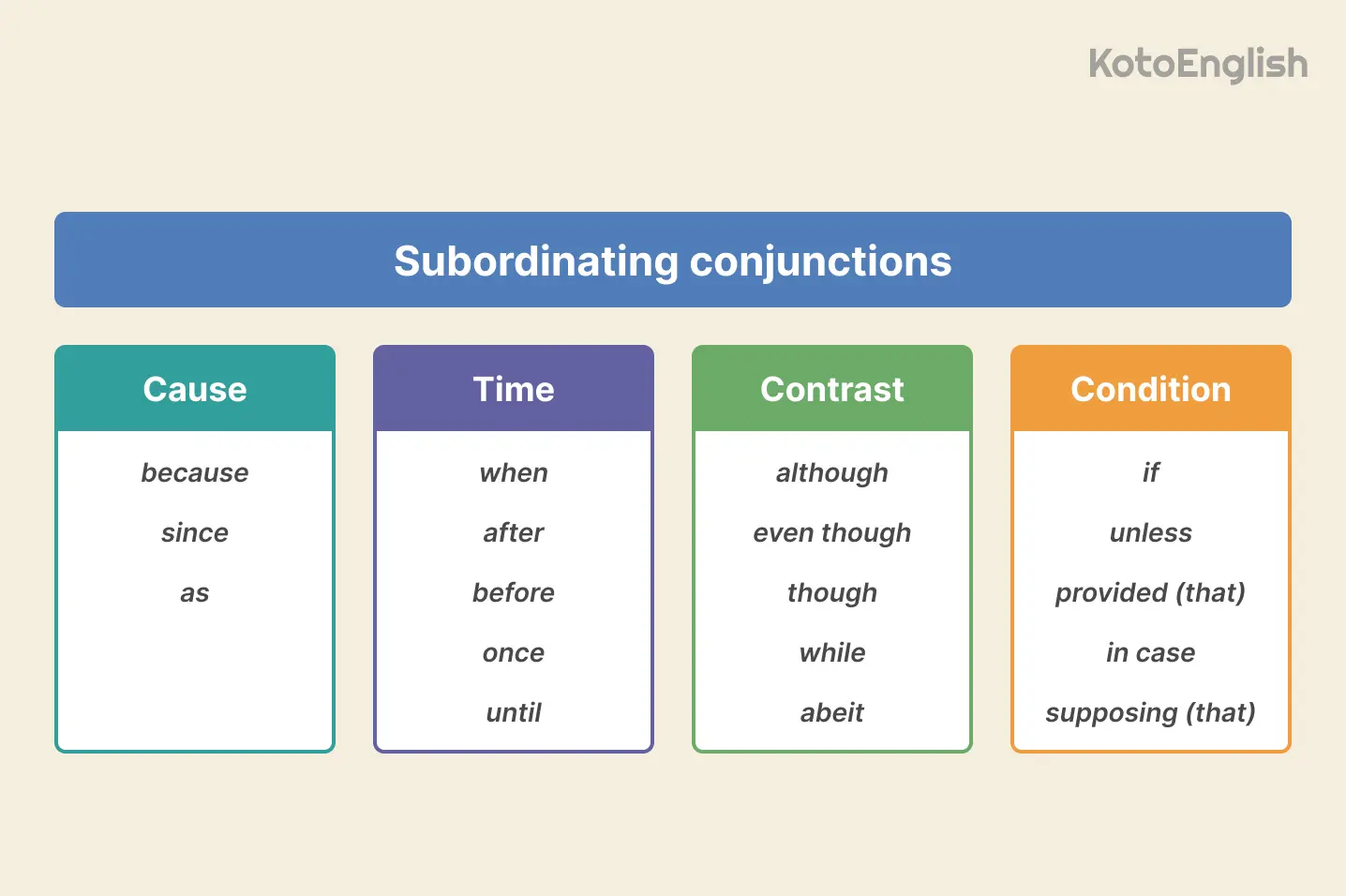
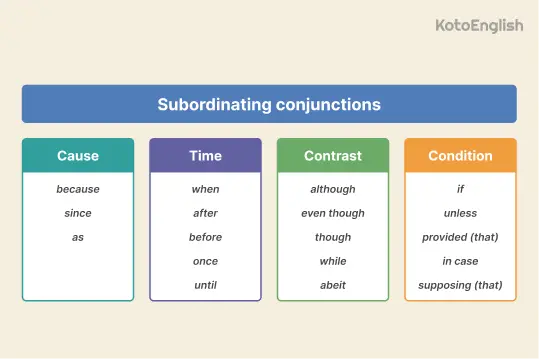
Dependent-linking words are grouped by the type of relationship they express:
Cause: because, since
Time: when, after, before
Contrast: although, even though
Condition: if, unless
These words help link ideas clearly and make complex sentences more engaging.
Position in a sentence
Subordinating conjunctions can appear at the beginning or in the middle of a sentence.
|
Beginning (comma needed) |
Middle (no comma) |
|---|---|
|
|
We stayed home
|
|
|
He finished the project
|
Starting the sentence with the conjunction calls attention to the dependent clause, whereas starting it in the middle focuses attention on the main action. Both methods are grammatically correct and can be used to vary the rhythm of the sentence.
Correlative сonjunctions
Correlative conjunctions are two-word combinations that function together as a single conjunction to join equal elements of a sentence. They are always used in pairs and help to connect ideas, words or clauses in a sentence smoothly and effectively.
Common pairs
The following are some of the most common pairs of correlative conjunctions:
|
Pair |
Example |
|---|---|
|
either…or |
|
|
neither…nor |
She likes
|
|
not only…but also |
She is
|
|
both…and |
He enjoys
|
|
whether…or |
I can’t decide
|
Paired words ensure ideas stay balanced and add rhythm to your sentences.
Usage rules with examples
Using such conjunctions correctly helps create clear and readable sentences. Follow these common and punctuation rules for conjunctions to synchronize your ideas.
Maintain parallel structure
Both parts of a paired word should be grammatically similar for clarity and rhythm.
Always use the pair together
Both connected pairs should be used together as a complete pair to link ideas effectively.
Connect balanced structures
The words, phrases, or clauses to be linked must be similar in structure:
Correlative conjunctions assist in checking that your sentences are precise, rhythmic and easy to read.
Common mistakes with conjunctions
Many people make mistakes in conjunctions because they use too many conjunctions of a particular type or violate the parallel structure. It is essential to identify these errors in order to make your writing more professional.
Overusing “and” or “but”
Using too many “and” or “but” conjunctions in your writing may make it seem repetitive or choppy.
|
I like coffee, and I like tea, and I like juice.
|
I like coffee, tea, and juice.
|
|
I wanted to go out, but it was raining, but I stayed home anyway.
|
I wanted to go out, but it was raining, so I stayed home.
|
Breaking parallel structure
Correlative conjunctions must have similar elements. Lack of parallelism will make the sentence structure awkward or wrong.
|
She likes both singing and to dance.
|
She likes both singing and dancing.
|
|
He is not only smart but also has courage.
|
He is not only smart but also courageous.
|
Mixing conjunction types
Blending coordinating, subordinating and correlative conjunctions may result in confusion or a sentence fragment.
|
I stayed home, because it was cold and.
|
I stayed home because it was cold.
|
|
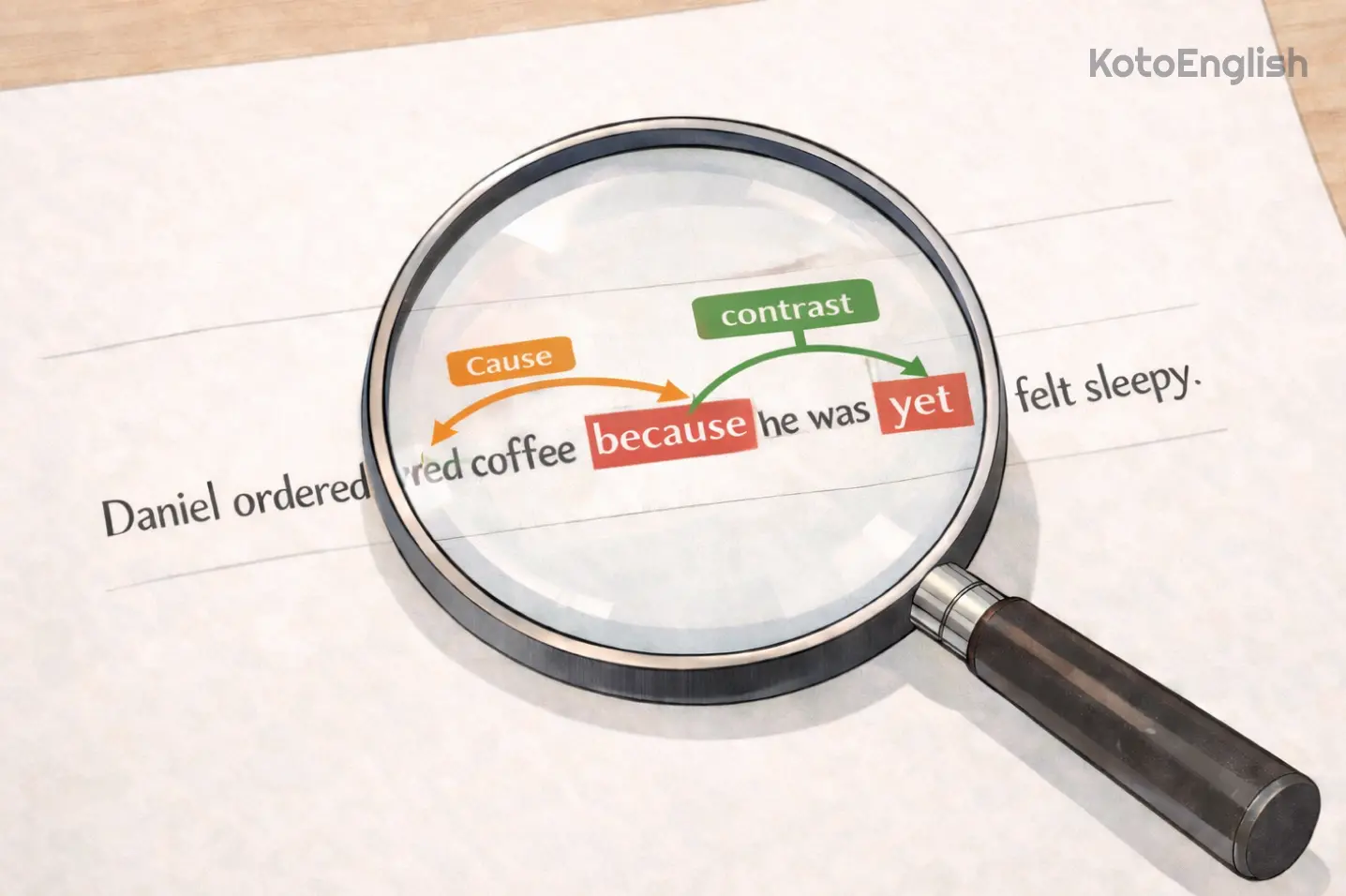
She wanted to go, yet because it was late.
|
She wanted to go, but it was late.
|
Tips to use conjunctions naturally
Strong command of conjunctions allows ideas to join seamlessly and sentences to remain clear. Follow these strategies to achieve this effect.
Tip 1: Read with focus
Observe how authors connect clauses and sentences. Pay attention to the links they convey and the range of conjunctions they employ.
Tip 2: Practice grouping ideas
Start organizing your thoughts into brief sentences in your head or on paper to see how various conjunctions let your ideas flow naturally together.
Tip 3: Vary your connectors
Employ a variety of coordinating, subordinating, and correlative conjunctions. Varying connectors makes your English writing interesting and prevents repetition.
Tip 4: Speak and write actively
Construct sentences orally or in writing, mentally focusing on which conjunction is most appropriate to connect your ideas.
Tip 5: Create your own exercises
Prepare short sentences or paragraphs using different conjunctions. Active practice enhances understanding and enables you to commit the correct usage to memory.
Practice: choose the correct conjunction
Try these exercises to work with coordinating, subordinating, and correlative forms and sharpen your sentence flow.
Final thoughts
Even the smallest words, such as conjunctions, can affect how ideas flow on the page. By understanding coordinating, subordinating, and correlative conjunctions, you can create sentences that flow smoothly and logically. Study English online and practice regularly, and soon connecting ideas will become second nature while your writing becomes more polished.
Frequently asked questions (FAQs)
The most common conjunctions include and, but, or, because, although, so, if, when, either…or and both…and. They appear frequently in speech and writing, signaling addition, contrast, cause, time, or choice.
Three categories of conjunctions exist:
- Coordinating conjunctions
- Subordinating conjunctions
- Correlative conjunctions
Each of these types has a different role in sentence construction.
The comma precedes a coordinating conjunction only when it is connecting two complete sentences. It is not needed when connecting individual words or short phrases. When using subordinating conjunctions, use a comma before the dependent clause if it is placed first, but not when it is placed after the independent clause.
FANBOYS is a mnemonic device that represents the seven coordinating conjunctions:
F – for
A – and
N – nor
B – but
O – or
Y – yet
S – so
This is a memory aid to assist students in recalling the most frequently used conjunctions to connect equal ideas in a sentence.