What are articles in English?
Articles are small words used with nouns and noun phrases. They serve as pointers, helping you introduce new information or refer to an item or a person that is already known.
Examples of English articles:

Types of articles in English
There are two types of articles, but we’ll also include cases where no article is used:
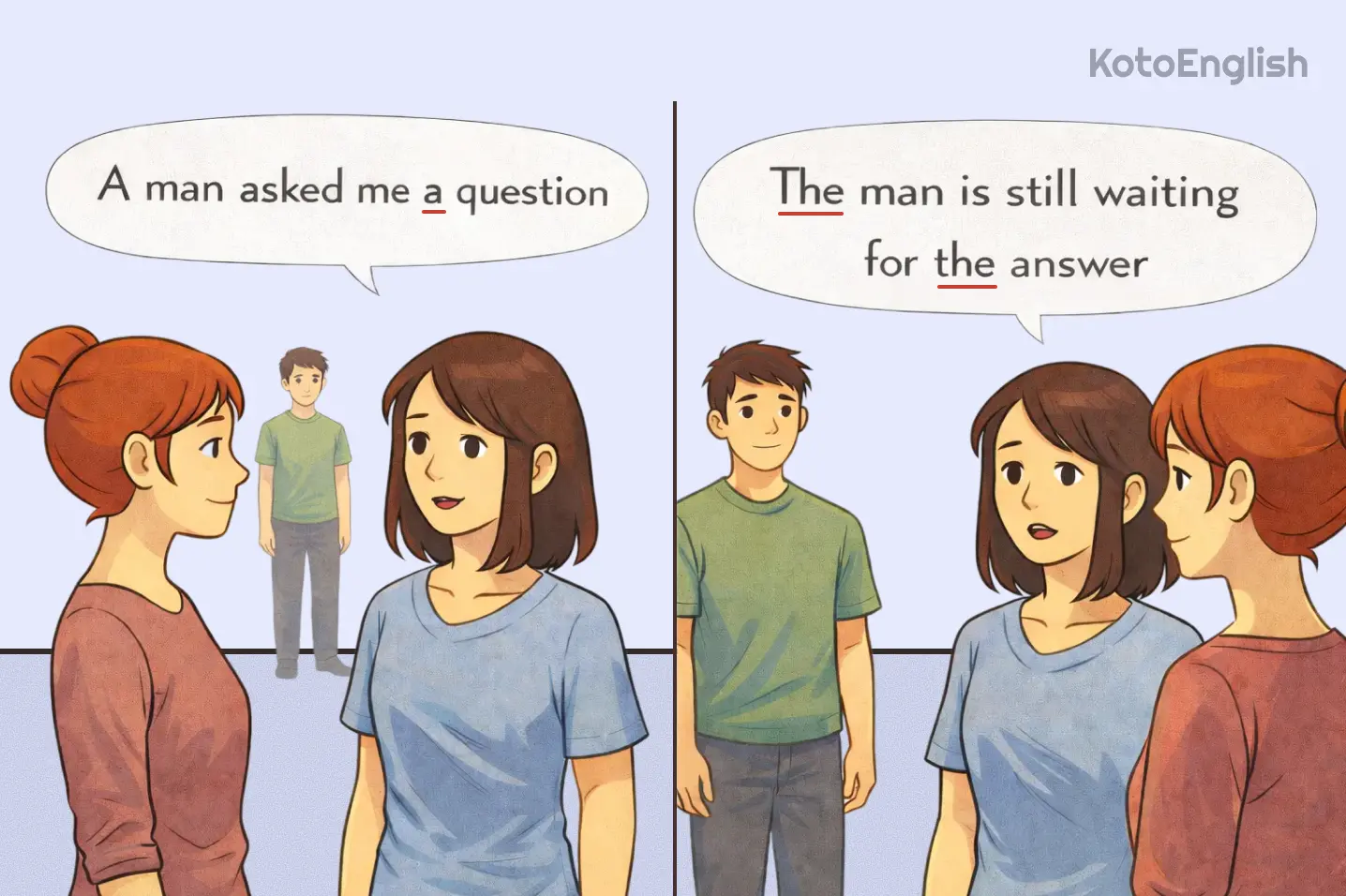
- Indefinite ( a , an ). Used to introduce something new.
- Definite ( the ). For unique and known things.
- Zero. For things in general.
Below, we’re going to explore each in detail.
How to use indefinite articles (a / an)
In terms of meaning, there is no difference between a and an; they serve the same purpose. When you see a or an coming before a noun, it means the object is one of many.
|
Article |
Placed before |
Example |
|---|---|---|
|
a |
consonant sound |
a car a store a house |
|
an |
vowel sound |
an animal an umbrella an airport |
Consider: the rule applies to the sound, not the letter, as some words starting with vowel letters need a ( a university , a uniform ). When a noun begins with a silent consonant letter, you use an if the next sound is a vowel sound ( an hour , an heir ).
How to use the definite article (the)
As the has only one form, there are no spelling rules when using it. What’s tricky is choosing the in the right context.
When we use the
You need to opt for the in these common scenarios:
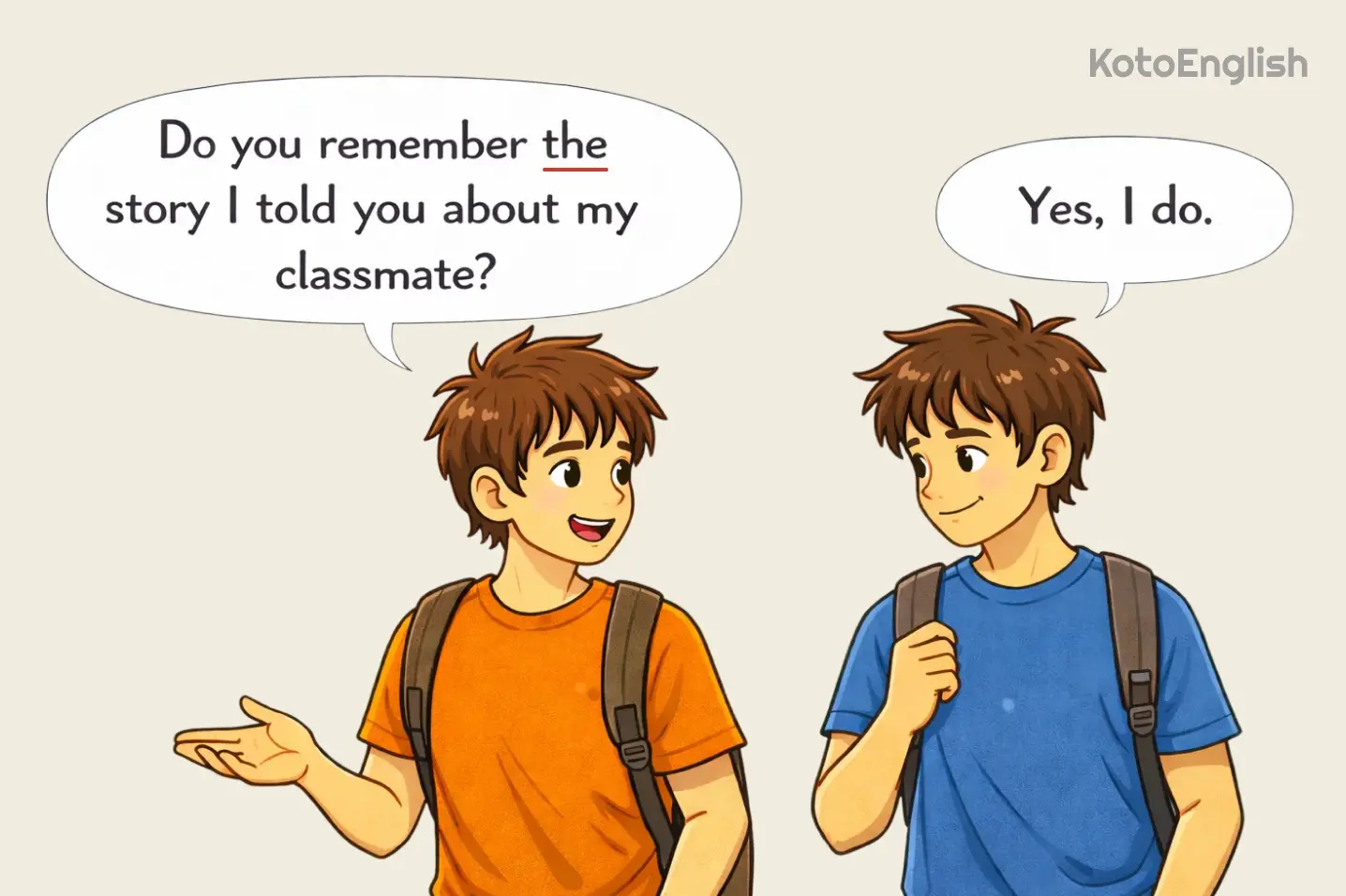
- The listener knows what you’re talking about.
Both people understand which door you mean.
- Something mentioned before.
Once you mention it, it becomes known information.
- Only one exists.
Unique items include the sun, the moon, the atmosphere, and the sky.
- With musical instruments.
The same applies to all the other instruments.
- With groups of people.
Using the definite article the with an adjective (the young, the unemployed, the injured, and the rich) allows you to refer to groups of people in the plural.
However, if you’re not sure whether your listener can tell which thing you’re referring to, use a or an instead. Ask yourself the following question: “Could my listener point to this exact thing right now?”
Using the with places and geography
Geographic names have fixed patterns, with name structure dictating it rather than the importance or size of the location.
|
Use the |
Examples |
How it looks in sentences |
|---|---|---|
|
Plural country names |
the Netherlands, the Philippines |
Will you visit
|
|
Rivers and oceans |
the Amazon, the Pacific Ocean |
I’d love to see
|
|
Mountain ranges |
the Alps, the Himalayas |
This isn’t a good season to go to
|
|
Deserts |
the Kalahari, the Mojave |
|
|
Famous buildings |
the White House, the Eiffel Tower |
I dream of seeing
|
At the same time, when talking about cities, continents, single mountains, individual lakes, and single islands, we don’t use any articles (London, Lake Victoria, Cyprus, Mount Everest, and Europe).
Countries whose names include a political term, such as the United States, the United Kingdom) use the, whereas single-word countries, like France or Brazil, do not.
Using the with superlatives and ordinals
When describing the extreme limit of something or someone in a group, like height (the tallest), price (the most expensive), probability (the least likely), and many other situations, you use the.
Examples:
When using ordinal numbers (first, second, twenty-third) and other words that indicate order (last, next, same, only), you identify its specific place in a series. As only one thing can be third or fifth, it becomes uniquely identifiable.
Example:


You don’t use any article with possessive pronouns:
How to use zero article (no article)
When discussing categories as a whole, articles are dropped. You typically use zero articles in these four situations:
- Abstract ideas.
Exception:
- Daily routines and activities.
Exception:
Exception:
- Languages and academic subjects.
Exception:
A quick test: if you can add “in general” to a noun and your message still makes sense, don’t use any articles. Look at this example:
A vs the: what’s the difference?
Learners are typically confused about when to use a, an, and the, as the grammar rules for using articles include many patterns.
Here is a table that can help you spot the differences between them and choose one quickly when you write or speak:
|
Feature |
A / an |
The |
|---|---|---|
|
Meaning |
One, non-specific |
Specific or identifiable |
|
Information status |
New information |
Known or already mentioned |
|
Quantity |
One of many |
The particular one or ones (used with all types of nouns) |
|
Uniqueness |
Not unique |
Unique or contextually clear |
Example:
Try this replacement test: change a / an to one, and the to this specific. If your sentence still works, you have chosen correctly.
Common mistakes with English articles
Before you fully grasp the article rules in English, you’ll make many mistakes. It’s unavoidable, as articles appear in almost every sentence you write and say.
Omitting articles
A singular countable noun can’t stand alone in a sentence; it almost always needs an article.
|
Could you give me cup of coffee?
|
Could you give me a cup of coffee?
|
|
Where is T-shirt I gave you on Friday?
|
Where is the T-shirt I gave you on Friday?
|
Overusing the
It’s common to use the in sentences where it doesn’t belong, especially when you are new to the rules or unsure what the listener understands.
|
The medicine shouldn’t be expensive.
|
Medicine shouldn’t be expensive.
|
|
The good information can save time.
|
Good information can save time.
|
Using articles with proper nouns
Names, surnames, songs, films, titles of books, holidays, brands and other proper nouns are typically not used with articles.
|
The Paris was wonderful.
|
Paris was wonderful.
|
|
The Nina helped me a lot.
|
Nina helped me a lot.
|
Using a / an with plural nouns
A and an literally mean one, which is why they can’t be paired with plural nouns.
|
A people need water to live.
|
People need water to live.
|
|
The planetarium is looking for an administrators.
|
The planetarium is looking for administrators.
|
Tips to learn articles faster
When learning articles, don’t try to memorize them all at once. Move on step by step: learn rules, spot the differences, and study patterns.
This structural plan will help you grasp fundamentals about using articles and improve over time.
Tip 1: Complete many exercises
Below, you will find a test that features activities for checking your understanding of articles. After finishing it, continue exploring drills, as they help you work on different aspects that are not covered in theory. You can study English online using the Koto app to find other tests.
Tip 2: Pay attention when reading
When you read other grammar rules, like demonstrative pronouns, and short text, keep the article topic in mind and revise for them as well, to check whether you understand why the writer used a, an, or the in a particular sentence.
Tip 3: Try to identify patterns
Articles follow some patterns very accurately. When you hear it in a song or short video — or see it in a text — try to relate it to a specific category. You’ll need to do it at first, but with practice, you’ll be able to choose the word quickly.
Tip 4: Create your own examples
For each case, write at least ten sentences with an article. With a, think of random things you would want: a car, a house, a star from the sky. When practicing the, consider items you and your best friend wouldn’t confuse.

Practice: choose the correct article
Articles have more exceptions than the Present Simple, so mastering them requires investing a lot of time in practicing with exercises. Below, you’ll find the test that covers different types of drills, helping you to choose the correct option at first and type your own answer at the end.
As zero articles are just blank spaces, when you need to write one, simply input a hyphen (-).
Final thoughts
It takes time to learn articles, but the patterns will become second nature with practice. Focus on one rule at a time and observe how native speakers use articles in context, without worrying about making occasional mistakes.
Frequently asked questions (FAQs)
No. Sentences without articles appear constantly, as in these examples:
You need to remember that zero article dominates when discussing categories as a whole rather than individuals.
Everything depends on sound, not spelling. When a word starts with a consonant sound (not letter), you use a. On the contrary, when it begins with a vowel sound, you use an. This rule exists only to simplify pronunciation.
Abstract, collective terms, plural generics, and routine activities all need no articles because they express broad concepts. Such words as kindness, freedom, and advice refer to a quality that cannot be divided into separate units.
Yes, both groups of nouns need articles when you refer to something specific. For example: