What is the Past Perfect Continuous tense?
The Past Perfect Continuous, alternatively called Past Perfect Progressive, is an advanced tense used to describe actions that were ongoing in the past and completed before another past event.
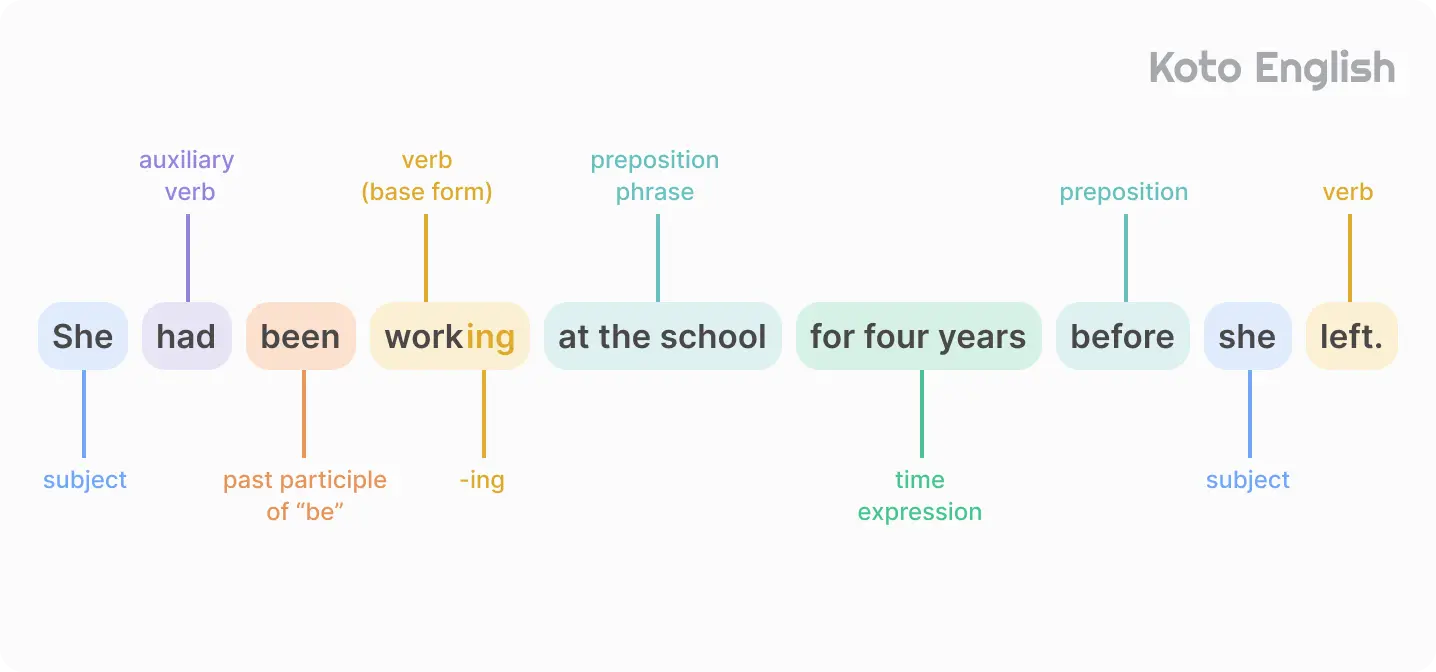
Let’s go through its usage step by step and find out how intuitive it is.
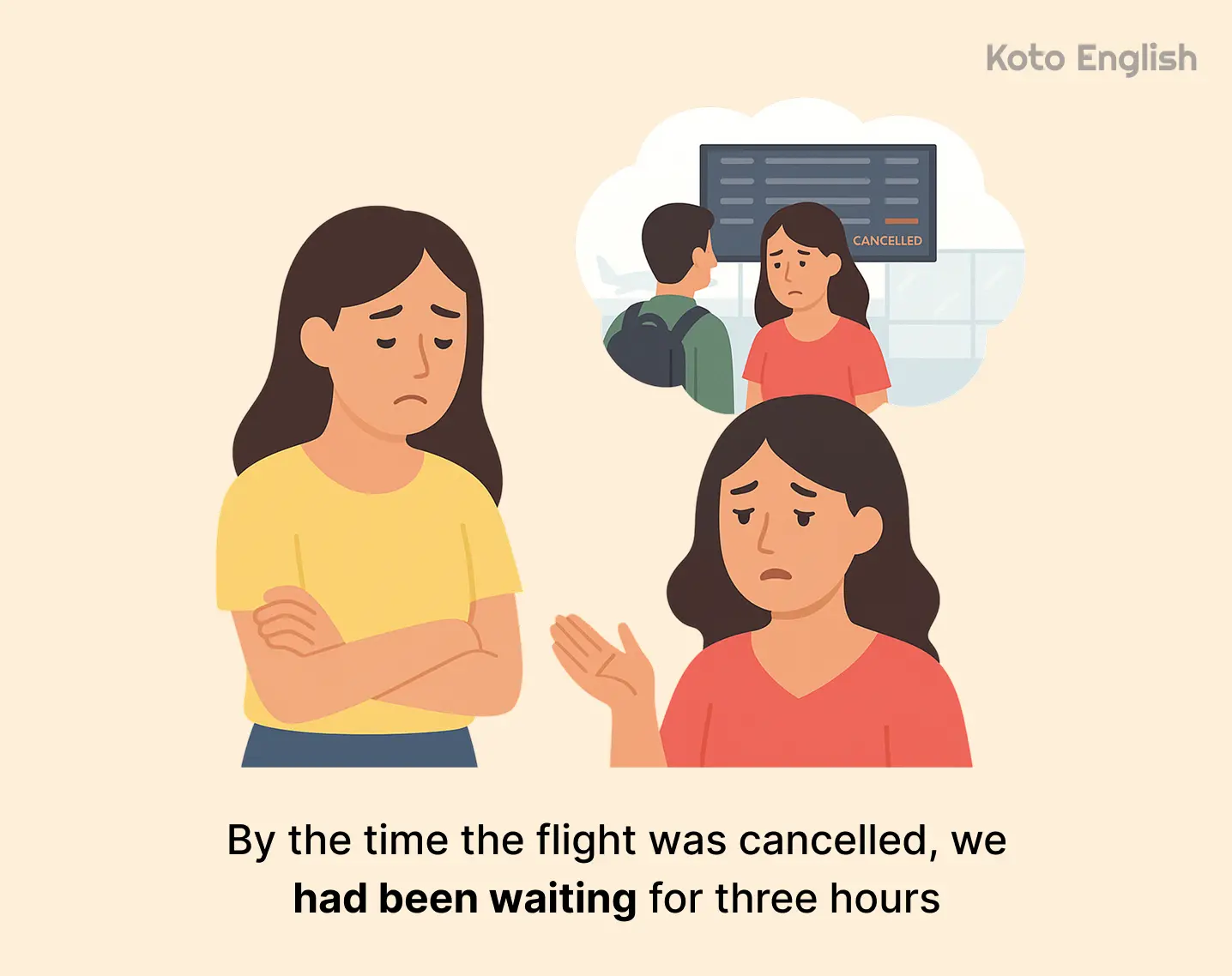
Past Perfect Continuous tense examples:
Level up your English with Koto!
Past Perfect Continuous tense formula
The structure of a sentence in the Past Perfect Continuous tense is formed by had been + a verb with –ing ending. Let’s unfold the meaning of each bit:
| Particle of the formula | Function | Examples |
|---|---|---|
| Had | The same form is used with each subject pronoun, whether it is she, I, or we. |
|
| Been | The third (past participle) form of the word to be that appears in each sentence, whether it is positive, negative, or a question. It connects the tense marker to the action. |
I
They
|
| Verb+ing | The main verb is in its continuous form, emphasizing the ongoing nature of a sentence. |
His colleagues had been
My sister had been
Her friends had been
|
The examples here are zoomed in to focus on the structure. The whole construction always requires a context.
When to use the Past Perfect Continuous in English?
The Past Perfect Progressive helps you to describe the situation or action that happened in the past and continued until another moment in the past, or an action that showed results in the past.
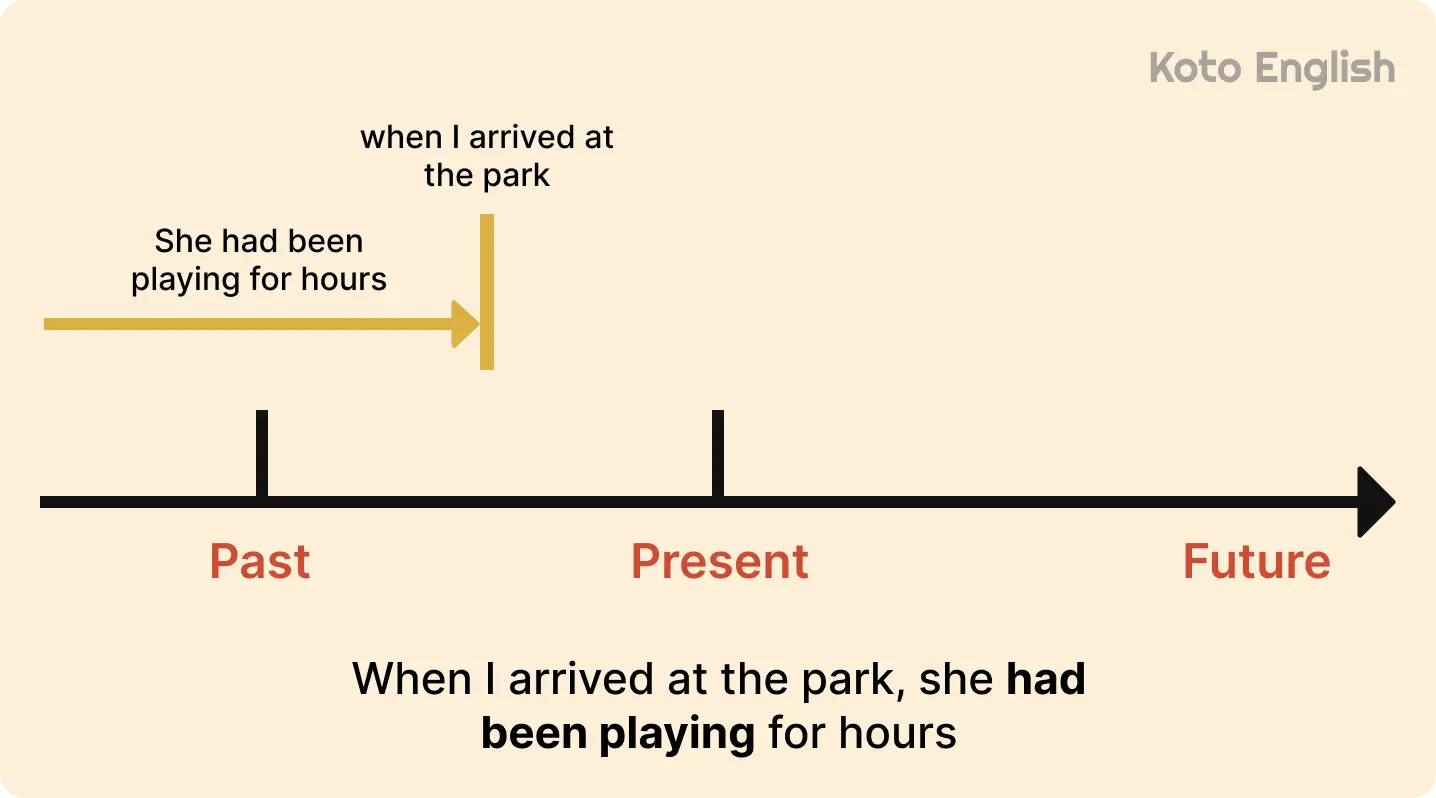
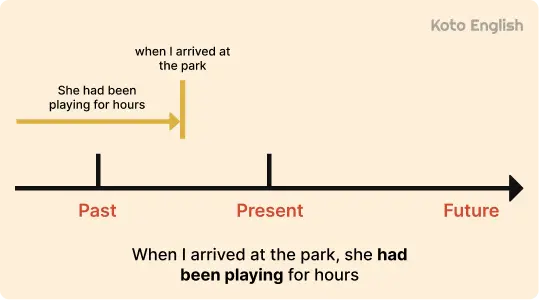
Examples of Past Perfect Continuous tense usage:
| Usage | Examples |
|---|---|
| Actions that were ongoing before another past event |
I
|
| Cause-and-effect sentences |
She
|
| One action was interrupted by another in the past, with the focus on duration |
I
|
| Pointing habits or lasting actions in the past |
They
|
Past Perfect Continuous tense markers include:
| Time indicators | Examples |
|---|---|
| for |
She
|
| since |
He
|
| all day |
I
|
| by the time |
They
|
| before |
We
|
| until |
She
|
The Past Perfect Continuous tense sentences with until can be used in various situations. For example, it shows the endpoint.
To help you determine which time marker to use in a given context, we have highlighted the most common matches and emphasized their specific use:
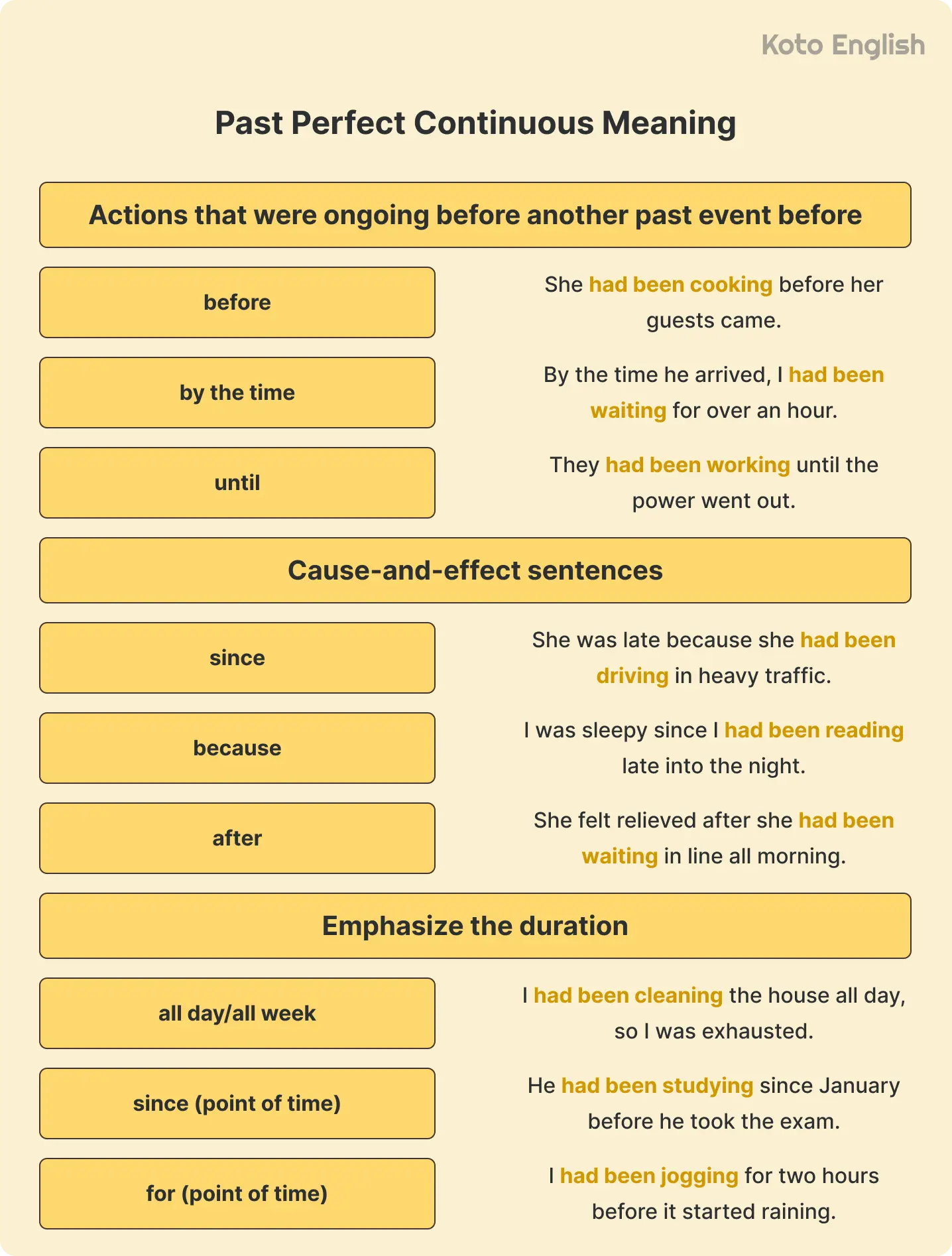
How to use this tense?
Here is a breakdown of Past Perfect Continuous tense rules that will help you learn English more productively. It will introduce ways of forming positive sentences, questions, including WH-variations and Yes/No interrogations, as well as negatives.
Affirmative sentences
To form a positive sentence, use

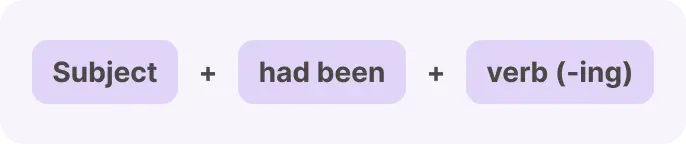
Let’s review how such examples of Past Perfect Continuous are formed according to full and short (more conversational):
| Subject | Full form | Short form |
|---|---|---|
| I |
I was tired because I
|
I was tired because I
|
| You |
You
|
You
|
| He/she/it |
It didn’t matter that he
|
It didn’t matter that he
|
| We |
We were upset because he
|
We were upset because he
|
| They |
They
|
They
|
| You (plural) |
You
|
You
|
Negative sentences
Speaking about something that has not truly happened, you need to use the Past Perfect Continuous formula, where you place not after had, and add been or use the short form hadn’t been for casual communication.

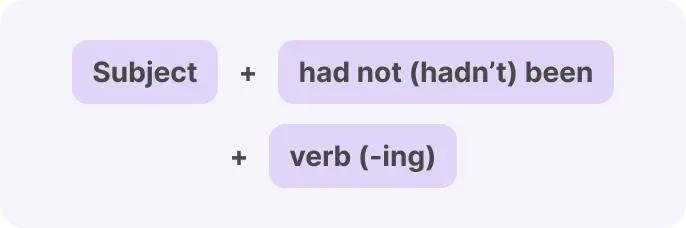
Let’s take a look at the Past Perfect continuous tense usage across negative sentences from real-life situations for more experience:
| Full form | Short form |
|---|---|
|
He
|
He
|
|
She
|
She
|
|
The cat
|
The cat
|
|
I
|
I
|
|
He
|
He
|
|
They
|
They
|
Questions
Here, you put had or had not (hadn’t) at the beginning of your sentence, add the subject + been and the verb with -ing form.

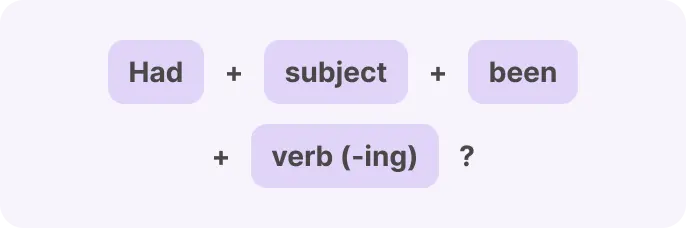
Yes/No questions
Let’s review some Past Perfect Continuous examples:
| Question | Answer |
|---|---|
|
|
Yes, I
|
|
|
Yes, he
|
|
|
No, she
|
Wh-questions

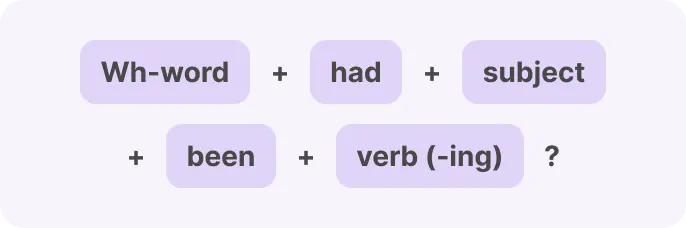
Examples of Wh-word questions:
| Question | Answer |
|---|---|
|
|
I
|
|
|
I
|
|
|
She
|
Enjoy personalized learning!
Common mistakes
The Past Perfect Continuous tense definition is not the easiest, so making mistakes is OK even for advanced learners. Still, you can avoid them if you know the most challenging areas of this grammar.
Confusing Past Perfect Continuous structure with Past Continuous
Past Perfect Progressive needs the phrasal adverbs that highlight the duration, which you can find in the section Where to use, in the time expressions table.
|
I had been reading her report when my boss called me from the office. |
I was reading her report when my boss called me from the office. |
|
He had been buying stuff online at 12 a.m. last night. |
He was buying stuff online at 12 a.m. last night. |
Remember to check for a clear time marker in sentences.
Misplacing time markers
Some people use since, for, until, and others in the wrong contexts. Here are some sentences.
|
We had been waiting since 6 hours before you drove here! |
We had been waiting for 6 hours before you drove here! |
|
She had been learning how to play a guitar for 2009 before she joined the band. |
She had been learning how to play a guitar since 2009 before she joined the band. |
Tips for mastering
Past Perfect Progressive is not as common as simple tenses, and has a more advanced structure. Don’t worry, though, because below you will find a brief list of points that will allow you to hack this grammar and use it naturally when passing international exams:
Write sentences with positive, negative, and question forms in equal proportion to ensure that you are able to recall each of them when you need to, and also dedicate enough time to nuances in the section Where to use…) to understand each nuance of this tense.
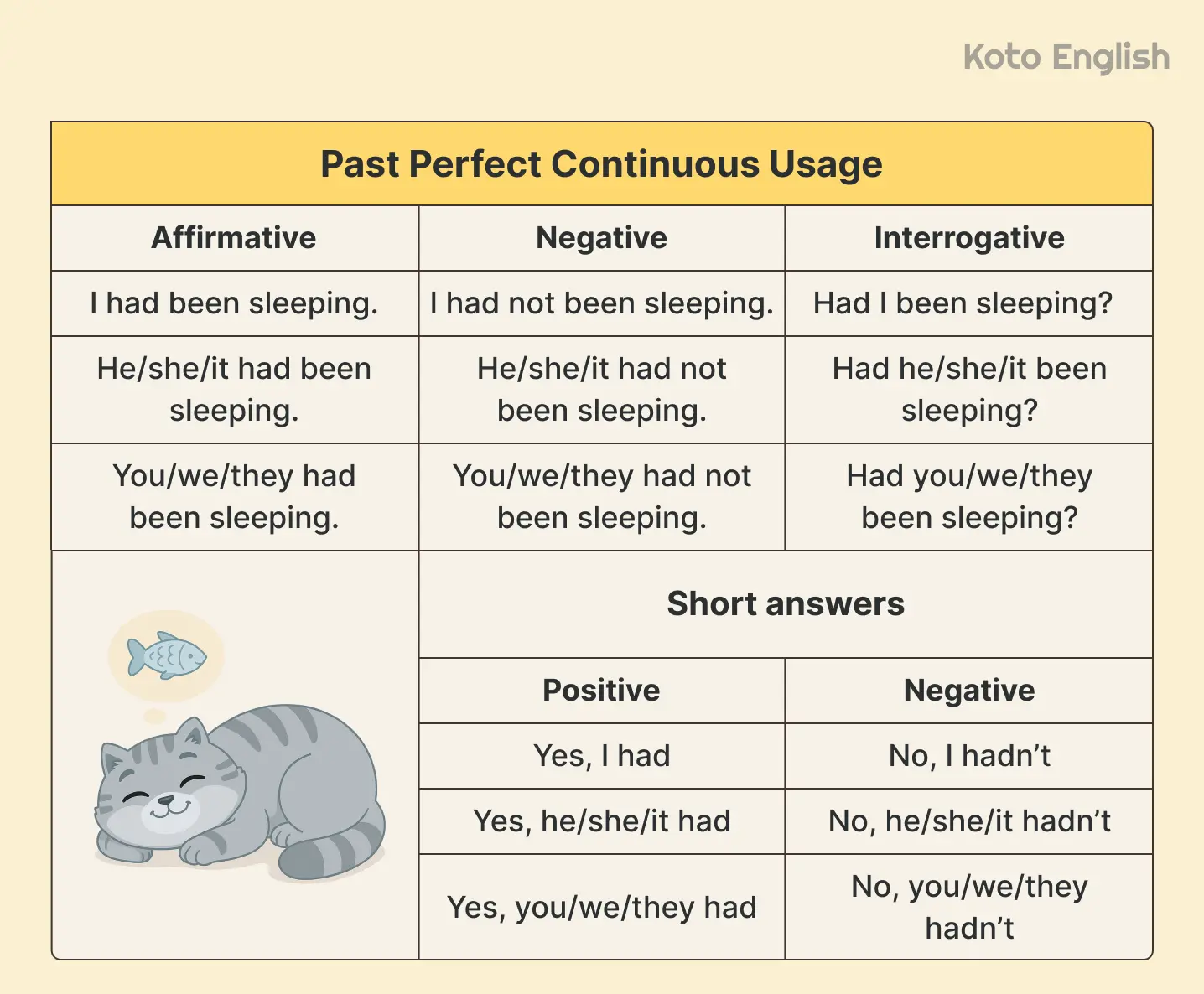
Take a pen and a notebook and write the most vivid descriptions with multiple details, taking into account the cause and effect of things and the durability of actions in the past that influenced your characters’ lives. A personal touch will allow you to experience the rules and learn all the tenses in English grammar.
Think of what you had been doing before a specific period of time in the past, or what you had been creating for several hours by the time something happened. In our guide, you have seen various examples with time indicators. They are a great base to make your own sentences.
Movies and videos are fine, but a really fascinating resource where you can encounter countless structures with the tense is books. Consider rereading Twilight, The Hunger Games, and The Fourth Wing in English, but focus on the formulas, contexts, and the frequency of the Past Perfect Continuous tense occurrence on pages.
Interactive drills, such as those found on the Koto English platform, will help you quickly pass a test to determine whether you have grasped the topic or need to go over some aspects again with more attention.
Summary
For now, you know all the details about the Past Perfect Continuous and can improve your writing regarding describing tiny time aspects that mean a lot for an interesting story. Continue polishing your skills and move on to comparing particulars of different tenses’ usage.
Past Perfect Continuous tense FAQ
Absolutely, you can. These expressions are frequently used when you want to emphasize that you had been doing something for all day or for hours by the time something occurred.
| Time marker | Examples |
|---|---|
| All day |
Our company
|
| For hours |
I
|
It depends. Since stative verbs can’t usually take the -ing form, it’s better to choose the Present Perfect when describing something you hate, love, know, or believe. For example:
|
I had not been understanding him since high school.
|
I had not understood him since high school.
|
Still, some of these verbs can be used in the -ing form if they indicate the action, such as:
Past Continuous describes the action that was ongoing at a specific time in the past (6 p.m., 7 a.m., in the morning) as well as simultaneous and interrupted actions.
While Past Perfect Progressive is used to stress the duration of an action (all day, two weeks, five hours) before something else happened.
Both tenses are used with time expressions, such as for, since, all day, and the difference is in the time aspect. Present Perfect Progressive is used to highlight that something has been ongoing up until now: We
For the Past Perfect Continuous tense, the defining factor is that the ongoing action ended before some point in the past: Our team
The tense is quite often used in daily dialogues by native speakers when it comes to:
- Explaining the reason for something that happened in the past.
They were tired because they
- Emphasizing the duration of something before a past event.
We