What are reciprocal pronouns?
In simple terms, the reciprocal pronouns definition refers to English pronouns that describe a situation in which two or more people perform actions toward one another. The two of them are:
- each other
- one another
Both express shared actions, reactions, or feelings, making sentences feel balanced and natural.
Each other
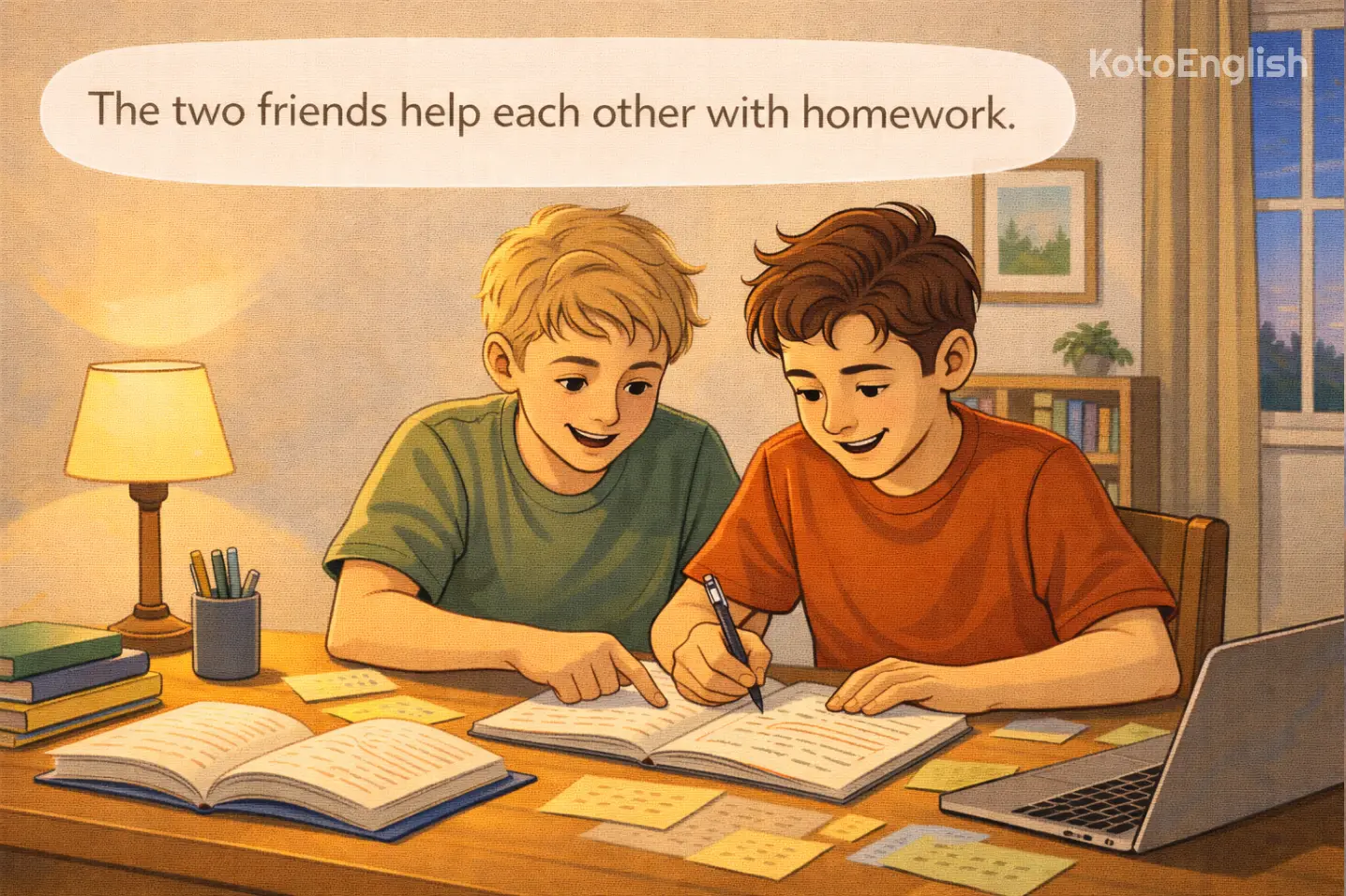
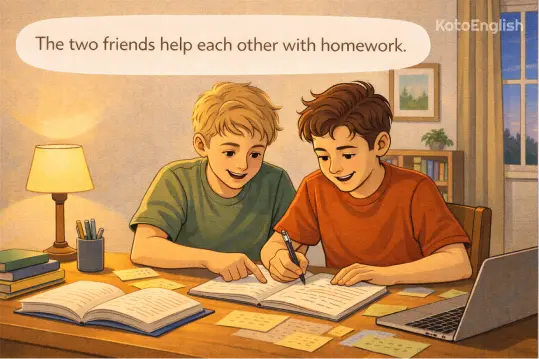
Each other form indicates an equal involvement by both parties, with the activity reciprocally flowing from one party to the other.
The term each other is mostly employed where there are only two individuals or objects under discussion.
One another
“One another” is generally used when talking about three or more people or objects. It gives the idea that everybody is participating in the reciprocal activity.
Reciprocal pronouns’ meaning becomes clearer when the two forms are set apart. “Each other” traditionally applies to two individuals, while “one another” reaches further — it refers to an interaction that radiates from a larger group rather than being restricted to just two individuals, like ripples in a lake.
In the spoken form of the English language, there is no clear difference made between “each other” and “one another,” and most speakers move between them without hesitation.
Use each other for two. Use one another for three or more.
Each other vs one another: Is there a real difference?
On first look, “each other” and “one another” might appear the same. After all, they both talk about mutual activities. However, you should be aware of an old difference between “each other” and “one another.”
|
Feature |
Each other |
One another |
|---|---|---|
|
Number of participants |
Two people/things |
Three or more |
|
Typical usage |
More common in everyday use |
Slightly more formal tone |
|
Meaning |
Mutual action |
Mutual action |
Having such a rule will help you organize your writing effectively, particularly when it comes to conveying ideas clearly and precisely.
However, in contemporary English, the strict rule mentioned above might become a bit relaxed. For instance, native English speakers might not always consider these terms completely separate and might freely switch between them.


Whether or not this distinction makes any difference at all ultimately depends on the context and intended application. In formal writing and discourse, adherence to the established norm may contribute an extra bit of finesse and elegance.
It demonstrates meticulousness in the sense of careful alignment of margins in the printed text. When using language on an informal level, however, the distinction becomes somewhat irrelevant since what really counts is how it works in practice and sounds.
In other words, it would be better viewed from the perspective of style than grammar. One may tune the degree of precision up or down depending on necessity. Language, in fact, should be seen not as a set of laws but as the environment that people freely inhabit and adjust according to need.
How to use reciprocal pronouns correctly
Reciprocal pronoun examples illustrate just how precisely these words operate. Although small, they carry real grammatical weight — they do not roam freely but adhere to specific English grammar rules when functioning as objects or possessives. Here is how reciprocal pronouns function within sentences.
Using it as an object
Reciprocal pronouns act as objects, not subjects, so they receive the action in a sentence. Unlike singular nouns, they never refer to just one person and instead express a shared action between participants.
|
Structure Type |
Example Sentence |
|---|---|
|
After a verb |
The players congratulated
|
|
After a preposition |
The team shared ideas with
|
If you try to use them as subjects, the sentence falls apart a bit:


Think of reciprocal pronouns as mirrors, they reflect actions back and forth, but they don’t initiate them
Possessive form: each other’s and one another’s
Reciprocal pronouns can also show possession. This is done by adding ’s to the end:
- each other’s
- one another’s
This form is used when something belongs mutually to the people involved.
|
Structure |
Example Sentence |
|---|---|
|
Each other’s + noun |
The twins finished
|
|
One another’s + noun |
They admired
|
Even when used as an object, the same concept of reciprocity exists; however, there is added a sense of ownership. Used correctly, reciprocal pronouns create harmony in a sentence.
Reciprocal vs reflexive pronouns
Reciprocal and reflexive pronouns might appear to be very alike at first, but in fact, they differ in the direction of their actions. Reciprocal pronouns establish a mutual relationship between people based on their actions, whereas reflexive pronouns reverse an action onto oneself.
|
Feature |
Reciprocal pronouns |
Reflexive pronouns |
|---|---|---|
|
Basic idea |
Shared action between people |
Action returns to the subject |
|
Common forms |
each other, one another |
myself, yourself, himself, herself, etc. |
|
Who is involved |
Two or more participants |
One person (same subject and object) |
|
Action direction |
Back and forth |
Inward |
Using the wrong type doesn’t just sound off, it can quietly change your meaning.
- They prepared
themselves . → individual effort - They prepared
each other . → mutual support
That tiny shift changes everything. One implies individuality; the other, teamwork.
Forget memorization of guidelines; concentrate on the connection between subject and verb:
- When people are acting together, employ the reciprocal pronoun.
- When an individual is performing some action on himself, apply the reflexive pronoun.
It really depends on how you look at it. The first involves people doing things to each other; the second, a person doing something to themselves. This can help us understand reciprocal pronouns sentences better.
Common mistakes to avoid
Reciprocal pronouns seem easy enough, but you’ll likely be tripped up by these seemingly minor errors. They are most often caused when people try to use English in a more idiomatic manner and fail to understand how these pronouns function grammatically. Here’s a list of the most common errors that learners make with reciprocal pronouns.
- Using reciprocal pronouns as a subject
Using each other or one another as a subject can be tricky for students of English.
|
Each other are good friends.
|
They are good friends.
|
|
One another helped a lot.
|
They helped one another.
|
Reciprocal pronouns need a subject to anchor them. Without it, the sentence has no clear starting point.
- Confusing with “us” or “them”
Another common mix-up happens when learners use us or them instead of a reciprocal pronoun.
|
We love us.
|
We love each other.
|
|
They understand them.
|
They understand one another.
|
Words like us and them point to people, but they don’t show interaction between them. Reciprocal pronouns carry that mutual meaning.
- Incorrect possessive form
The possessive form (‘s) can feel awkward, so it’s easy to get the structure wrong.
|
each others ideas.
|
each other’s ideas.
|
|
one anothers opinions.
|
one another’s opinions.
|
The important point here is the placement of the apostrophe +s at the end of the entire phrase, not only after one word.
The majority of these problems arise when you try to make a complicated sentence easier or “better.” The important thing to understand about reciprocal pronouns is that it’s all about the relationship.
Conclusion
Despite their diminutive size, reciprocal pronouns play a crucial role in influencing the way relationships are described in your sentences. After getting familiar with identifying actions that occur reciprocally, the process of using either each other or one another comes effortlessly.
Pay close attention to structure carefully, avoid mistakes, and think about where the action is going. With all these in mind, you will be able to write great sentences.
FAQ
No, reciprocal pronouns cannot function as the subject. They are used as objects, meaning they receive the action. A subject must always come first.
Not necessarily. Traditionally, each other is used for two participants, while one another is used for three or more. However, in modern English, this distinction is often relaxed, and both forms are commonly used interchangeably without causing confusion.
“Talk to each other” shows a mutual action between people. In contrast, “talk to themselves” means each person is speaking to their own self, not interacting with others.
- They talked to
each other . → conversation between people - They talked to
themselves . → each person spoke alone