
What is the Past Perfect tense?
The Past Perfect is used to talk about actions that happened before certain events in the past. Instead of emphasizing the chronological order of events, this tense’s main focus is on showing that something occurred before an event.
It is widely used in narrative writing, describing experiences and reasons.
Let’s tap into its usage to break it down:
Past Perfect tense examples:
Level up your English with Koto!
Past Perfect tense formula
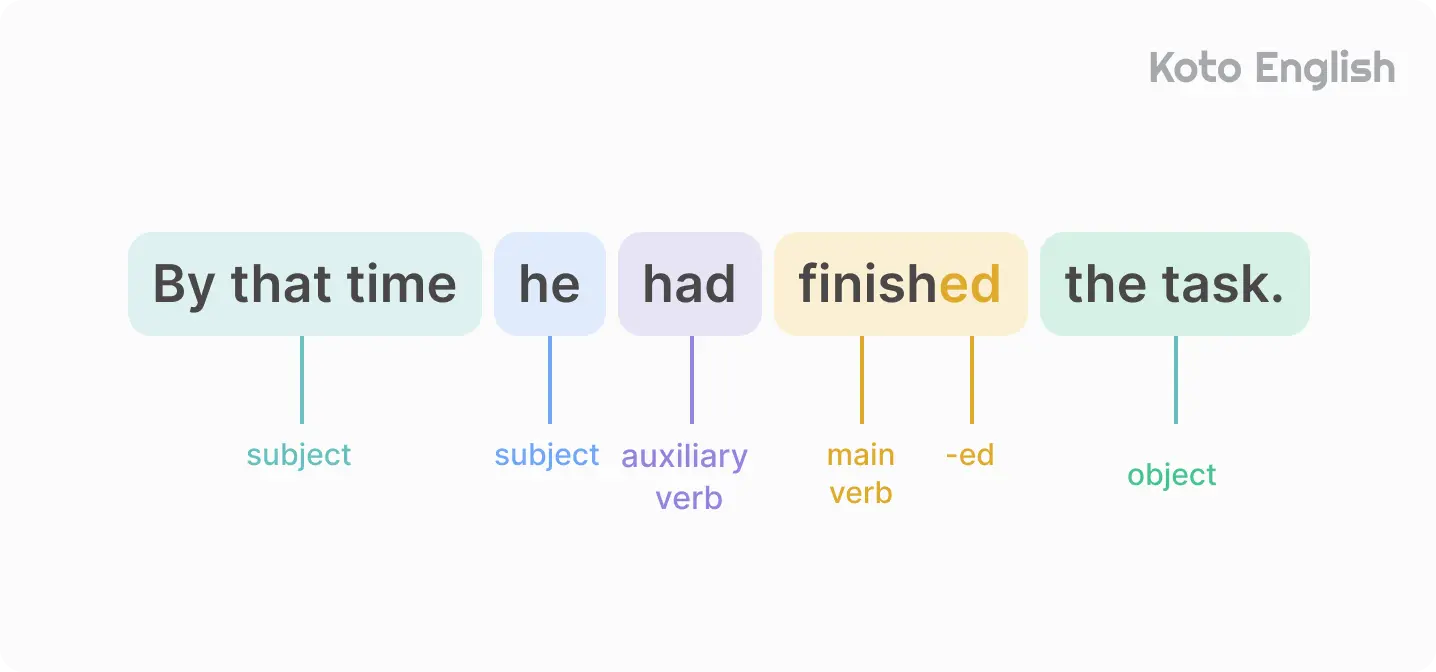
To form Past Perfect tense sentences, you need to follow a rather complex structure that includes the subject, auxiliary verb — had , the main verb in the past participle with the -ed ending if it is regular, and the 3rd column if the verb is irregular.
You can always turn to a dictionary to check the irregular verbs’ form, but memorizing them will help you communicate freely.

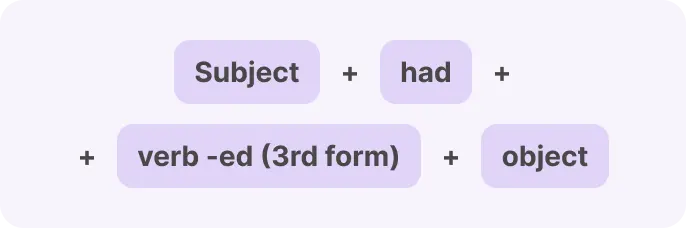
Look at the examples of Past Perfect tense in full and contracted forms:
| Subject | Full form | Short form |
|---|---|---|
| I |
When they called me, I
|
When they called me, I
|
| You |
You started to follow a balanced diet after you
|
You started to follow a balanced diet after you
|
| He/She/It |
By the time he took a connecting flight, he
|
By the time he took a connecting flight, he
|
| We |
Once we
|
Once we
|
| They |
They cut down on caffeine after they
|
They cut down on caffeine after they
|
| You (plural) |
You
|
You
|
Be mindful of the similar forms. The contraction ‘d is used not only in the Past Perfect but also with would. Remember: if the word after ‘d goes in the past participle form or with -ed ending, it is the Past Perfect. If it is followed by the base form, it is a structure with would.
When do we use the Past Perfect?
The Past Perfect allows us to express more complex ideas than simple tenses. Using this tense, we specify what happened first and what caused certain consequences, tell about our past experiences, and speak of the longevity of particular events.
The Past Perfect tense usage instances:
| Time indicators | Examples |
|---|---|
| before |
Helen
|
| after |
The author reviewed her notes
|
| by the time |
|
| just |
The company
|
| for/since |
We
|
| already |
We
|
Sometimes the Past Perfect tense is compared to the Present Perfect, but with the difference that we use the Past Perfect to speak about things that had already happened or just happened before some event in the past.
How to use the Past Perfect tense?
We have already outlined the Past Perfect definition and the ways of forming positive sentences. Below, you will find an explanation of how to create negative and question ones.
Past Perfect questions
Speaking of questions, we will discuss two main variations: yes/no and wh-questions. The structure of the interrogative sentence is almost the same as the positive, as you will see when you look at the table with the Past Perfect example. The one thing you have to do is to swap the subject and the auxiliary verb places.
Yes/No questions

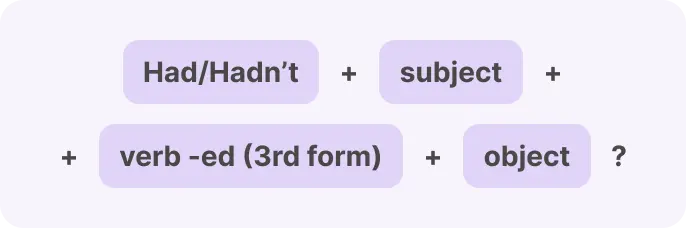
Take a look at some instances:
| Question | Answer |
|---|---|
|
|
No, I
|
|
|
Yes, I
|
|
|
Yes, she
|
Wh-questions

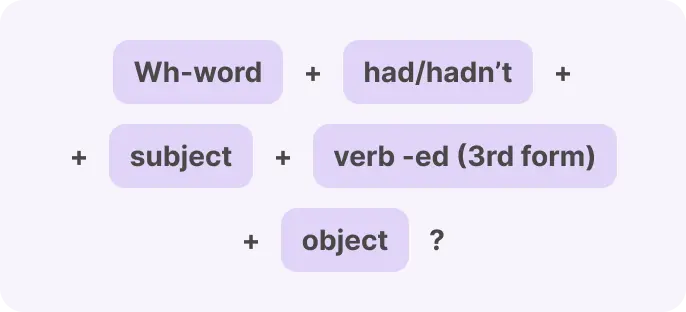
Let’s refer to examples of questions with answers:
| Question | Answer |
|---|---|
|
Why
|
He didn’t want to go to that university. Joe
|
|
How long
|
I
|
|
Where
|
Check their notes. They
|
Enjoy personalized learning!
Past Perfect negative
When you know the positive structure, it isn’t difficult to build a negative one. To form it, you place the particle not after the auxiliary verb had but before the main verb with the -ed (or verbs from the third column).
The Past Perfect structure in negative sentences:

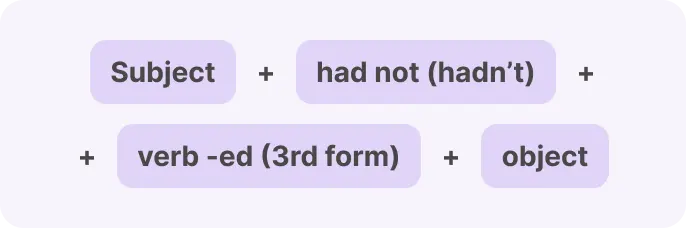
Examples:
In discussions or stories, you could notice that the negation is usually shortened to hadn’t (had + not). In daily conversations, it sounds more natural than the complete form.
Examples of Past Perfect with long and short negative forms:
| Subject | Full form | Short form |
|---|---|---|
| I |
I
|
I
|
| You |
You
|
You
|
| He/She/It |
He
|
He
|
| We |
My sister and I
|
My sister and I
|
| They |
They
|
They
|
| You (plural) |
We
|
We
|
Common mistakes with the Past Perfect in English
The Past Perfect tense may feel confusing because of the irregular verbs and their similarity to the other perfect tenses, so it is natural to make mistakes. Look at the most frequent errors to avoid them in the future.
Omitting time phrases
Unlike the Present Simple, the Past Perfect can’t be used without any time expressions and connected events — the sentences always include the timeframe when something happened. Even though the sentences below are grammatically correct, leaving a construction like this will only add a layer of uncertainty because it feels incomplete.
|
We had created content.
|
We had created content before we launched the website.
|
|
We had missed this opportunity.
|
By the time we answered the founder, we had missed this opportunity.
|
Use this tense when you connect two events and highlight which one happened first — choose the Past Perfect for it.
Choosing Past Perfect form instead of Past Simple
When you learn Past Perfect, it is easy to confuse this tense with another, especially when you want to talk about something that happened in the past. The most common error is to form a sentence in the Past Perfect tense when it had to be formed in the Past Simple.
|
Samantha had negotiated her salary yesterday.
|
Samantha negotiated her salary yesterday.
|
|
Dilan had talked me into reading last year.
|
Dilan talked me into reading last year.
|
To avoid this error, remember two points: first, time expressions, such as yesterday, last week, three years ago don’t typically match with the Past Perfect. Second, the Past Simple can refer to one completed action in the past, while the Past Perfect requires two events.
Using Present Perfect in place of Past Perfect
The Past Perfect meaning is indeed close to the Present Perfect. However, while we can use the Present Perfect as a one-action stand, the same can’t be applied to the Past Perfect as it is connected to past events, and without them, the sentences won’t feel natural.
|
I had never made decisions on my own.
|
I have never made decisions on my own.
|
|
Had you ever worked overtime?
|
Have you ever worked overtime?
|
Use present tenses when you speak about now. Choose the Past Perfect when you mention something that had happened before a specific time.
Summary
Now, it should be clearer how to create your sequence sentences and when to use the Past Perfect tense. However, to fully grasp it, consistent practice is essential — it will help you form phrases more quickly. Keep working toward excellent speaking and writing skills with Koto English. We have exercises that will help you build a strong language foundation.
Past Perfect tense FAQ
To form a sentence in the Past Perfect, place the auxiliary verb had after the subject and add the past participle form of the main verb after it.
The negative form requires adding the particle not after the auxiliary verb.
To create an interrogative sentence, use inversion — swap the subject’s and the had’s places.
The Past Simple tense is used to describe a single event in the past or a sequence of actions in chronological order. Past Perfect helps to emphasize that one action happened before another event in the past.
| Past Simple | Past Perfect |
|---|---|
| My colleague |
When my colleague got stuck in traffic, I |
Yes, it is a standard tense marker used with the Past Perfect. You use this phrase to specify that something had already happened before a certain time in the past. For example:
It is natural to make an error when you master the Past Perfect tense because its structure and rules add a layer of complexity. Below, we outlined the most common cases to pay attention to:
- Misusing the auxiliary verb:
|
I did just opened a bank account when I received a bonus.
|
I had just opened a bank account when I received a bonus.
|
- Forgetting about had:
|
When we made an appointment, I sprained my ankle.
|
When we made an appointment, I had sprained my ankle.
|
- Using Past Perfect for both parts:
|
Our plane had taken off before we had checked in at the airport.
|
Our plane had taken off before we checked in at the airport.
|
- Choosing inappropriate time phrases:
|
Then she had finished the project.
|
By the time we called her, she had finished the project.
|