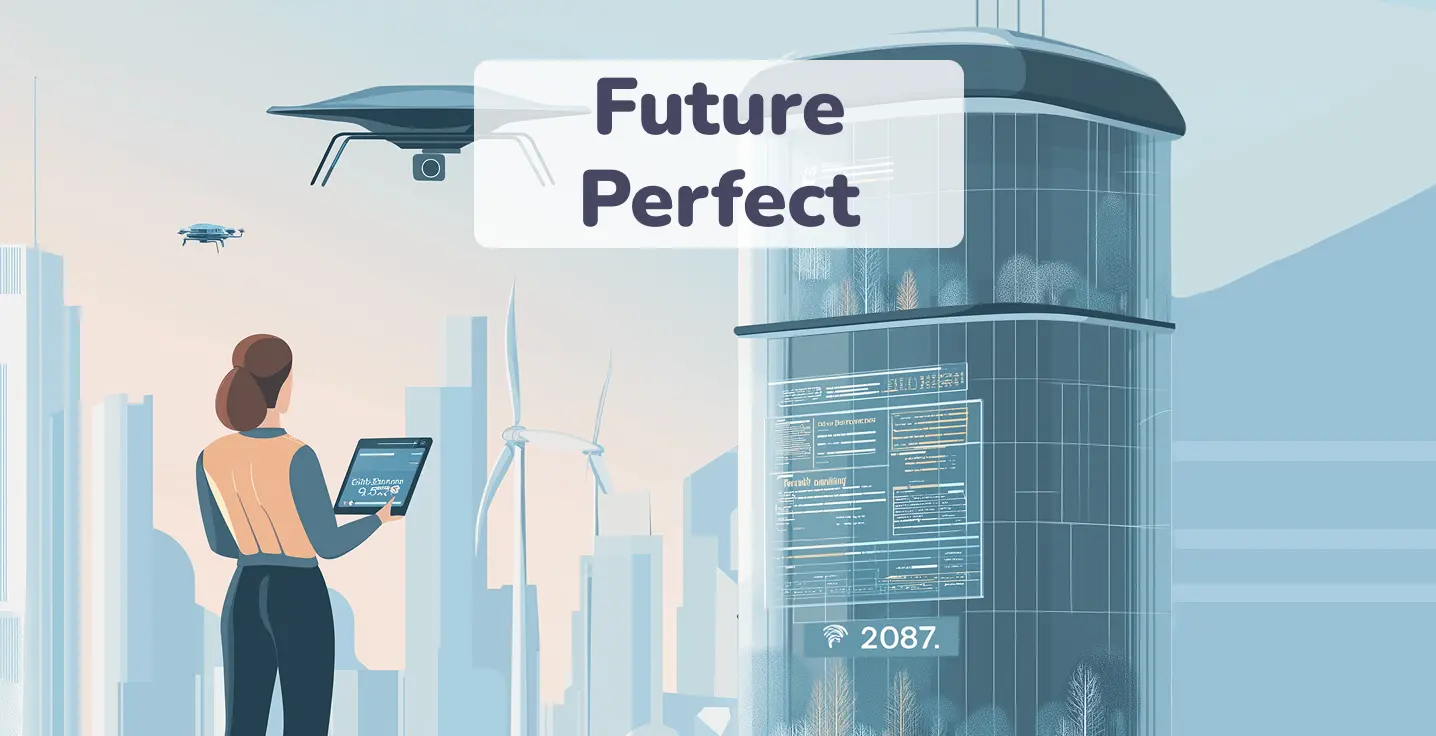
What is the Future Perfect tense?
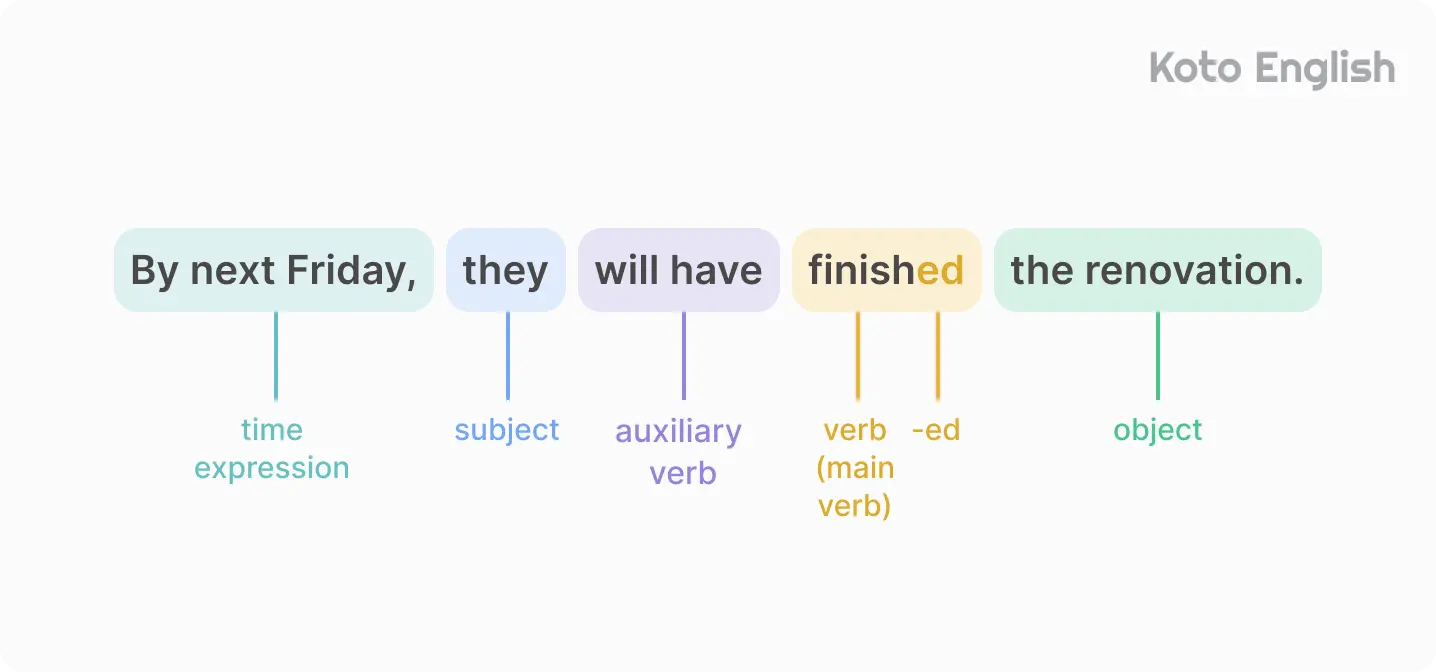
The Future Perfect tense refers to actions expected to be completed prior to a specific future time. It is commonly used to indicate scheduled completion, project milestones, and chronological order.
Its precision makes it valuable in both academic and professional contexts, especially when sequencing future actions.
Let’s explore the details to get a solid grasp of this tense.
Future Perfect tense examples:
Level up your English with Koto!
Future Perfect formula
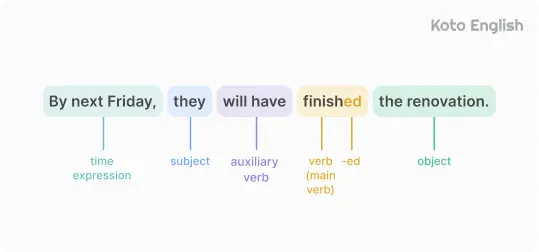
The Future Perfect structure is formed by using will have , followed by the past participle of the main verb. For regular verbs, the past participle is typically formed by adding -ed to the base verb. For irregular verbs, the past participle form must be memorized.


Check out these Future Perfect sentences to see how they’re used:
| Subject | Examples |
|---|---|
| I |
I
|
| You (singular) |
You
|
| He |
He
|
| She |
She
|
| It |
It
|
| You (plural) |
You
|
| We |
We
|
| They |
They
|
The Future Perfect tense works with all subjects in the same way: I/You/He/She/We/They will have + past participle. There’s no variation based on the subject.
When to use Future Perfect?
We use the Future Perfect to talk about actions that will be completed before a specific point in the future. It’s also used to describe events that will have happened by a certain deadline or before another future event occurs. This tense emphasizes completion and timing. It is often used when you want to highlight what will have been done at a certain moment in the future.
Future Perfect examples:
| Usage | Examples |
|---|---|
| Actions completed by a specific time in the future |
By next week, we
|
| Simultaneous events, where one will be finished before the other starts |
By the time you arrive, I
|
| Actions completed before a deadline |
By 8 p.m. tonight, they
|
| Describing future expectations with completion |
By this time next year, we
|
Future Perfect tense markers:
| Time Indicators | Examples |
|---|---|
| by + specific time |
|
| by the time |
|
| before |
I
|
| in + time period |
|
| by + specific deadline |
|
We use the Future Perfect form when we want to express what will have been completed before a specific point in the future. It’s also used to show that one event will be completed before another event happens.
How to use the Future Perfect tense?
We’ve already learned what is Future Perfect and seen many examples of the tense used in positive sentences. Now, let’s look at its negative and question forms, which have their unique structure.
The negative form of the Future Perfect
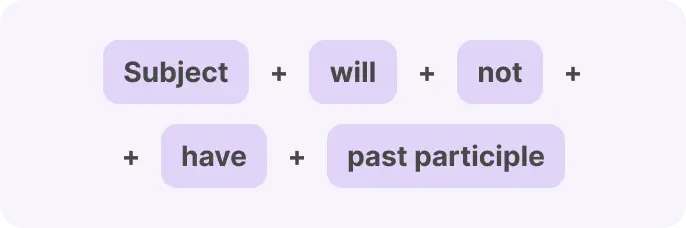
To create negation in the Future Perfect tense, simply place not after have to form will not have. The structure is as follows:

Examples:
For more casual and natural speech, will not is often contracted to won’t.
Future Perfect example of negative patterns:
| Subject | Full form | Short form |
|---|---|---|
| I |
I
|
I
|
| You (singular) |
You
|
You
|
| He/She/It |
She
|
She
|
| We |
We
|
We
|
| They |
They
|
They
|
| You (plural) |
You
|
You
|
Enjoy personalized learning!
Future Perfect questions
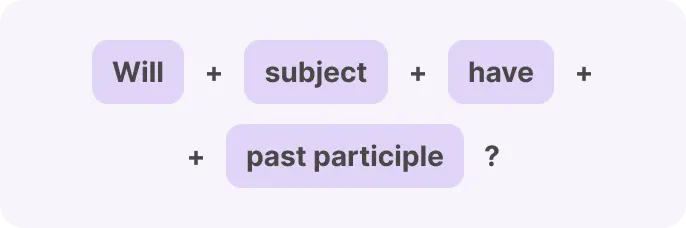
The formula for asking Future Perfect questions is straightforward. You swap the subject and auxiliary verb will have to create questions.
Yes/No Questions

Examples of Yes/No questions:
| Question | Answer |
|---|---|
|
|
Yes, I
|
|
|
No, she
|
|
|
Yes, they
|
Wh-questions

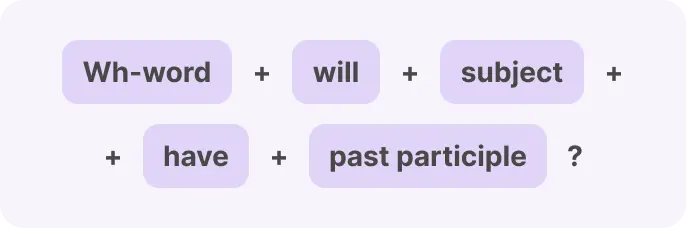
Examples of Wh-word questions:
| Question | Answer |
|---|---|
|
Why
|
They
|
|
|
I
|
|
|
I
|
Common mistakes with the Future Perfect in English
Since the Perfect Future tense deals with actions that will be completed before a specific point in the future, it can be tricky to master. Here are some common mistakes learners make with this tense.
Using the wrong verb
The Future Perfect requires the use of will have, but learners often make mistakes by using the wrong form of the auxiliary verb.
|
By 2025, she will has finished her studies.
|
By 2025, she will have finished her studies.
|
|
I will have ate lunch before I go to the meeting.
|
I will have eaten lunch before I go to the meeting.
|
Confusing the Future Perfect with other future tenses
The Future Perfect is often confused with other future tenses, like the Future Simple or Future Continuous. Be careful to distinguish between the use of these tenses to avoid mistakes.
|
I will be reaching my destination by this evening.
|
I will have reached my destination by this evening.
|
|
He will do his daily routine at 6 p.m.
|
He will have done his daily routine by 6 p.m.
|
Incorrect word order in questions
When forming Perfect Future questions, remember to invert the subject and the auxiliary verb will have.
|
Have we will submitted the report before the deadline?
|
Will we have submitted the report before the deadline?
|
|
Have she will prepared the documents by the time the meeting starts?
|
Will she have prepared the documents by the time the meeting starts?
|
Using the wrong time expression
The Future Perfect in English is used to indicate actions completed before a specific point in the future. Misusing time markers can cause confusion.
|
He will have moved out next week, at the latest.
|
He will have moved out by next week.
|
|
You will have learned the basics before 2025 ends.
|
You will have learned the basics by the end of 2025.
|
Always remember to use will have followed by the past participle, and avoid confusing the Future Perfect with other future tenses or using incorrect time markers.
Summary
Mastering the Future Perfect meaning and usage will enable you to describe future actions that will be completed by a particular time. This tense is valuable when you need to talk about deadlines, predictions, or events that occur in a specific sequence. Keep practicing, and soon you’ll be expressing future events with clarity and confidence!
Future Perfect tense FAQ
Time expressions like by tomorrow, by next week, by the time, by then, and in a year are often used with the Future Perfect to indicate a specific time when an action will be completed.
The Future Perfect is used to describe an action that will be completed before a specific time in the future, while the Future Simple refers to actions that will happen in the future, without a clear sense of completion by a particular time.
| Future Perfect | Future Simple |
|---|---|
|
She
|
She
|
Yes, will have can be used with all subjects (I, you, he, she, we, they) to form the Future Perfect tense.
To form a negative sentence in the Future Perfect, use will not have (won’t have). For questions, invert the subject and will.
| Negative | Question |
|---|---|
|
I
|
|