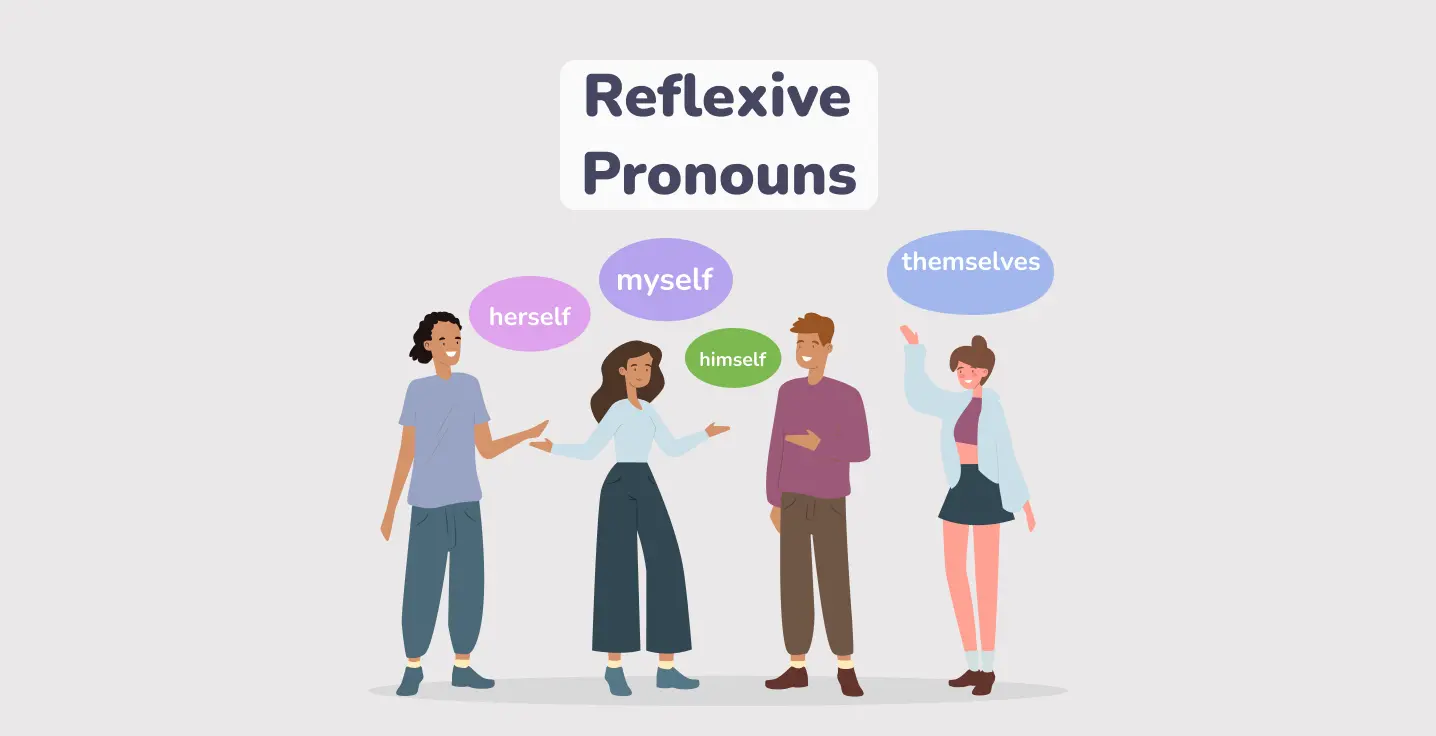
What are reflexive pronouns?
A reflexive pronoun is a pronoun that we use when the subject and the object of the sentence are the same person or thing. This means that the action “reflects” back to the person who does it. For example:
The easiest way to check how it works is to compare these sentences:
The pronoun here changes the meaning completely. This part of English grammar A2 also covers how to use these small words correctly, preparing you for various situations you will learn further.
How reflexive pronouns are formed
The formula for reflexive pronouns is simple: they are formed by adding self or selves to a personal pronoun. The choice is determined by whether the pronoun is singular or plural. Singular pronouns add self, while plural pronouns take -selves.
Here is how each pronoun pairs with its reflective form:
- I → myself
- You → yourself
- We → ourselves
- They → themselves
The proper plural form is themselves, not themself. Although you may occasionally see themself used in casual writing, this is not proper grammar. If you are referring to two or more individuals, always use themselves, such as “They prepared themselves for the exam.”
List of reflexive pronouns
There are eight reflexive forms you need to memorize when learning English, and each one corresponds to a particular subject pronoun. Before getting into when and how to use self words, it is helpful to have all of them in one place, and the reflexive pronouns list below is a great place to start.
|
Subject pronoun |
Reflexive pronoun |
|---|---|
|
I |
|
|
you |
|
|
he |
|
|
she |
|
|
it |
|
|
we |
|
|
you (plural) |
|
|
they |
|
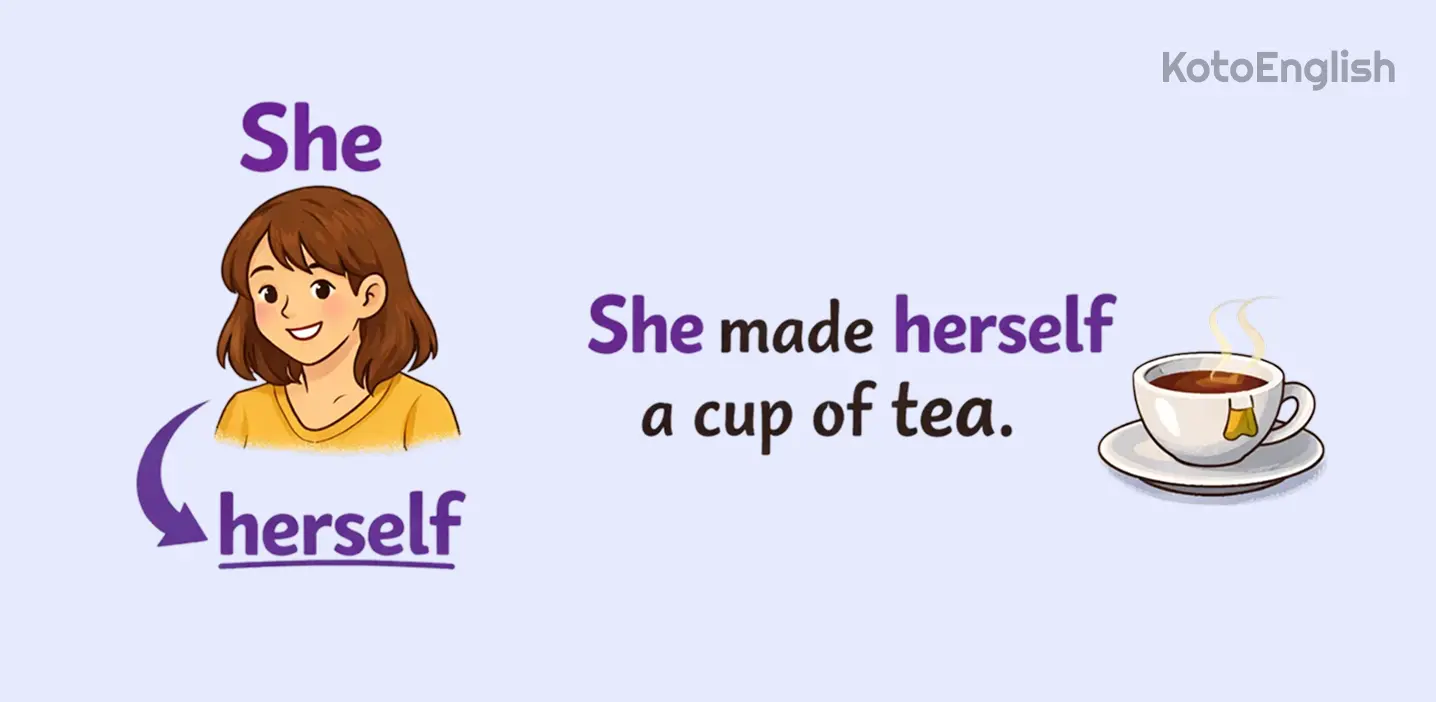
English reflexive pronouns have just one corresponding reflexive pronoun. This list will help you choose the right word without second-guessing yourself. For example, if your subject is she, your reflexive pronoun must be herself to form “She made herself a cup of tea.”

When do we use reflexive pronouns?
Reflexive pronouns are used in more situations than you might think, and knowing exactly when to use them is crucial to making your English sound natural. The problem is that many people either avoid reflexive pronouns because they are unsure when to use them or, conversely, add them to sentences when they are not used.
Both of these are surprisingly easy to do. In most cases, the issue comes down to one thing: knowing what the pronouns are actually doing in the sentence. Once you get this, everything else falls into place naturally.
With actions done by the subject
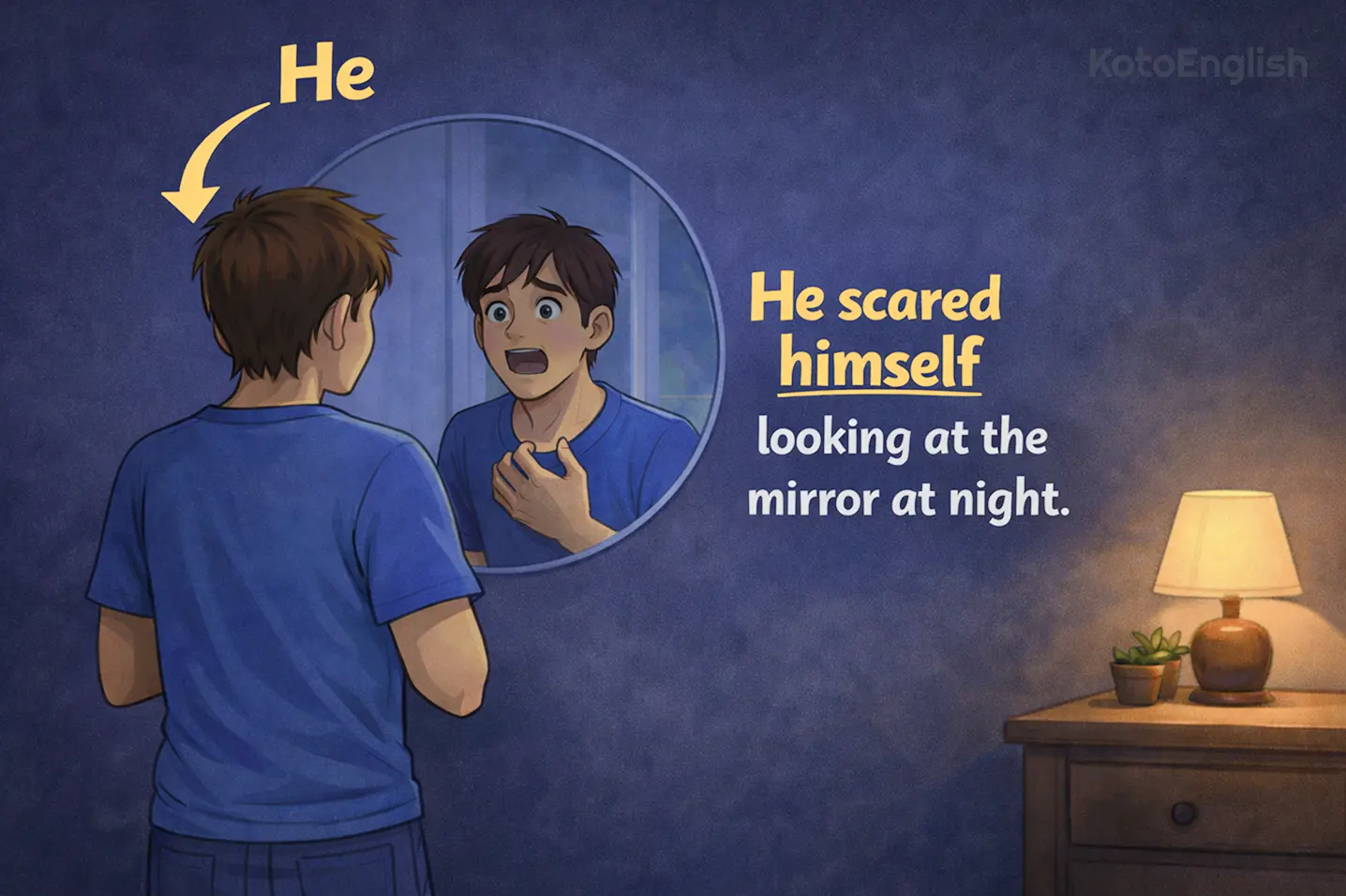
To define when to use reflexive pronouns, you need to learn this point, which is the most common for students and native speakers. Here are the two rules:
- The action goes back to the subject
- Subject and object are the same person
Here is how it works in real-world reflexive pronouns examples:

With verbs that require a reflexive pronoun
Some common phrases in English almost always go with a reflexive pronoun. These are phrases you will hear and read often, like when chatting or reviewing your favorite Netflix show, so it is worth learning them as a group:
- enjoy yourself
- help yourself
- introduce yourself
- behave yourself
In everyday language, they can be set like this:
For emphasis
Occasionally, we choose to use a reflexive pronoun merely for emphasis — to draw attention to the fact that one individual in particular performed an action, perhaps alone. Compare these two samples:
The second sentence has a stronger meaning. The reflexive pronoun myself is an optional part of this sentence, but it certainly enhances the meaning. This is referred to as an intensive pronoun.
Reflexive vs intensive pronouns
Reflexive pronouns and intensive pronouns are often confusing to learners. This is because they are similar in form but differ in usage. They are: myself, yourself, himself, herself, itself, ourselves, yourselves, themselves.
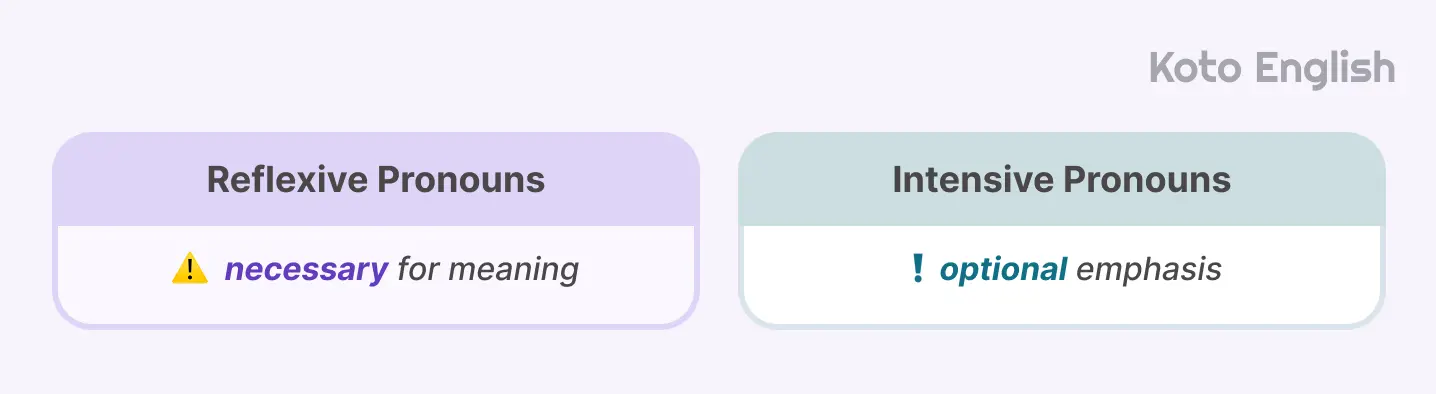
A reflexive pronoun is needed for the sentence to make sense. It refers to the subject and indicates that it performs an action on itself. The saying would not be correct without it.
An intensive pronoun is used for emphasis only. It emphasizes the subject of the sentence but is not needed for grammatical correctness. The sentence would be correct without it, but it would not be as emphatic. Here is a comparison through examples:
|
Reflexive |
Intensive |
|---|---|
|
She pictured
|
The CEO
|
In the first sentence, herself is vital. Without it, “She pictured” does not make sense because it does not tell us whom she pictured. “She pictured herself” suggests that she took the photo of herself.
In the second sentence, himself adds emphasis to the fact that the CEO himself signed the document. Without this word, “The CEO signed it” is still grammatically correct.
Key difference:
Knowing the difference will help you avoid common mistakes with reflexive pronouns. Let’s consider other confusions that can appear when you are learning this grammar.
Common mistakes
Reflexive pronouns are also commonly misspelled even at the intermediate level. This is more essential than it might seem, since the wrong pronoun can completely alter the meaning of a sentence or make it sound like something no native speaker would ever say.
In formal or academic writing, such mistakes can also easily be picked up by a reader, which can have a negative effect on the overall impression of your English. The good news is that most mistakes in A2 grammar can be broken down into just three patterns, which are easy to avoid once you are aware of them.
- Confusing object pronouns and reflexive ones.
This occurs when the subject and object are the same, and the writer accidentally uses a regular object pronoun instead of a reflexive pronoun.
|
She caught her talking to the cat.
|
She caught herself talking to the cat.
|
|
They filmed them at the concert.
|
They filmed themselves at the concert.
|
- Using incorrect forms of reflexive pronouns.
Hisself and theirself do not exist in English, but sometimes students can confuse them.
|
He locked hisself in the car.
|
He locked himself in the car.
|
|
They cooked the whole Thanksgiving dinner by theirself.
|
They cooked the whole Thanksgiving dinner by themselves.
|
- Adding a reflexive pronoun when it is not needed.
If the rule is not followed for self-form construction and the subject/object are not the same person, it is better to use personal pronouns and other forms instead.
|
The chef himself cooked this for myself.
|
The chef himself cooked this for me.
|
|
My manager called yourself three times!
|
My manager called you three times!
|
Summary
Reflexive pronouns are not very complex but play an integral role in the structure of English sentences. The proper usage of reflexive pronouns like myself, yourself, himself, herself, itself, ourselves, yourselves, and themselves helps you be clear in expressing the intended meaning in a grammatically complete sentence.
They are not just for show; they have a function. Taking one out of a mandatory sentence can lead to an incomplete or false meaning. By mastering reflexive pronouns rules, you will be able to take a step toward your English fluency and communicate better.
Frequently asked questions (FAQs)
Typically, they include verbs like hurt, enjoy, teach, introduce, blame, prepare. For example, “She introduced herself,” or “He enjoyed himself.” They describe actions a person does to themselves, without involving anyone.
No, and that’s one of the most common mistakes in English. Myself should only be used when you are both the subject and the object of a sentence, and that’s rare. “He called myself” is not correct and it should be “He called me.” Still, you can put it in one sentence, like in the lyrics from The Fate of Ophelia, “I swore my loyalty to me, myself, and I.”
They look the same but function differently. These terms substitute the object and are required for the sentence to be meaningful — “She cut herself.” Intensive pronouns are only for emphasis and can be removed from the sentence without affecting the meaning — “She baked the cake herself.”
Take a try at removing herself from each sentence and you will understand the difference.