What are indirect objects?
Indirect objects in English usually refer to the person (or sometimes thing) that receives something in a sentence. When we use pronouns, we replace the name of that person.
Here are some indirect object examples:


Using them helps you avoid repetition in speaking and writing. Look at this table to see how they improve clarity:
|
Without |
With |
|---|---|
|
The teacher showed the students examples. Then he told the students the answers. |
The teacher showed the students examples. Then he told them the answers. |
In both cases, the message is the same, but using “them” makes the text shorter and more natural.
Direct vs indirect object
A sentence can have two objects, direct and indirect. To identify both, you need to look at these two examples:
In this instance, the door is the direct object, the action is directed at it.
This sentence includes both objects. To identify which is which, you need to ask two questions. What? refers to the direct object. In our case, it is the article. To determine the indirect object, you need to ask Whom? The right answer is me.


List of indirect object pronouns
To correctly use these pronouns, you need to know their subject forms first. Below, you will find instances of using this grammar in real sentences.
|
Subject pronoun |
Object pronoun |
Examples |
|---|---|---|
|
I |
Me |
Give
|
|
He |
Him |
I want to write
|
|
She |
Her |
Her parents make a cake
|
|
It |
It |
I liked the soup. Cook
|
|
You |
You |
Your father will get
|
|
We |
Us |
The teacher gave
|
|
They |
Them |
You asked
|
The subject and object forms of it and you are the same. You need to understand their roles.
Word order with indirect object pronouns
These pronouns can appear in two different positions: in the middle or at the end of a sentence. Their position in a sentence changes whether you need to use to or for.
Without to or for
Look at this indirect object pronoun sentence structure. When it goes right after the verb, it doesn’t need a preposition.

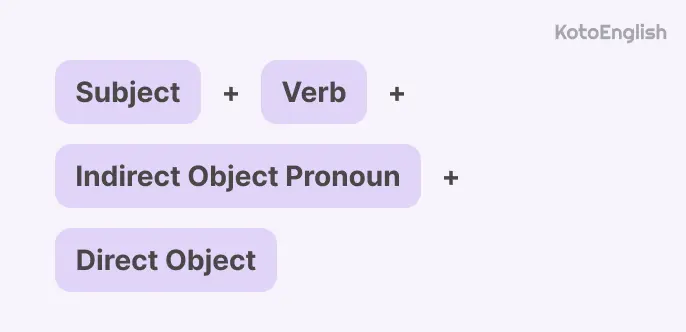
Examples:
With to or for
Positioned after the direct object, the pronoun requires to/for to separate them, as in this formula:

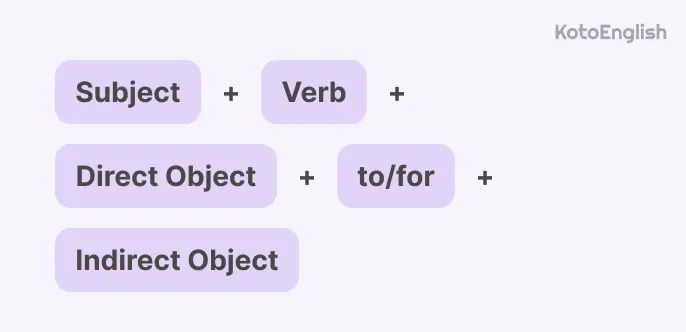
Examples:
Both structures are fine when the direct object is short. For example: He gave me the keys and He gave the keys to me are both correct and natural. However, when the direct object is long, the second option provides more clarity: She gave the key to the office to me.
Some verbs only use to
With some verbs, you can’t follow the first pattern where the indirect object stands in the middle of the sentence. Only the second formula where you use to before pronouns works for them.
Examples:
This rule applies to the following verbs: explain, describe, introduce, mention, propose, report, and say.
Common verbs with indirect object pronouns
There are some common verb groups that follow this particular pattern. Here, they are categorized by meaning.
|
Category |
Verbs |
Examples |
|---|---|---|
|
Giving things |
|
My friend lent
|
|
Giving information |
|
She read
|
|
Doing something for someone |
|
I made
|
The outlined verbs follow both order structures with indirect object pronouns in the middle of the sentence and at the end of it.
Common mistakes to avoid
Looking at the most popular mistakes will help you focus on the rules where most learners misstep. Let’s explore them:
- Using subject pronouns instead of object pronouns.
The roles of subject pronouns (I, you, we, they, he, she, it) differ from object pronouns (me, you, us, them, him, her, it).
|
My brother invited we to a party.
|
My brother invited us to a party.
|
|
His girlfriend showed he a photo.
|
His girlfriend showed him a photo.
|
After verbs, use object pronouns, not subject pronouns.
- Placing the pronoun in the wrong position.
The word order is fixed, so you cannot move the pronoun freely in the sentence.
|
She gave the charger me.
|
She gave me the charger.
|
|
The office sent to her a laptop.
|
The office sent her a laptop.
|
If placed in the middle, the pronoun is used without prepositions. When it is at the end of the sentence, you need to use to or for with it.
- Confusing indirect object pronouns with possessive forms.
It’s easy to misuse my and me or him and his, as only one letter differs in those words.
|
She gave the phone to my.
|
She gave the phone to me.
|
|
The manager explained the rules to their.
|
The manager explained the rules to them.
|
Learn all possessive pronouns to see the difference between them clearly.
Quick tips to remember indirect object pronouns
You will use this grammar confidently and won’t confuse it with other parts of the sentence if you follow this simple plan when learning English:
Tip 1: Memorize object pronouns
If you don’t know object pronouns (me, him, her, us, them) by heart, it will be difficult to produce your own phrases with this topic. So, first, you need to understand when to use them in general.
Tip 2: Ask the right questions
When creating a sentence, ask yourself these questions:
- For whom is something done?
- To whom is something given?
It will enable you to quickly decide between for and to.
Tip 3: Complete several tests
Do short exercises to practice multiple sentence structures. This way, you will learn exceptions and become familiar with the topic.
Tip 4: Write your own examples
Personalize the grammar with the examples from your life. Think of situations where you bought something for someone, cooked your friend dinner, or taught your family member algebra. These examples stick to memory better than general ideas.


Summary
Knowing how to use indirect object pronouns can make a noticeable difference in how you sound in English. The best way to study this grammar is through exposure. Try to catch them in songs, find them in texts, and use them in real life. Keep building on foundations like this, and fluency will follow.
Frequently asked questions (FAQs)
A direct object is the thing that receives the action of the verb, while an indirect object in English is the person who receives the direct object. Look at this example:
Offer is a direct object and him is an indirect object.
You typically use to when transferring something to someone else. For is useful when you specify that you do something on someone’s behalf.
No, it’s not. Even when using the verb from the common list, you can drop a pronoun if the person is known or not important for the context.
Look at these examples:
There are two common patterns of placement of indirect object pronouns. In the first case, you put it after the verb, before the direct object. In the second example, you add to or for and position the pronoun at the end of the sentence.