What are indefinite pronouns?
Indefinite pronouns in English talk about people or things without saying exactly who or what we mean. Words like somebody, anything and nobody are all part of this group. Here’s how they work:
|
Sentence |
What it means |
|---|---|
|
|
A person did it, but we don’t know who. |
|
Is there
|
We’re asking about things in general — no specific item. |
|
|
Zero people picked up. |
Such pronouns can also be used in idiomatic expressions, such as “someone special” or “nothing doing,” that add character to your sentences. In narrative or in speech, they can raise suspense or interest by leaving certain details unclear.
Types of indefinite pronouns
Learning these words can become challenging for people, but it becomes easier if we divide them into different groups. Moreover, such structuring makes learning English possible through fun activities, turning them into enjoyable experiences.
Indefinite pronouns for people
They serve the purpose of identifying people without revealing their specific identities. The terms can refer to one person, multiple individuals and all members of a particular group. Positive forms introduce people neutrally or positively, negative forms display their absence, while question forms enable you to learn about them in general.
|
Positive |
Negative |
Question |
|---|---|---|
|
someone |
no one |
anyone |
|
somebody |
nobody |
anybody |
|
everyone |
— |
— |
Everyone can be used in negative and question sentences in the same form, but the construction changes slightly because this pronoun is grammatically singular all the time.
Examples:
This type of pronoun often reflects politeness or generality in English. For example, asking “Can anyone help me?” sounds softer and more general than naming a specific person.
Indefinite pronouns for things
They represent objects, ideas and situations in general rather than specific instances. Positive forms indicate what exists, negative forms what doesn’t and questions explore general knowledge.
The correct application of usage rules will improve sentence flow by stopping writers from using excessive nouns.
- something
- anything
- nothing
- everything
Examples:
The indefinite pronouns of things can also be used to show possibilities or uncertainties, which can be very helpful if you are not sure what is going on. For example, “Is there anything I should bring?” is very flexible.
Indefinite pronouns for places
These are used in a general or indefinite way. The positive form indicates the existence of something somewhere, the negative form shows that something does not exist and the question form asks about the location.
|
Positive |
Negative |
Question |
|---|---|---|
|
somewhere |
nowhere |
anywhere |
|
everywhere (all places) |
— |
— |
Examples:


Indefinite pronouns for places help you talk about locations in a general way and share your feelings about them. The statement “Let us visit an unfamiliar location” creates a sentence structure that allows multiple potential outcomes to develop.
Grammar rules for indefinite pronouns
There are several grammar rules that you must remember. These words are very easy to read, but sometimes they are difficult to understand. Once you learn how they work, it will become easy for you to avoid mistakes and sound like a native speaker.
Some- vs any- pronoun form
The selection between some- and any- depends on the sentence structure that you are constructing. This choice shows the speaker’s intention to provide information, make a certain request or state that something does not exist.
- some- → positive sentences
- any- → questions & negatives


Singular or plural?
Indefinite pronouns in English can be singular or plural and this affects the verb you use. Most of them are singular, even when they refer to several people. A few pronouns exist that always require plural verbs because they function as plural subjects.
Singular:
- everyone
- everybody
- someone
- somebody
- anyone
- anybody
- no one
- nobody
- everything
- something
- nothing
- each
- either
- neither
Plural:
- both
- few
- many
- several
Word order with adjectives
When you use an indefinite pronoun with a describing word (adjective), the scheme is following:


This is different from normal adjective placement, where they usually come before nouns.
- something interesting
- someone special
- nothing important
Using indefinite pronouns in negative sentences
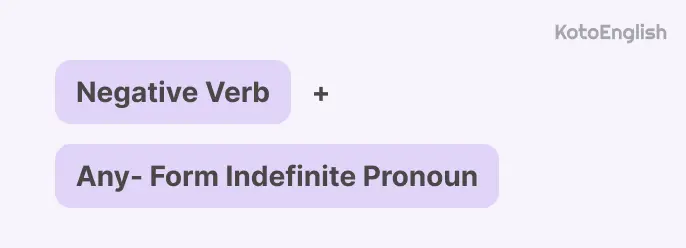
In standard English, we do not use double negatives in the same clause. If the verb is negative (don’t, can’t, isn’t), we use anyone, anything, anywhere — not no one, nothing, nowhere.

Common mistakes to avoid
Even confident learners slip up with indefinite pronouns grammar, so let’s look at three traps worth watching out for.
- Using plural verbs
Everyone and somebody are words that seem to refer to a group, so naturally, many students will choose a plural verb. As you now know, grammatically, though, each of these pronouns acts as a single unit. Treat every one of them the same way you’d treat the words he or she.
|
Everyone are happy.
|
Everyone is happy.
|
|
Nobody were listening.
|
Nobody was listening.
|
- Making double negatives
In English, one negative word per clause is the limit which uses two negative words to create an opposite meaning. The rule confuses speakers whose native languages require double negatives. The word sequence after don’t or can’t should use anything, anyone or anywhere.
|
I don’t know nothing.
|
I don’t know anything.
|
|
She can’t find nobody to help.
|
She can’t find anybody to help.
|
- Confusing “someone” and “anyone”
These two indefinite pronoun examples sound very similar, but they are not identical and the distinction is important. Use someone when you assume the person exists, such as with offers or positive statements. Anyone is used when you’re really asking a question and can’t assume the answer, or with negative sentences.
|
I don’t know someone who can fix this.
|
I don’t know anyone who can fix this.
|
|
I invited anyone to the party.
|
I invited someone to the party.
|
Quick summary
Generally speaking, learning to use indefinite pronouns helps you to develop an understanding of context in the English language. This is because it will teach you to always pay attention to the meaning, tone and intent, which will in turn improve your listening and reading skills.
Over time, this ability makes understanding native speakers easier and helps you respond more naturally in conversations. With consistent practice, using proper indefinite pronoun grammar will soon become second nature, boosting both your confidence and fluency in English.
Frequently asked questions (FAQs)
They can be singular, plural, or both, depending on the pronoun. For example, everyone, someone and each are singular, while few and many are plural. Some pronouns, such as all, some and none can be either singular or plural depending on the noun they refer to.
Someone refers to a specific but unknown person, often in positive statements. The term anyone denotes all people, which serves as a base for both questions and negative statements.
Yes, adjectives can follow these pronouns to describe them, as in “someone special” or “anything important.” Your writing will achieve greater authenticity through this technique, which enhances the natural flow of your sentences.