What are direct object pronouns?
We will start with the simple question “What is a direct object?” The direct object is the noun to which the action of the verb happens. To find the direct object, you can ask what? or who? after the verb:
The direct object pronoun replaces the noun to avoid repetition. Instead of saying “She adopted a dog and named the dog Luna,” you say “She adopted a dog and named it Luna.” In English, the direct object pronouns are: me, you, him, her, it, us, them.
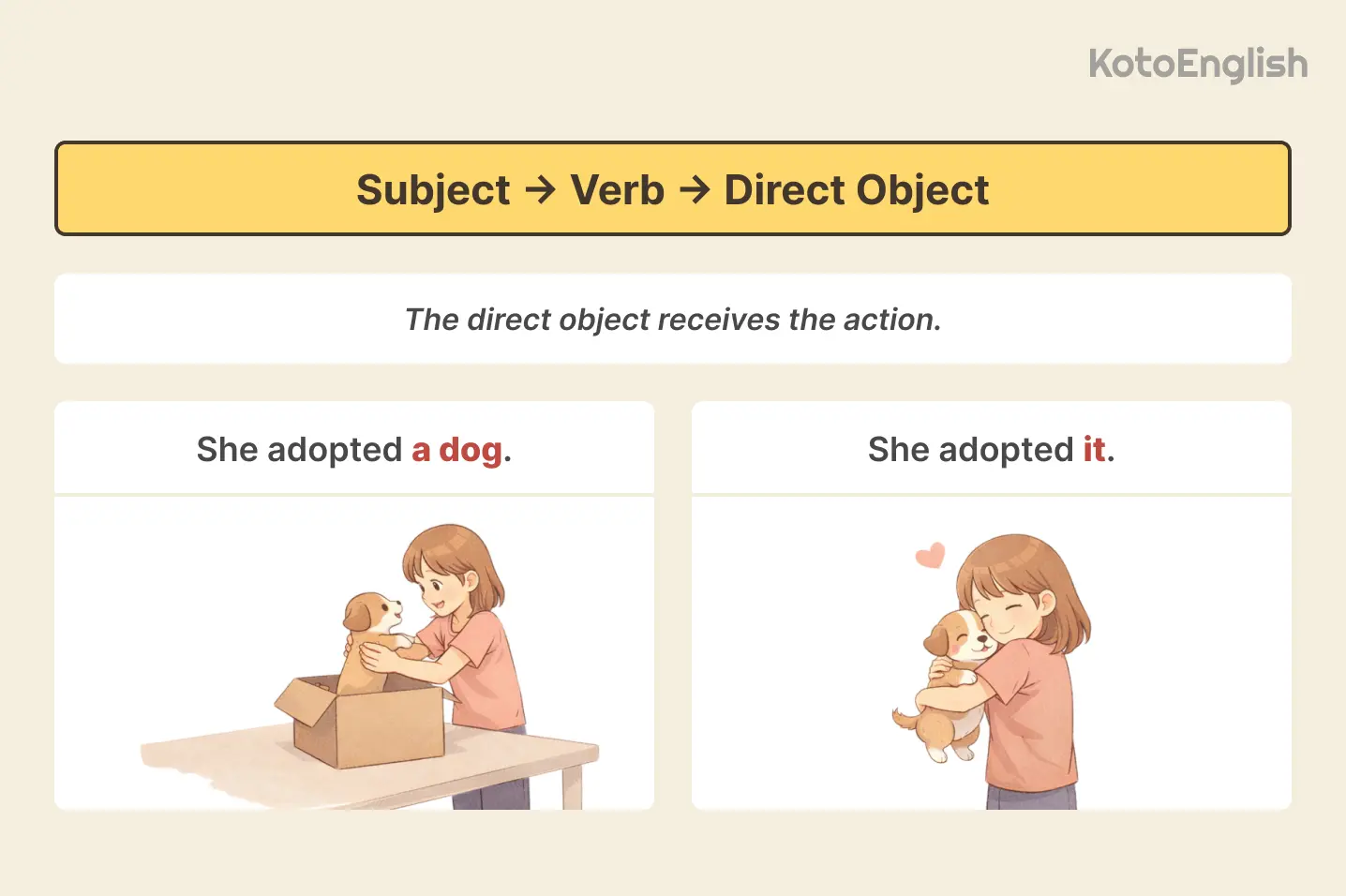
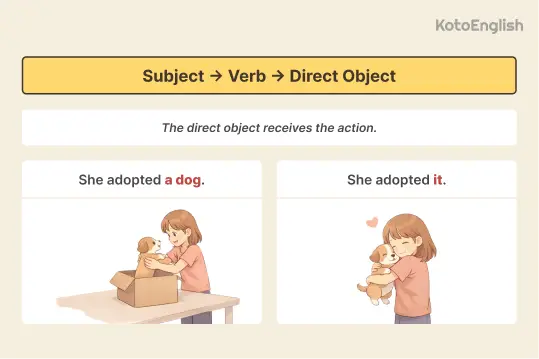
She adopted a dog. → She adopted
We’ve seen what the direct object pronouns are. Let’s see the list of all the direct object pronouns and what they mean.
List of direct object pronouns
English has seven direct object pronouns. Each one corresponds to a subject pronoun, but changes form because it’s functioning as the receiver of the action, not the doer of it.
|
Subject pronoun |
Direct object pronoun |
|---|---|
|
I |
|
|
you |
|
|
he |
|
|
she |
|
|
it |
|
|
we |
|
|
they |
|
A few things worth noting in this object pronouns chart:
“You” stays the same. Whether you is the subject or the object (singular or plural), the word doesn’t change. Context makes the meaning clear.
How to use direct object pronouns
When learning English, the key to using these pronouns correctly is to understand two things: what to replace and where to place the pronoun in the sentence.
Direct object pronouns replace nouns
A direct object pronoun replaces a noun whenever it would sound redundant or clumsy to repeat the word. This happens all the time in everyday conversation, especially after you’ve already referred to something once, so you use a pronoun to clarify exactly what you mean.
The object pronouns rules for replacement are simple: just replace the direct object with a pronoun that refers to a person or a thing and match it with its pronoun equivalent.
The pronoun must agree with the noun it replaces in number and gender — not with the subject of the sentence. If the original noun is plural, use them. If it refers to a male person, use him. If it refers to a concept or object, use it.
Position in the sentence
In English, the direct object pronoun appears after the verb in the same position as the noun.
This is a relatively simple rule in comparison to many other languages. In other languages, pronouns appear in a different position from the noun, depending on the verb tense or type.
With a single verb, the pronoun follows it immediately:
In sentences with auxiliary verbs (can, will, should, have, be…), the pronoun follows the main verb, not the auxiliary:
After infinitives, the pronoun follows the infinitive itself:
After gerunds, the pronoun follows the gerund:
Exception: The only time the word order can be varied is when using phrasal verbs, verbs consisting of a verb and a particle like up, off or out. When the object is a pronoun, it must be placed between the verb and the particle, never after the particle:
|
Turn off it.
|
Turn it off.
|
|
Pick up them at noon.
|
Pick them up at noon.
|
With phrasal verbs, the pronoun comes between the verb and the particle, and this will soon become second nature.
Examples of direct object pronouns in sentences
The best way to commit the pronouns to memory is to see them in action. The following sentences describe common situations in the workplace, social life, and day-to-day activities, making it easy to start using the pronouns right away.
Sentences with “me” and “you”
We use me when the action happens to the speaker, and you when it happens to the person being addressed.
Me:
You:
Sentences with “him,” “her” and “it”
These three pronouns replace singular nouns: him for a male person, her for a female person, and it for objects, animals, and abstract ideas.
Him:
Her:
It:
Sentences with “us” and “them”
Us replaces the speaker plus at least one other person, while them replaces any plural noun — people, objects, or a mix.
Us:
Them:
Direct object pronouns vs subject pronouns
Subject pronouns and direct object pronouns are like two sides of the same coin. They are the same people or things, but with a difference in their functions in a sentence. This is one of the most common mistakes in English, and it is important to understand the difference.
The basic concept here is simple: subject pronouns do the action, direct object pronouns receive it.
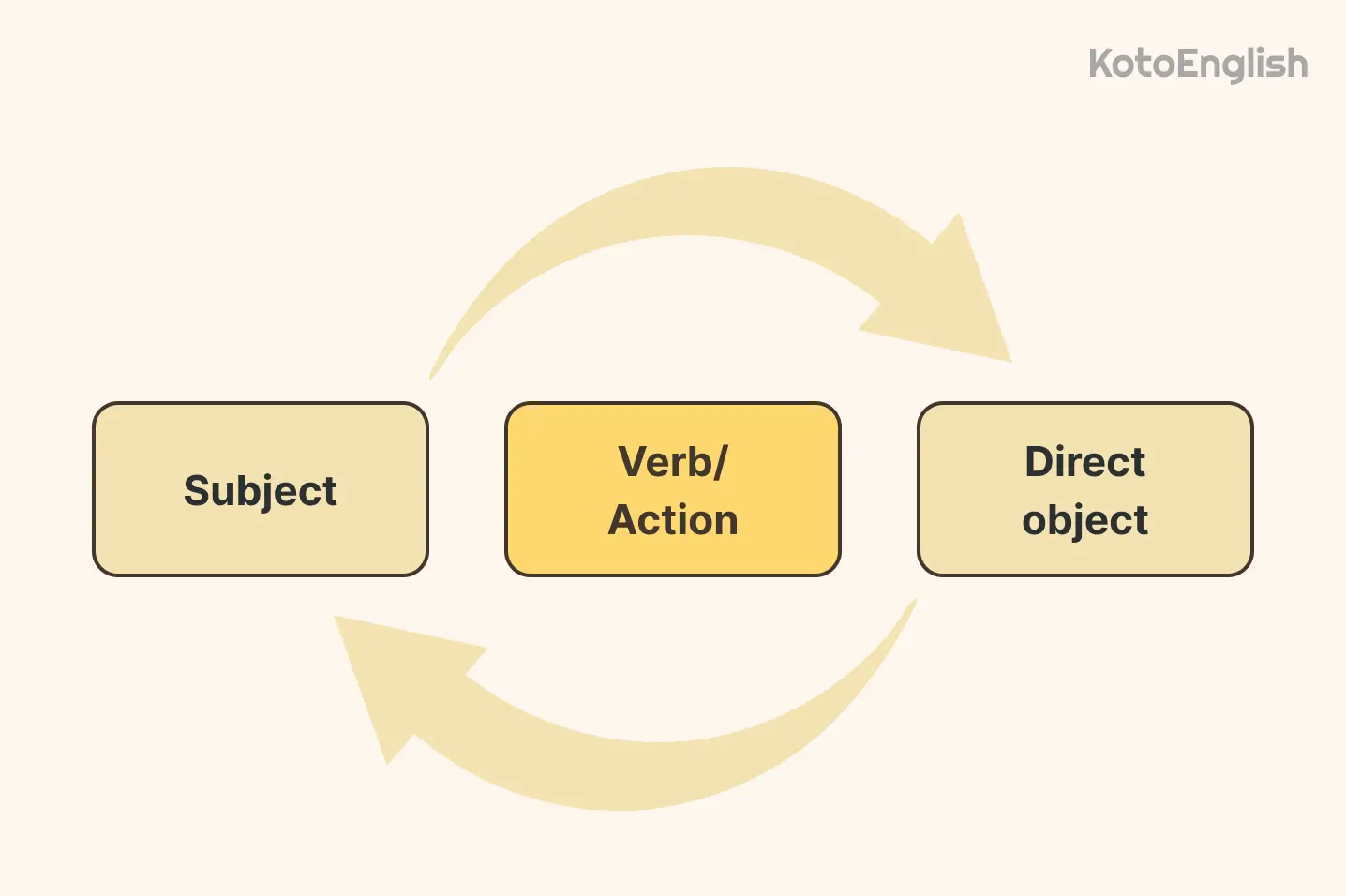
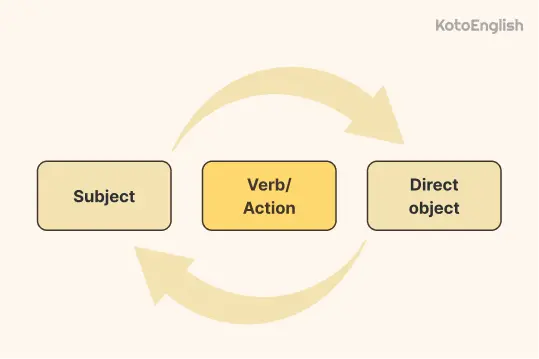
Let’s take a sentence as an example:
She is the subject as she is the one issuing the challenge. Him is the direct object, the person receiving the challenge. If you switch the pronouns around, you get a completely different meaning:
Same words — different usage.
Here is a side-by-side comparison of both sets:
|
Subject pronoun |
Direct object pronoun |
|---|---|
|
|
|
|
|
|
|
|
|
|
|
|
|
|
|
|
|
|
|
|
|
As you can see, most of the pronouns change form depending on their use. The only two pronouns that don’t change are you and it.
A few more direct object pronouns examples with both pronouns used in the same sentence:
Notice how each sentence has one pronoun driving the action and one receiving it. Getting comfortable with this distinction between subject and object pronouns will make your English sound much more natural and precise.
Common mistakes
You already know how direct object pronouns work. Now it is time to look at the common mistakes students make with object pronouns, how to correct those mistakes, and what to watch out for in the future.
Mistake 1. Using a subject pronoun instead of an object pronoun.
One common error is using pronouns after a verb. However, what you should be using is the object pronoun. The rule is: after the verb, you should always use the object pronoun.
|
The dog bit I on the leg.
|
The dog bit me on the leg.
|
|
The coach chose she for the team.
|
The coach chose her for the team.
|
Mistake 2. Putting the pronoun in the wrong place with phrasal verbs.
When using phrasal verbs, the object pronoun should always go between the two words. It should never go after the phrasal verb.
|
The chef heated up it slowly.
|
The chef heated it up slowly.
|
|
She threw away it.
|
She threw it away.
|
Mistake 3. Replacing a noun that is not a direct object.
It is a common mistake to think all the nouns in a sentence are direct objects. However, not all the nouns are objects, especially those which are accompanied by a preposition like about, for or with.
|
The journalist wrote him.
|
The journalist wrote about him.
|
|
He argued her all night.
|
He argued with her all night.
|
Mistake 4. Forgetting the pronoun entirely.
Pronouns are frequently used in English instead of omitting previously mentioned nouns, as is the case in certain other languages.
|
The magician made disappear.
|
The magician made it disappear.
|
|
She photographed and posted online.
|
She photographed it and posted it online.
|
Quick summary
Now you know what direct object pronouns are, how to identify the direct object in a sentence, and how to replace it with the correct pronoun. You also know where to put the pronoun, even with tricky phrasal verbs. And you can tell object pronouns from subject pronouns.
Well done! You have accomplished a lot. The seven pronouns: me, you, him, her, it, us, them are among the most common words in spoken English. To reinforce your learning, practicing with object pronouns exercises in conversations, films, and written texts will make them come more naturally when it’s your turn to speak.
Frequently asked questions (FAQs)
Yes! The only pronoun that does not change is you. It can be used both as an object pronoun and a subject pronoun, both in the singular and the plural forms. So, “You helped me” and “I helped you” both use the same word. The difference is the way they’re used. The meaning is always clear from the context.
Yes, you can. We can use two object pronouns in a sentence when there is a combination of a direct and an indirect object pronoun. The indirect object pronoun should always come first. In practice, native speakers avoid using two object pronouns in a sentence. It can sound a little awkward.
We use them to avoid repeating a noun many times. They make our sentences shorter, more readable, and more natural. That’s exactly how native speakers speak and write in everyday life.
In most cases, the pronoun appears right after the verb. That is, in the same place as the noun it stands in for. The only time it doesn’t is in phrasal verbs.