
What is a proper noun?
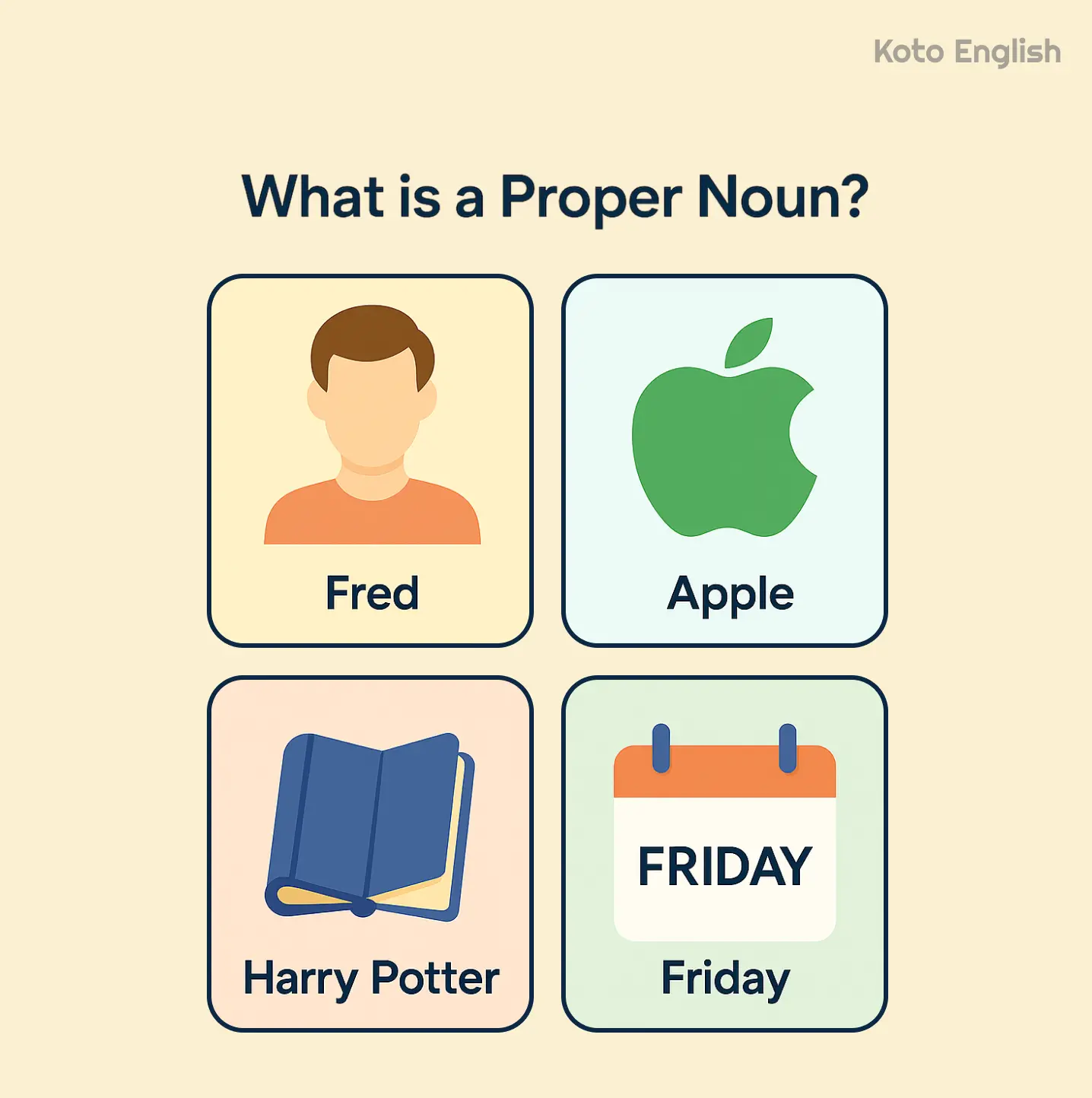
A simple explanation from our methodologists is, “A proper noun is a term that names special entities, from brand names to places, movies and books titles, people’s personal names, months, etc.” You use these nouns daily when talking about:
- your relatives or friends: This is my bestie,
Fred . - favourite content: I always watch “
Harry Potter ” in the winter. - plans: We will meet on
Friday . - brands: I will attend the new
Apple presentation, and more.
Why is it important to study? The core reason is that you make your English richer. Instead of saying common information about the device you use, like “a smart watch,” you can say “Apple Watch,” which brings more details to other people. This name is connected with the brand, known for its quality, values, and more.
As you can see from the proper nouns examples above, they can name a plethora of stuff and other concepts. Let’s talk about the kinds of them for you to receive more understanding of this grammar rule and learn English effectively.
Level up your English with Koto!
Types of proper nouns
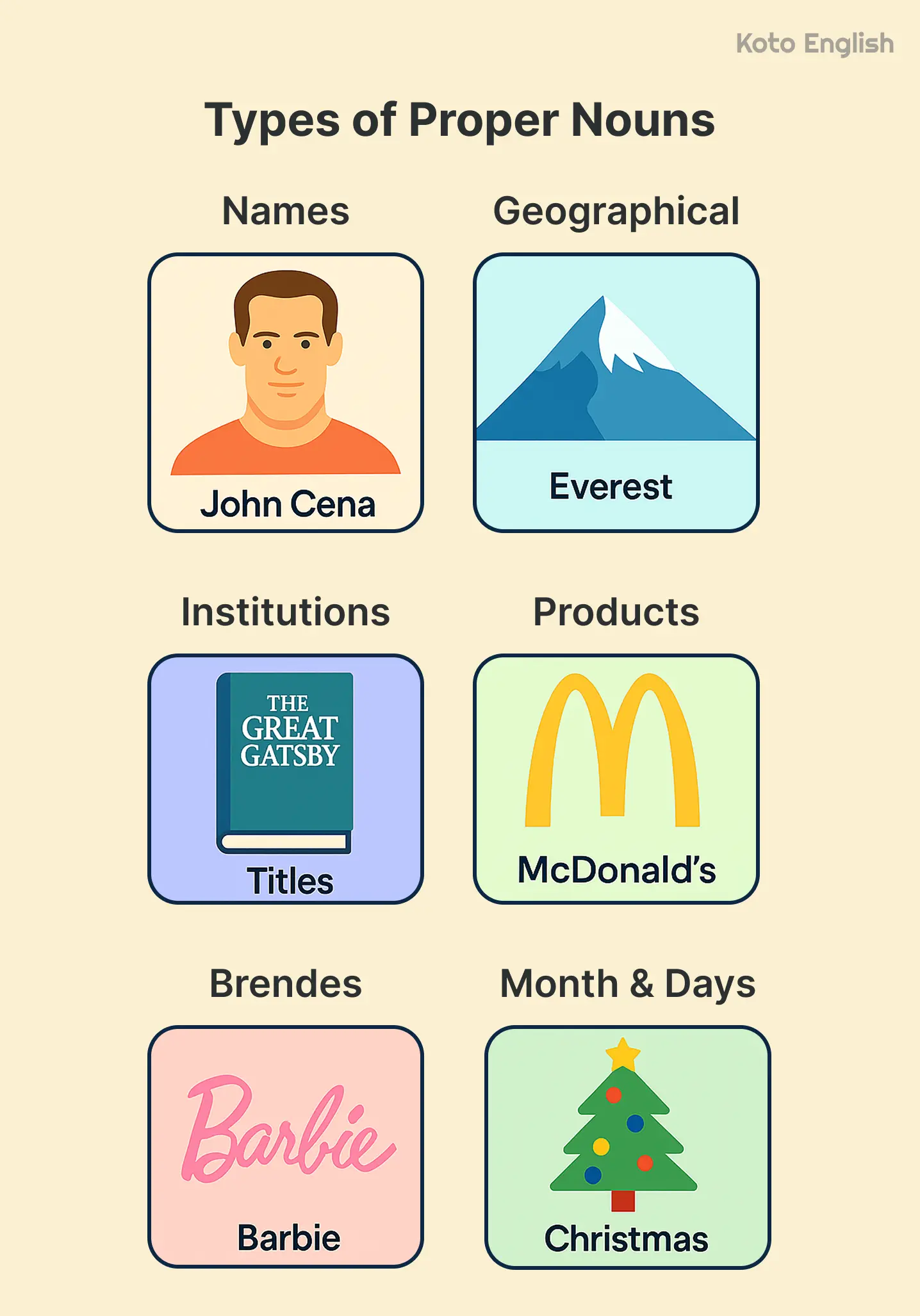
To improve your language, you need to answer more than the question, “What are proper nouns?” but study their types. You will review each category for this kind of English nouns, gathered under a single and simple table with short explanations and real-world samples.
| Type | Description | Examples |
|---|---|---|
| First and second names | Used for people to identify them. |
Have you seen a new film with
You may know my mother,
|
| Geographical | Used for locations and places. |
His dream is to visit
Sorry, I can’t talk right now, I am at the
|
| Institutions | Used for organizations, companies, universities, and more. |
I will attend
My friend is a software engineer at
|
| Titles | Used for books, movies, songs, paintings, etc. |
Every autumn starts with the “
I am looking for “
|
| Products | Used for naming brands that produce food and beverages. |
Oh, I am craving
Is it OK that he always drinks
|
| Months and days | Used for official holidays and calendar elements. |
My family celebrates
Our finals are scheduled this week, from
|
For now, after this short scan, let’s focus on the core ones with an accurate description of examples of proper nouns:
- Names of people and animals are the most common as you start learning about them from the beginning of your English journey. When you say, “My name is___,” the last noun (your name) will be a proper noun, with a capital first word.
- Geographical names are one of the widest categories as they include every naming from countries to streets, and you will also identify them by capital letters. It adds more recognition to the text or speech, as saying “a city” and “Palo Alto” gives a different vibe and interconnection.
- Brands & organizations are other terms used by us daily, from the name of your drink —
Coca-Cola , to your favourite store —Walmart , and so on. It is typically used in the commerce area, and you can also find these words when reading articles, preparing for the IELTS exam, and more. - Titles (books, movies, artworks) literally refer to everything uniquely published or created. In both academic and casual styles, you will write them with a capital letter: “
Pride and Prejudice .” - Days & holidays, when they are about a special day/month, will be written like
Monday because you point out a specific timeframe, not a general one (like weekends).
You have mastered the proper nouns list with common sentences, so you are aware of their usages and can apply them in conversations, small essays, when journaling, and more.
Rules of capitalization
You have noticed from the proper nouns definition that these nouns are always written with a capital letter, and it seems to be quite easy. It is in most cases, and we will consider some core rules with clear explanations:
| Capitalize | ||
|---|---|---|
| Case | Context | Samples |
| Places | With capital letters in combination with common nouns. |
Han River
Pacific Ocean
|
| Institutions | Every word (they can be expanded to 5 or even more) will be written equally. |
Oxford University
United Nations
|
| Titles | They are always written with capital letters, even the articles. |
The Sandman
The Hunger Games
|
| Historical events | Write in capital letters, but articles — with a small letter. |
the Industrial Revolution
Moon Landing
|
With this table, you will learn the concept easily, and you don’t need to memorize it — just keep practicing with a proper nouns worksheet, and you will master this skill across reading and writing as well.
Proper nouns vs. common nouns
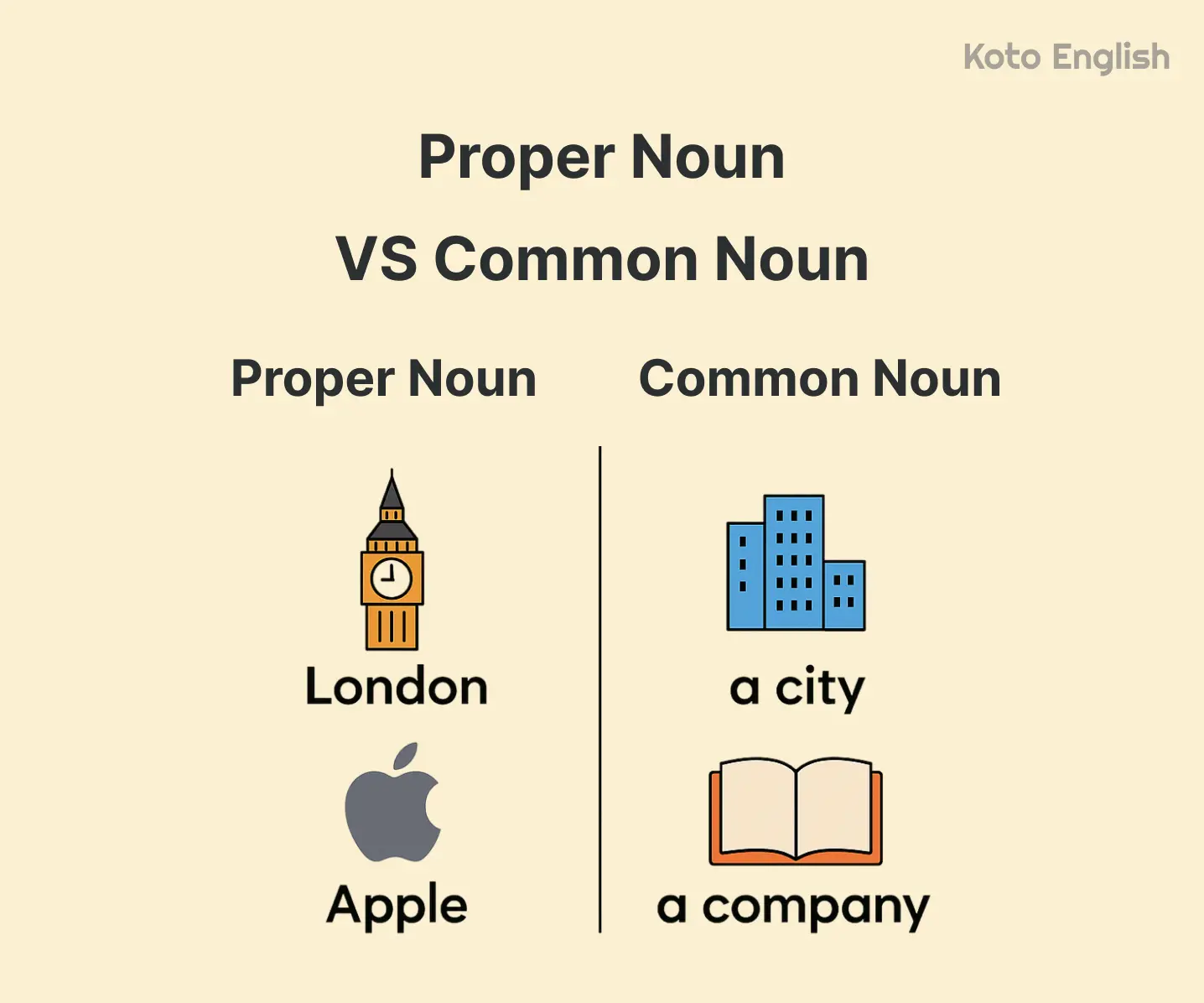
Our English specialists decided to include this point of view as common terms can be tricky and even connected to the proper ones, so new learners get confused sometimes. You have already learned the proper nouns’ meaning, so let’s focus on differentiations between them and common:
| Type | Common | Proper |
|---|---|---|
| People | writer |
Sarah J. Maas
|
| Location | city |
Los Angeles
|
| Days/months/holidays | day |
Thursday
|
| Languages | mother tongue |
English
|
| Titles | book |
Normal People
|
Here, you can define a proper noun by the capital letter, and also considering the context: if there is a specific name needed, then your option is the unique noun. If you have to say something or someone in general, you use a common type.
The context also plays crucial role in the usage of common and proper terms, as they can be combined for more detailed sentences that bring clarity to the fact, situation, or idea:
Common mistakes in usage
Some mistakes can appear among native speakers, so it is totally OK to learn, though there are some issues. You need to develop your knowledge, and one of the ways to do it is to learn from others’ mistakes. Let’s check them and learn how to avoid:
Ignoring capitalization
You can accidentally find this mistake while scrolling Reels or videos in social networks, and it can have a place in informal writing (like chatting), but the standard says that you need to write a capital first letter. Here are some proper noun examples:
|
I love april so much!
|
I love April so much!
|
|
He decided to choose a samsung tablet.
|
He decided to choose a Samsung tablet.
|
Confusing common and proper nouns
This mistake can lead to misunderstandings, especially if you use it in official communication, when writing academic papers, and more. There are some exceptions to this rule, like
|
I can’t wait for christmas eve!
|
I can’t wait for Christmas Eve!
|
|
He needs to meet me in that french restaurant.
|
He needs to meet me in that French restaurant.
|
Over-capitalizing nouns
This mistake is more common for new learners who try to add more emotions to speaking, or they simply don’t follow the grammar rules stated in the proper noun definition, which are quite strict when it comes to formal writing and speaking.
|
I want you to meet Robert, my Lovely Friend.
|
I want you to meet Robert, my lovely friend.
|
|
For my sister, Halloween is the Best Day ever.
|
For my sister, Halloween is the best day ever.
|
You have gained the knowledge of the most crucial issues that can appear when using the list of proper nouns, and it will not be a problem anymore. Further, we will define a deep understanding of their importance for you.
Exceptions for proper nouns
Not every case is common for English as this language changes and adapts to new concepts. For example, Google is the name of a company that was proper at first, but now, with years, it has become a common noun that can be written like “google” in informal style.
Also, some brands choose the small first letter to differentiate their name, just like iPhone did. You can see these examples in various series, just like the one trending “Emily in Paris.” There is a word “champagne” which was a geographical term at first, but now, we use it as a general noun.
Developing your English, you will learn more cases like this. When diving into the language context, you surround yourself with native usage, so keep your eyes wide open.
Conclusion
You have developed your knowledge of this tricky English grammar, so now, you need to put effort into practice and prepare for more complex topics. Further, you will learn about other types of nouns, their specifications, usage, and exceptions.
Keep your learning journey engaging, and you will find out that motivation is not leaving you, and discipline is strong. The Koto English platform has many worksheets and blog posts that will help you to become fluent in English, so we will meet you in another article!
Enjoy personalized learning!
Proper nouns FAQ
Simply, you just need to look for the word with a capitalized letter in a sentence, just as it is said in the proper noun meaning. To make it more detailed, you need to find a word that names a specific person or an item. Here are the examples:
For even more understanding, you can look at these two related sentences:
Jack is the personal name of a dog, so it is a proper noun that you can define by the capitalized letter and the context — it is the dog’s name.
Yes, you always write proper nouns with a capital letter in English. All these nouns, from language names, cities, countries, continents, to names of unique businesses, companies, famous historical events, and more.
You will master this topic while practicing your reading and listening skills, for example, when reading articles and noticing proper nouns, or when listening to a podcast, show, or else.
Yes, they can, for example, when you say your name, you don’t use any article. The same when you are telling or writing about the country you live in/visited, etc.:
Still, you need to remember the rules for usage of the when you point out a specific person (when two people have the same name and you mean particularly that one) and the names for geographical objects, which are followed by the which you can find in the proper noun example in the article above.
These two terms sound familiar but are different parts of speech. Let’s explain it simply: a pronoun is put in a sentence to replace the noun, while proper nouns are used to point out a specific person, thing, place, and so on. Here is the example:
You will also differentiate them by the fact that proper terms are written in capital letters, no matter where it is in the sentence.
Yes, some of them can have this form, especially if we are talking about names for people (or surnames) and locations which you can meet in articles, news, and even in books: Johns, Kennedys, Taylors.
The core grammar rule here is to add -s regardless of the ending, as you can in the term Smiths, when you don’t modify the ending, and simply add -s, which is the easiest way to form a plural noun.
Talking about common usage, we can say that it is important to follow the context of a text or a sentence. For example, if you need to use this term for an official email to your colleague, they will form the impression of your professionalism, so pay attention to the clarity.
If you need more information about some unusual cases, you can check the word in one of the vocabularies (offline or online).