
What are people nouns?
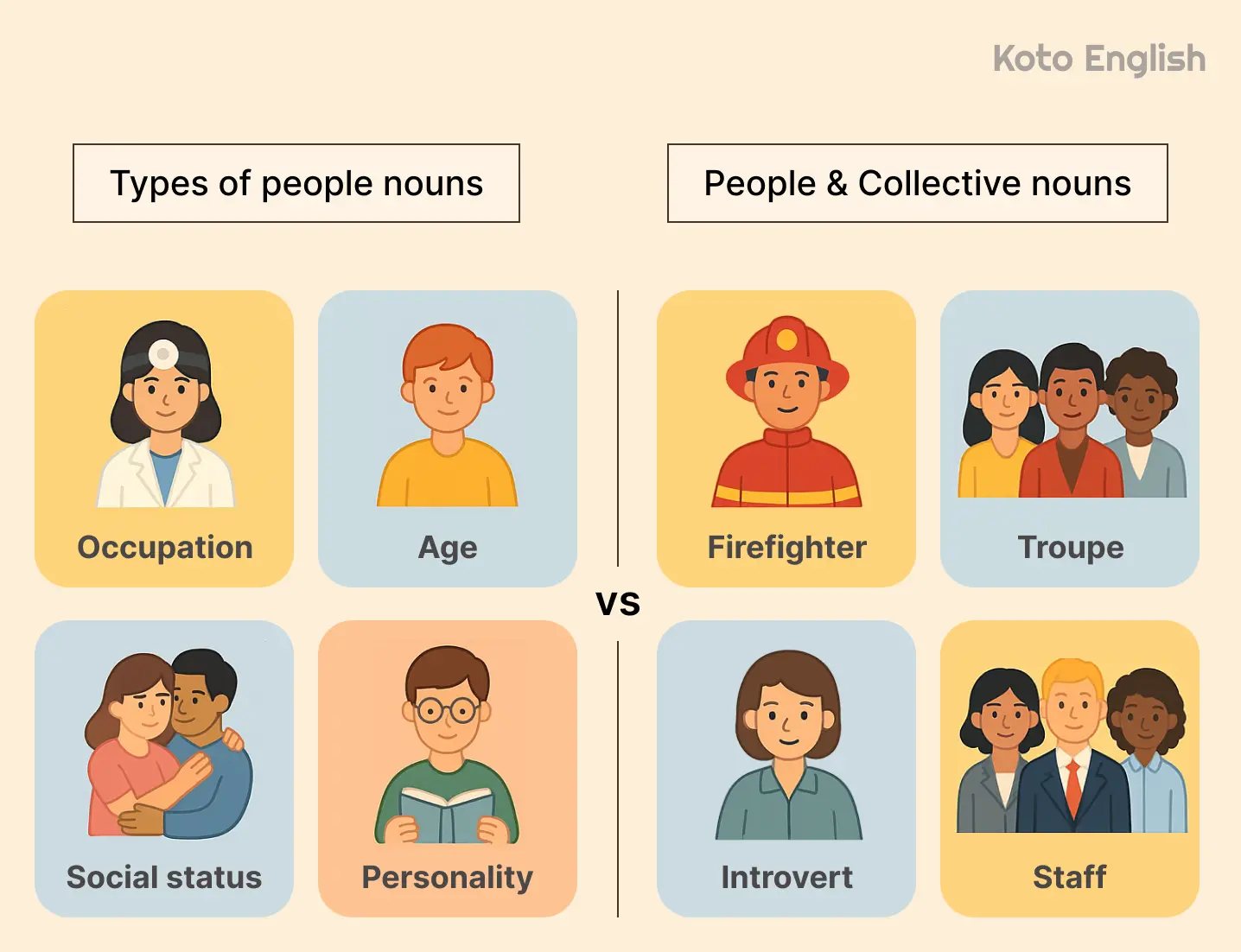
When studying English and expanding your grammar skills, you will meet the topic of a noun for people to describe other humans, yourself, relationships, occupations, and other moments.
There are a plethora of types for such words, and we will focus on collective and common categories as they are the most regular in usage. Let’s start simply — a noun in our case names a person according to what they do, like, what is their status, occupation, and so on.
For example, if you are introducing your friend to another human and you want to say more than their name, you can go like, “This is my bestie Frank, he is a teacher,” or “My closest friend Georgia is an actress!” Guess where we used nouns that name people? — “teacher” and “actress,” that’s right.
Now, you are ready to keep diving into these kinds of terms to enrich your language and become more confident using visual and practical material from our experts.
Level up your English with Koto!
Types of nouns that describe people
As you have learned the definition, it is time to keep turning a labyrinth into a straight corridor and define the kinds of nominals that can be used for various cases. We will go further than just a simple and popular list but also reveal some specific nouns of people. Let’s dive into categories used the most in everyday life, papers, literature, and so on.
By role or occupation
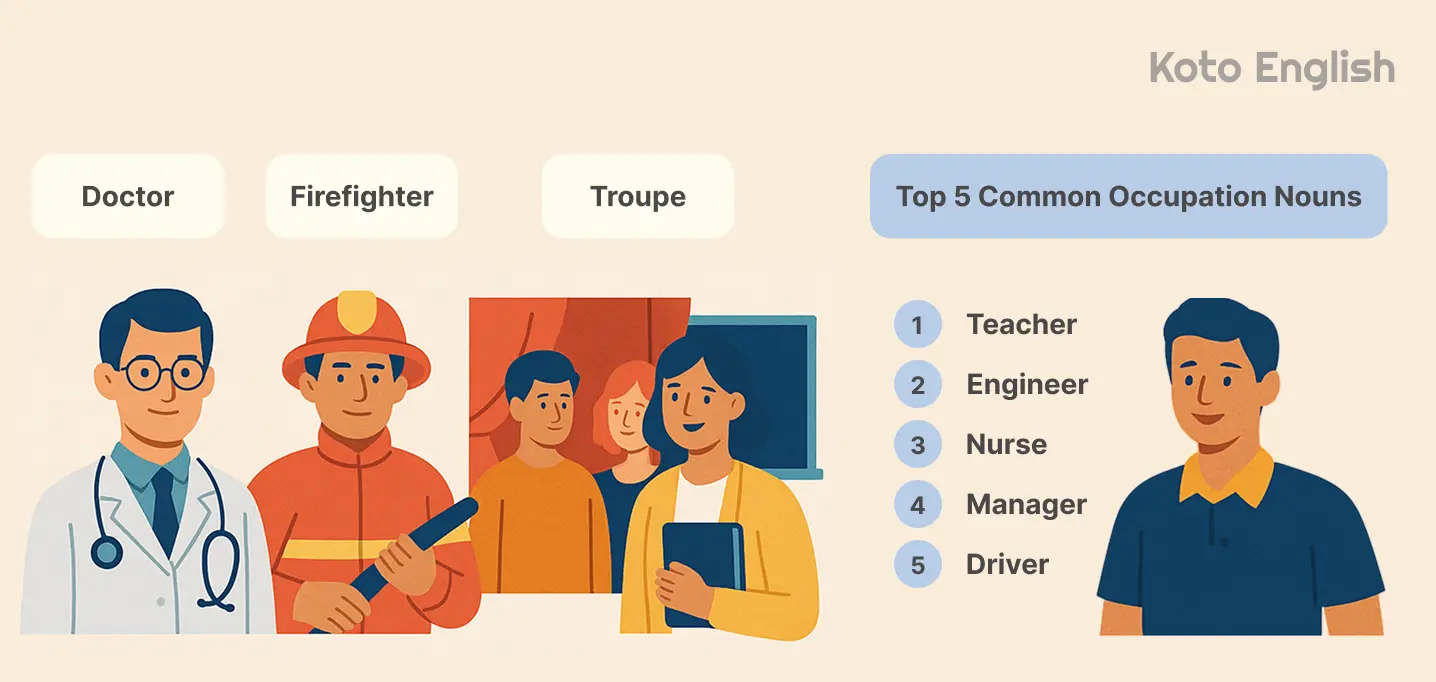
Assigned to groups of humans, this type refers to their jobs and professions (for instance, the title in a diploma). Adding this vocabulary to your dictionary will enhance your speaking and writing skills, making the flow smoother and showcasing your ability to make a story more engaging.
Here is a table of the most common nouns for people when it comes to their roles in work:
| Term | Meaning | Example |
|---|---|---|
| Doctor | A professional in the healthcare industry. |
I want to become a
Good
|
| Firefighter | An emergency worker who protects others and property from fire. |
Being a
I want to know what the typical salary is for
|
| Troupe | Used for actors engaged in one play. |
I had to join my friend’s
This
|
By relationship or social status
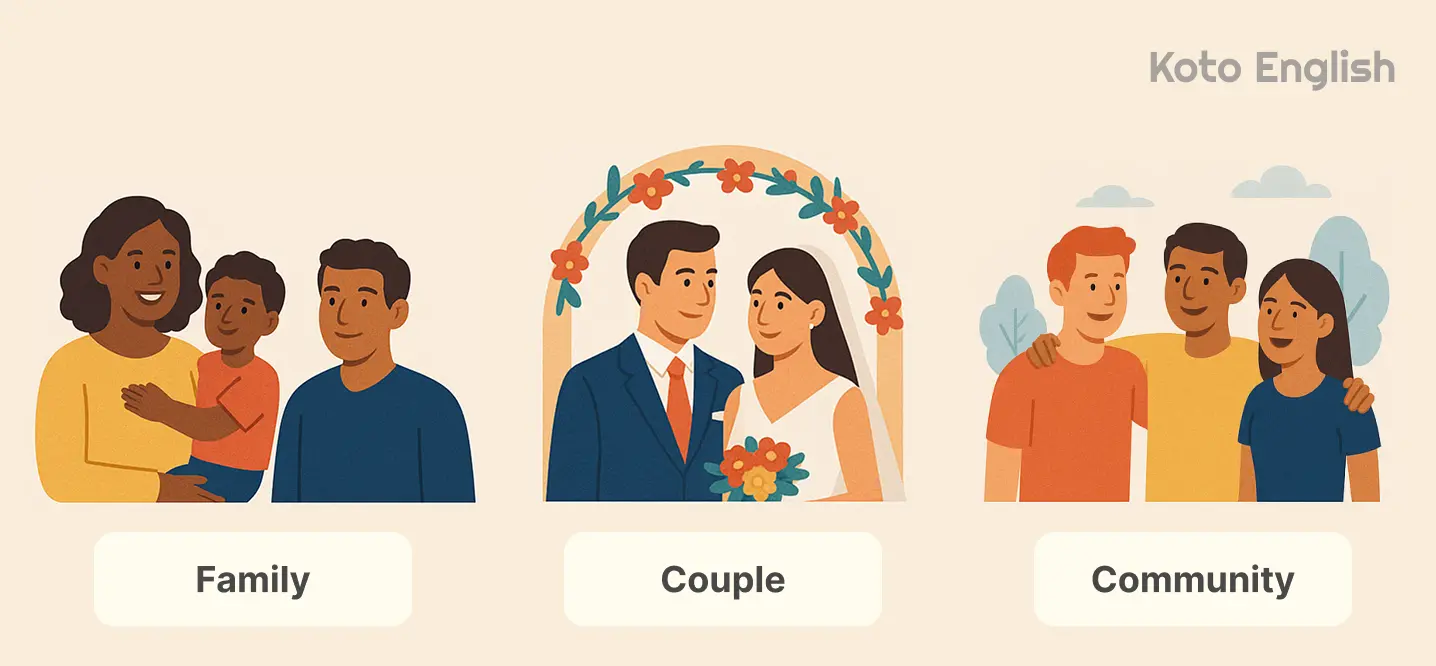
This one can be frequently used when talking about or to relatives and connected people, so it is essential to learn some of the common nouns:
| Term | Meaning | Example |
|---|---|---|
| Family | People related by blood, marriage, or adoption. |
The day you joined our
I want my
|
| Couple | Two people in a relationship. |
We became a
I just love to see them as a
|
| Community | A group of humans united by one physical place or the same values. |
He wanted to join their
We are connected as a
|
| Enemy | Someone who hates another human. |
You better don’t make me your
I adore this trope —
|
By age or stage of life
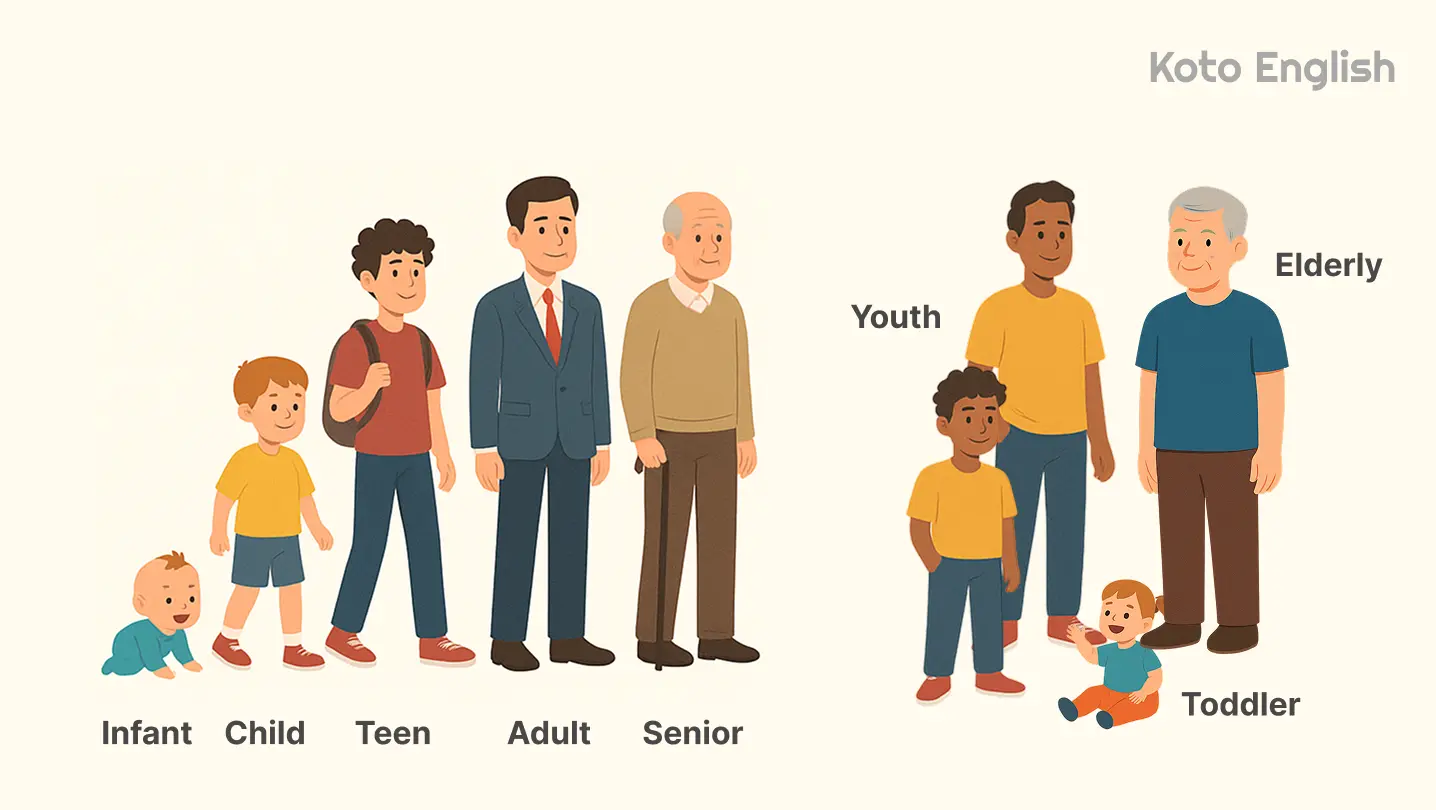
There are broad and age-specific expressions that you can see in articles, books, and hear in movies, so we will consider the most in-demand of them:
| Term | Meaning | Example |
|---|---|---|
| Children | Small people, typically under the age of 18. |
This umbrella is designed for
|
| Youth | Young persons. |
Schools are not suitable for
The
|
| Elderly | People aged 65+. |
Who will take care of the
We need to provide communication support for the
|
| Toddler | A child of 1–3 years old. |
I think my
Raising
|
There are some nuances to be mentioned: it is advised to use the definite article “the” with “youth” and “elderly” because it is a common rule for the English language.
By personality or identity
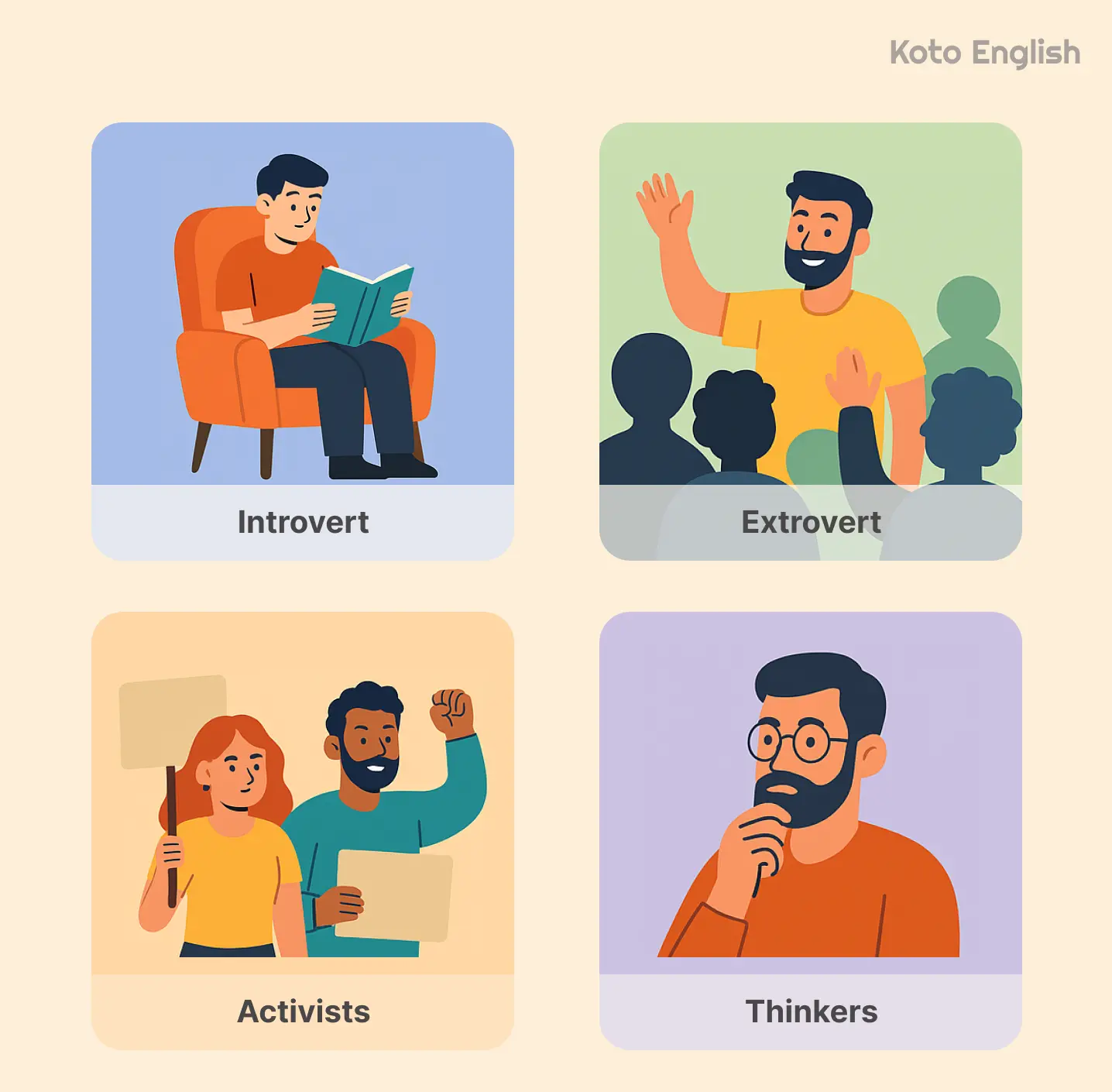
This type is the most creative one as you have to pay attention to characteristics like behavior, life position, psychological moments, and more. Let’s check the most regular ones:
| Term | Meaning | Example |
|---|---|---|
| Audience | People who are consuming content. |
She needs to listen to her
|
| Activists | The ones who make and call for actions in various sectors. |
We need
|
| Introverts/Extroverts | Refer to people who like 1) alone time with less social interactions and 2) who are after getting energy from communication. |
It’s not true that
They must be
|
| Thinkers | A human with high (self-) reflection. |
Education can be harder for
|
To put some more information, you can use “public” as a more general and neutral word, while you can choose a more specific one if it is required by the atmosphere and situation.
By group or classification
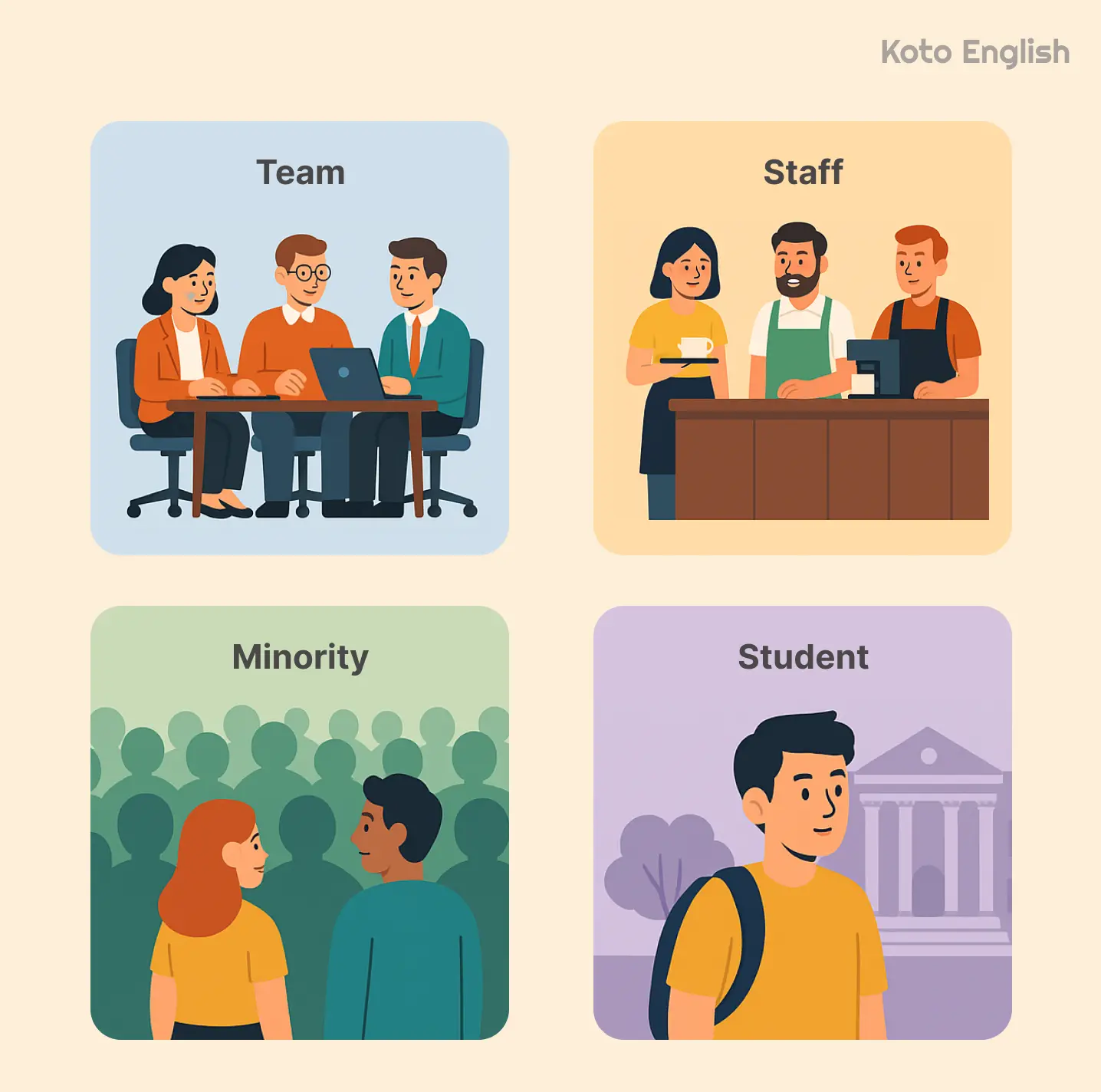
With these words, you will be able to enhance your speaking and writing, changing “some people” to more specific phrases that highlight individuality and the specificity of a context.
| Term | Meaning | Example |
|---|---|---|
| Team | People working together in the corporate world, study groups, football, and more. |
John joined our sales
The teacher brought us together as a
|
| Staff | Employees at a store, office, or other places. |
This cafe has been lacking
The CEO is close with the
|
| Minority | A small number of people inside a large group. |
Being in the
The
|
| Student | Someone who studies at a university. |
There’s nothing better than being in love when you are a
|
After reading this material, you are a pro in grammatically correct sentences with nouns that indicate people according to their job, beliefs, and so on. For now, let’s investigate this topic in more detail to perfect your English.
Singular vs. plural forms of people nouns
Stage-by-stage, we have come to the crucial point of differentiating various setups for one person and more of them, and your goal is to learn how to use them properly, and what the grammar rules are following this topic.
The point here is that turning singular into plural is a piece of cake — you just need to add
teacher → teacher
friend → friend
mom → mom
It is easy-peasy, right? Stay with us as we are going to explain the nuances of irregular nouns to describe people:
man → m
woman → wom
child → child
person →
They need to be learnt by heart as there is no grammar explanation and rules, so your way is to practice them, luckily it will be easy as we talk about other people all the time (see, even here).
Countable vs. uncountable nouns for people
Distinguishing these types can feel like a battle for new learners but once you make it make sense, you will use them without thinking about the correctness. Humans definitely can be counted and described with a proper noun — a person for 1 and people for 2 and more.
Countable:
Uncountable:
Sometimes, you need to make an abstraction about people worldwide, like an idea or the whole population. It is advisable to put humanity, the human race, society, nation, and related people nouns in English because you mean all of them together, not a number.
We believe that this part of the article was helpful in your learning journey, and you have learnt the basics which will lead you to more enhanced English usage as you will study more complex grammar concepts.
Common mistakes and confusions
Only the practice and knowledge of possible errors can make you a master of English, so our specialists decided to include this part, displaying areas that are typically too tricky for students and the list of people nouns needs to be promoted with more explanation.
-
Confusing people and person
It may not be a big deal but it leads to misunderstandings as you may say “person” meaning a few of them, and your listener will not get it, especially if there is a lack of context. As well, if you are about to pass an IELTS or other exam, it will decrease your points in the speaking or writing sections.
There are two person.There are two people. -
Job titles vs. traits
Let’s imagine you are describing (formally) your colleague, and you provide a description of her which sounds like a role but not an occupation. It gives more precise information about her job, not her personal qualities.
She is the leader.She is the manager of our team. -
Overgeneralizations
It is a common mistake you can find in texts when the author says something like “elderly are boring” meaning all of them are like this, and it is not an emphatic phrase for a group of people called.
Youth don’t read paper books nowadays.Some youth don’t read paper books nowadays.Tip: If it is not proven by a trusted source of information, you better not use broad nouns to describe the whole profession or age group, and focus on more accurate data.
Further, we will consider the suggestions that will help you avoid any mistakes, provided by experienced learners.
Practical usage tips
As you have determined the answer to an intricate question, “What is a group of people called?”, even types and nuances, let us provide you with some advice to make the learning process easier. Here is what we got:
-
How to choose a correct noun according to the context?
It is all about your ability to read the text and read the room (understand what is going on in this moment) as you need to be more specific:
health worker → doctor
colleague → work bestie/buddy/friend
fireman → firefighter (if you don’t know the gender) -
Turn to dictionaries and look for synonyms
You need to define the meaning and then choose analogies to enhance your vocabulary and avoid repetitive sentences. We have mentioned the word “leader” above, and you already know the synonym “manager,” but there are also “head,” “supervisor,” and so on.
-
Stick to formal and informal language
It is simple here: you can use “guy” when talking to friends but it is preferable to say “man” if the situation is more formal. Pay attention to respectful forms of collective nouns for the groups of people we listed above, and you will do it correctly.
You are mastering your English with every part of this material, and for now, you are a pro in understanding which words to use to name people. Follow our tips to make your speech and writing smooth and understandable.
Conclusion
Collective nouns that you can use for humans make your speech richer and more nuanced, bringing details into communication, whether you are preparing for an IELTS test, presentation, conference, job interview, or else.
Recall the information you studied above and develop your grammatical accuracy with Koto English. You can expand your vocabulary, make your sentences more readable and easier to understand.
Enjoy personalized learning!
Collective nouns for people FAQ
At its core, this question has a straightforward answer which sounds like “Collective ones can be used as plural and singular, while plural is obviously referring to more than one person.”
For instance, you can say “family” and it seems to be a singular form but means plural, so you can differentiate it from other expressions, as well as pay attention to the context. When it comes to the plural form, you will meet “-s” at the end of a word: friends for example.
To put it simply, you need to ensure the choice includes people roles and professions (depending on the type of material you prepare), and here are some of the most accepted nouns that can be added to your essay, presentation, or else:
- group, which perfectly suits a few experts,
- assembly, which is more formal and can refer to an organized arrangement,
- audience — can be used for live presentations and conferences,
- team — when you refer to your colleagues or employees,
- panel — more of a science-oriented term.
Yes, that’s definitely true. Moreover, you are able to use a collective noun for people and for animals. There is a plethora of such terms that can be applied to various types of creatures, from birds to lions.
For the last one, you can use “pride,” which indicates that these nouns (collective) differ from the ones we use for people, so we will consider this material in our next blog post.
Here is a simple trick: define if you need to talk to the whole group as one organism, then you choose “is,” or you would like to indicate some specific part of it, or individuals and need to put “are.” On hand, this is how it works:
Tip: some nouns like “police,” “people,” “cattle,” and others are always plural no matter the sense you are putting into a sentence.
In such a wide topic as nouns for a group of individuals, there is a lot of space for imagination, so let’s consider some of the most extraordinary nouns you can meet in literature, everyday communication, music, and so on:
For example, you can find a squad, a flock (for tourists), a giggle for a few girls, never thriving for jugglers, a clutch for wrestlers (and suno as well), and more. You can also use the word “huddle” when talking about teenagers, and it may sound a bit uncommon for those who have just started learning this topic.