What is a second-person pronoun?
This term refers to the point of view when you need to point out a person or people who are being addressed in a sentence. For example, it is widely used daily when you are talking to your relatives, friends, colleagues, classmates, or even a seller in your favorite bakery.
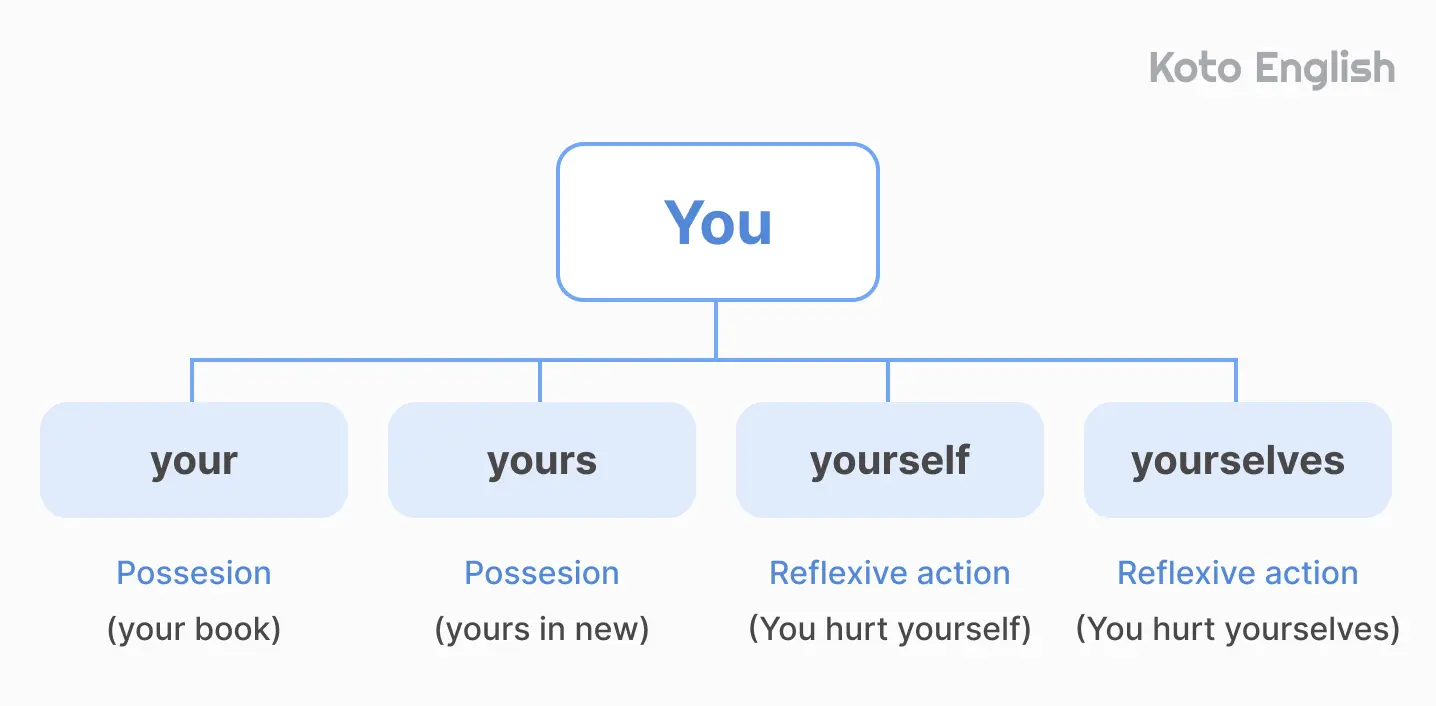
The second-person pronouns definition is both simple and tricky: it stands for you, your, yours, yourself, and yourselves, which can be both plural and singular:
| Before | After |
|---|---|
|
Henry, dear, need to clean the room before going on this trip.
|
Henry, dear,
|
Visual comparison of command clarity with and without the second-person pronoun:
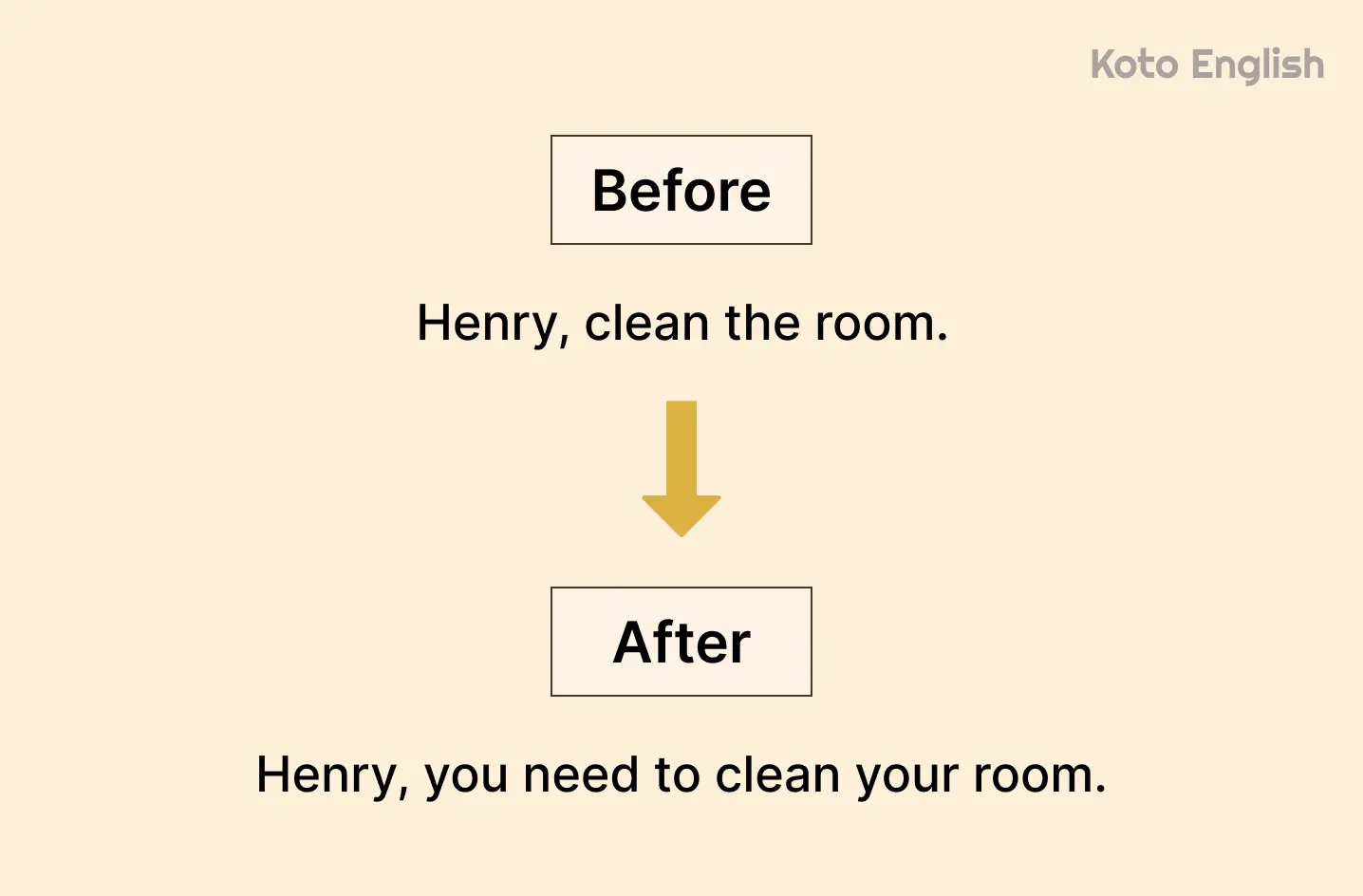
As you can see, it is all about more clarity in who you are speaking to, giving commands, advice, propositions, and so on. In the first sample, there is a name but no concrete information given, so it can refer to Henry, or for him to spread the information to someone else. The second one is more precise.
Level up your English with Koto!
When to use them correctly
As you have answered the intriguing question, “What are second-person pronouns?” it is time to move forward and learn a few fundamental rules to sound like a native speaker and avoid miscommunication.
-
Use it directly on someone
Can you imagine addressing a point to no one in particular? Probably not because it looks weird, so the first regulation tells you to implement pronouns like this:
Areyou busy? I needyour help with this presentation.I didn’t seeyou there. Wasn’t this partyyours ? -
Put it for more engagement
Common for many blogs, the list of second-person pronouns allows authors and performers to make better connections with target audiences, being informal and friendly at the same time:
You need to hear this before someone else does!Isn’t ityour chance to improve your life? -
Write it anywhere in sentences
There are no strict rules as you can place you at the beginning of a text, in the middle or even at the end, still following grammar regulations of course. Here is how it looks in practice:
Was this film aboutyou ?I thought it was notyours , but anyway.
Further, you will learn three core styles when this pronoun can be implemented for you to sound more confident, whether your goal is to start a blog, write better essays, or just communicate with other people.
How to use second-person pronouns?
For now, let’s check the actual usage in various circumstances so that you are familiar not only with the second-person pronoun meaning but also with real-world examples. They will help you to speak and write fluently whether you are a student (or going to be one), a worker, or just a human having fun with learning English.
In informal communication
Pointing at someone you are talking to or about is possible with the second-person word “you,” which has to be used accurately. Here are some common situations and cases where you can implement it:
-
Friendly tone: such a reference makes your words sound more conversational and smooth, for example, when you are writing comments in social media, some posts, or personal emails.
You can also hear this form of address from bloggers when consuming their content as they use “you” when talking to viewers to make this personal and build warm relationships, to make the audience feel included. It seems as if you are sitting with your friend and discussing something.
If you are interested in more life-related second-person pronoun examples, you can apply this for reflective sentences, belongings, and so on. For example, “You won this game, why aren’t you proud of yourself?” And this phrase is simultaneously friendly and mindful, as you are talking to a person directly.
-
Clearer message: it is not always obvious who you are talking to at the moment if there is more than one person, so the indicator “you” allows you to signal to a listener that he or she is the topic of your speech.
You definitely see the difference between “Better go there,” and “You better go there.” In such a way, you will avoid any confusion and continue the conversation flawlessly.
The core moment here is to pay attention to your tone and the vocabulary you use because being friendly is cool when you are respectful, and don’t use slang or specific idioms if they don’t fit the atmosphere.
In marketing and copywriting
The second-person pronoun definition for these industries is defined by the fact that they are aimed at advertising and making connections with clients. Here, speakers keep the personal connection and add advertising material to persuade someone to buy their goods or services.
Here are some common expressions used by marketers and copywriters in terms of the “you” pronoun:
- “You will” and “you can” forms highlight the benefits a reader can receive from some products, which allows them to try on an experience that a business offers. It also makes it personal in a good way, showcases the problem it will solve for the particular person, and more.
- “You are” is also a strong tool focused on building a correlation between propositions and the values of a customer. How does it work? — Write, “You are that person!” in a reliable context, and it balances the text for the client’s side.
It works because sometimes people want to read about themselves and it is an easy way to make them feel heard.
In technical or instructional writing
When it comes to such a formal form, you can use a second-person pronouns list as usual, also engaging a viewer with “you” and “yours” or even “one” and “ones” depending on the level of formality that varies from one organization to another.
Before:
“To create a new account, press ‘Add’ and enter the required information.”
After:
You can create a new account by pressing the “Add” button. Then, you need to enter the needed information.”
However, if you are a university student writing an essay, it is recommended to avoid certain “you” usage and use “one” as an analogy which will be more suitable for such a piece of paper.
Second-person pronoun examples in sentences
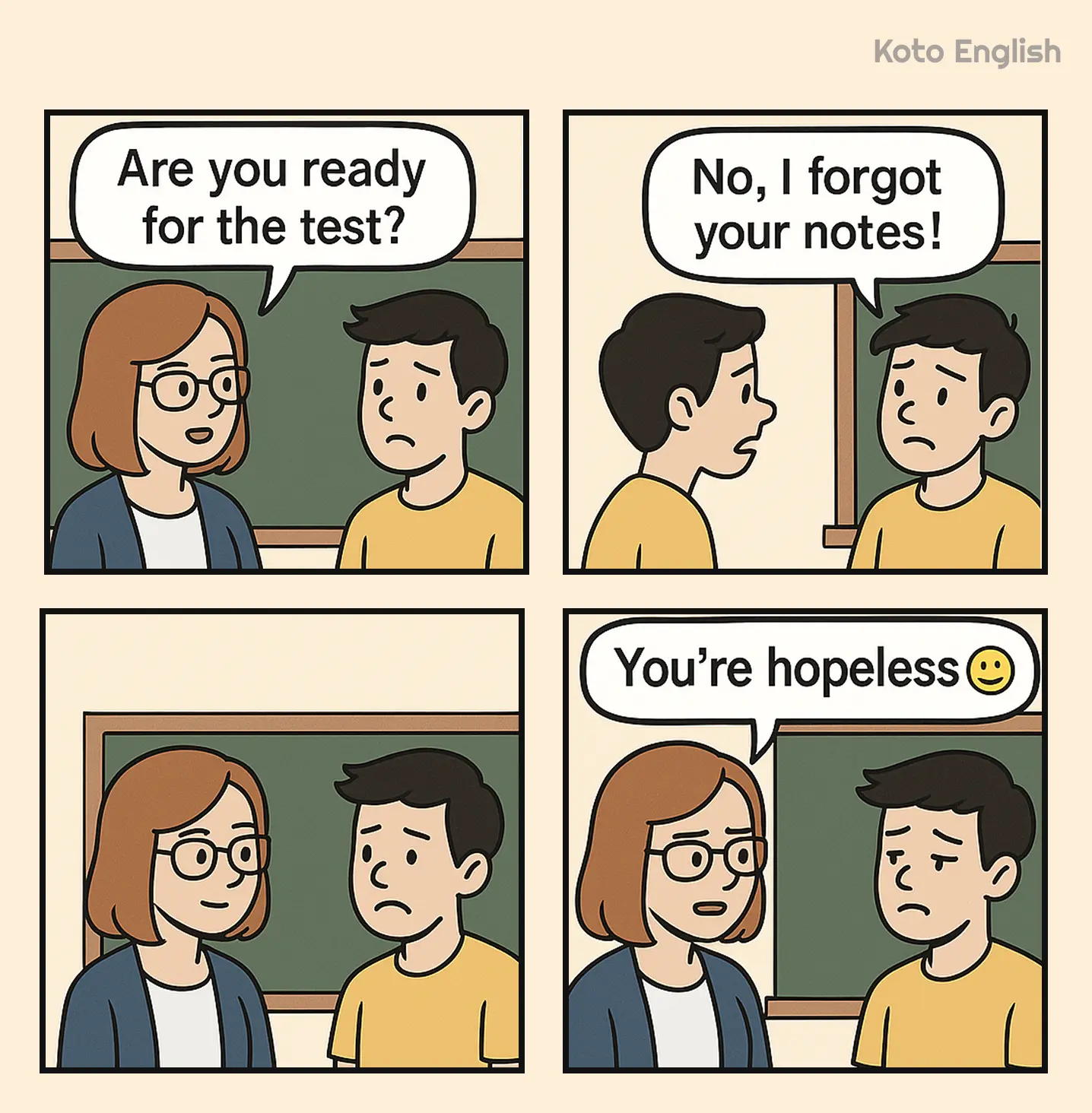
The “you” is widely used in our daily communication, when you speak to someone directly, referring to them and using it as both singular and plural forms (according to the context). Here, you will learn about the real-life samples for a better understanding, though it seems to be a simple topic.
Let’s consider “you” when it is implemented in various types of sayings that you can use when speaking with relatives, friends, colleagues, teachers, and other people.
Positive sentences
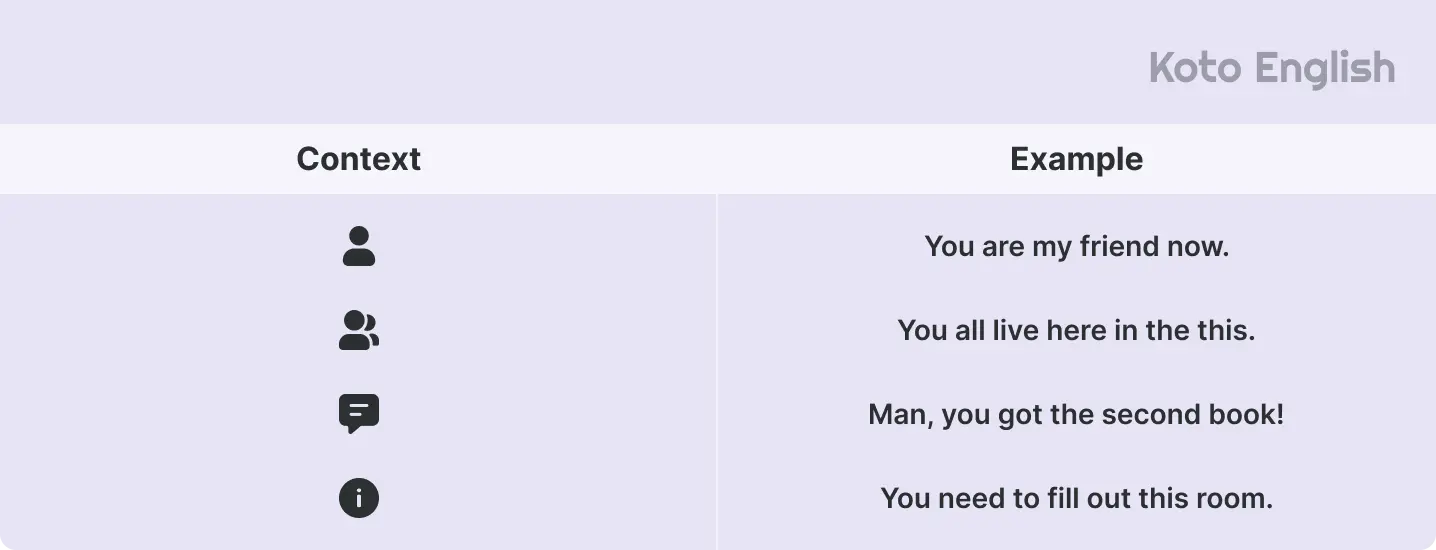
You are able to say something that is valid to you or others, and here are some samples you will find helpful:
| Case | Tone | Number | Example |
|---|---|---|---|
| A message to a friend | Informal, friendly | Singular |
|
| Motivational statement | Informal | Plural |
All of
|
| Suggestions (plural or singular) | Informal | Both |
Man, you got the second book! It seems that
It is your second slice. Do
|
Negative sentences
They are used to indicate that something is not true, for instance, when a speaker uses words “no,” “never,” “no one,” etc.
| Negative form | Tone | Number | Example |
|---|---|---|---|
| You are not | Informal | Singular |
|
| You don’t (do not) + verb | Neutral | Plural |
|
Questions
This type is used everyday when you want to ask something and get more clarity on some nuances.
| Question type | Context | Example |
|---|---|---|
| Are you..? | Casual conversation |
|
| Do + you | Clarification of something |
|
As you can see from the tables above, there are a plethora of situations where second-person pronouns examples are used, from describing some activities to your emotions, something that you like and don’t like, even telling about others or giving instructions.
For you to learn more about this grammar, we will consider errors that take place in communication even between native speakers so that you will escape all of them and become more fluent.
Common mistakes to avoid
This concept looks easy as there are only a few terms to remember, but it can be problematic once you dive into the usage with verbs and adjectives, so here, you will study the familiar errors for all learners worldwide.
Confusing you’re and your
They look similar and sound like short forms of “you are,” and here is the moment that only you’re can be used like this, while your indicates the fact that something belongs to a person.
|
Your taking the same class
|
You’re taking the same class.
|
|
It looks like your struggling with the text.
|
It looks like you’re struggling with the text.
|
Put you with a wrong verb form
Sometimes, students think like this, “If I need to talk to a woman, then I need to use is with you,” and that’s a wrong point as it is always you are. Here are examples of second-person pronoun in such a case:
|
Sarah! You is so gorgeous!
|
Sarah! You are so gorgeous!
|
|
Is you going to the ceremony?
|
Are you going to the ceremony?
|
Don’t be afraid of mistakes as you make perfect making them; moreover, they mean that you are working on getting better in English.
Summary and actionable tips
For now, you are a pro in using this pronoun in sentences that refer to various life situations, making your conversations and messages clear and natural. Keep practicing using our materials, and let’s meet on another topic!
Enjoy personalized learning!
Second-person pronouns FAQ
Yes, “you” can indicate one or many persons, but it also depends on the other words you are using in the sentence, for example, “all of,” “guys,” “y’all” (for more informal speaking), and more.
There are also various dialects and forms of speaking that differ from state to state in the USA, and there, you can meet words like “yinz,” “youse,” and others.
In academic writing, according to the information provided by St. Louis Community College, “you” gets replaced by nouns. Still, you can use it freely for emails, work chat, and pay attention to the context.
Remember about the third-person perspective when you are working on essays and related materials, as you need to be more formal and provide a review of a theme from not your perspective but overall.
These generic pronouns are usually used shoulder-to-shoulder when it comes to naming someone in general, but there are differentiations in these second-person pronouns in English.
It is advisable to use “you” for more informal communication or when you would like to make a connection with the reader, as writers do in blogs. When it comes to “one,” it is an old-style pronoun used to create a wider context, like “One should be working hard.” Instead of putting “you” as a form of address.
Though “you” is definitely used in all types of writing and speaking, you need to pay attention to how you combine it in a sentence, and which lexicon you choose and how rich it is.
Let’s say you receive a work email from your customer or a colleague, which starts with, “You! What’s up? Did you receive my last letter?” In these examples of second-person pronouns, they used it correctly as a grammar point, but together with such a slang expression, it sounds too informal for such a situation.
How to make it more professional? — Add a name and Ms./Mrs. or Mr. at the beginning of your message, and then use “you” as always. “Hello, Mrs. Jones. I wanted to ensure you received my last letter.” is much more formal and suitable for such communication.