What is a demonstrative pronoun?
When you talk about things you have already mentioned but don’t want to repeat them, you can use demonstrative pronouns instead. There are four words, this , that , these , and those , which you choose based on what you want to say.
Talking about objects, people, or animals next to you or far from you, you can easily use these pronouns.
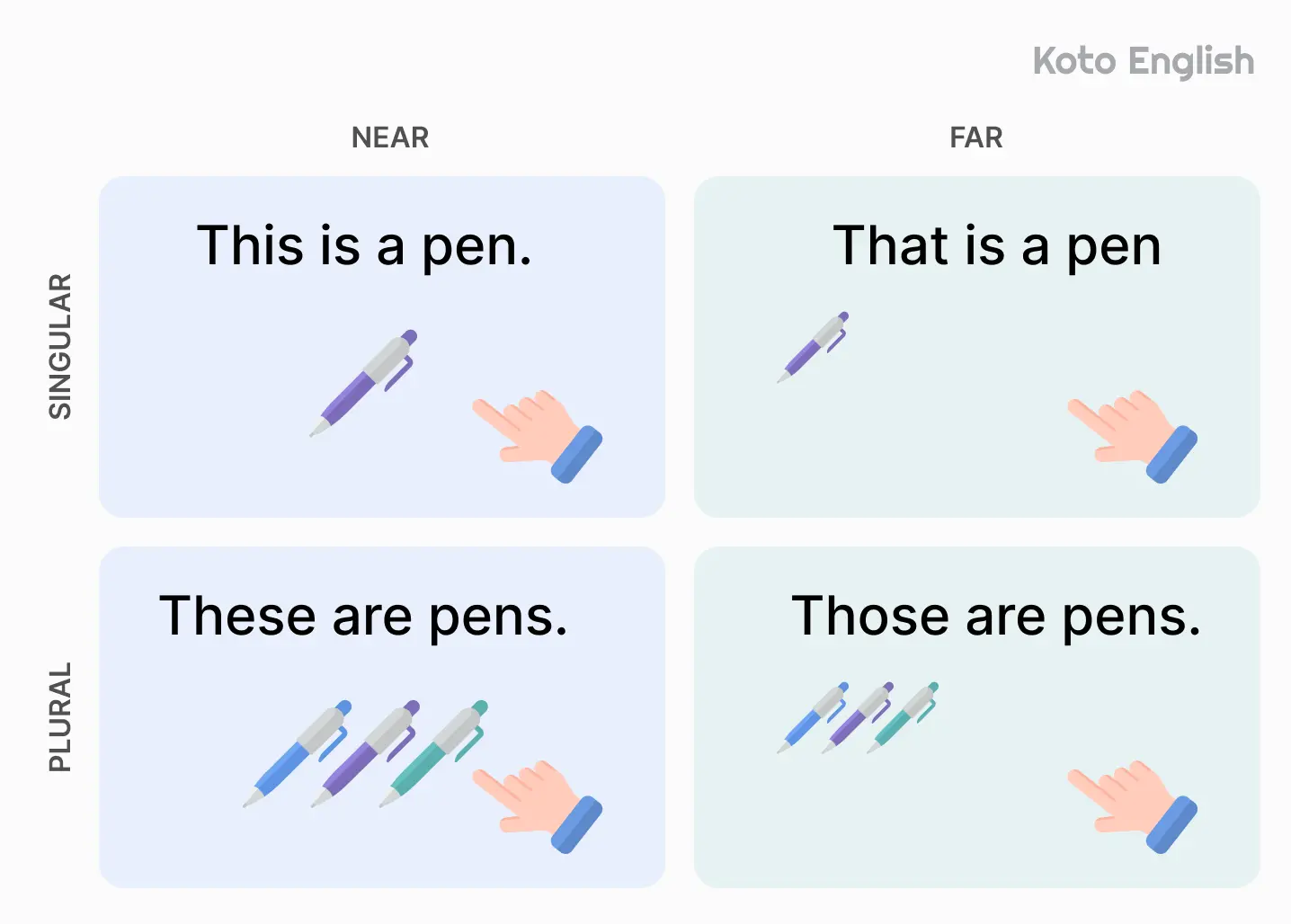
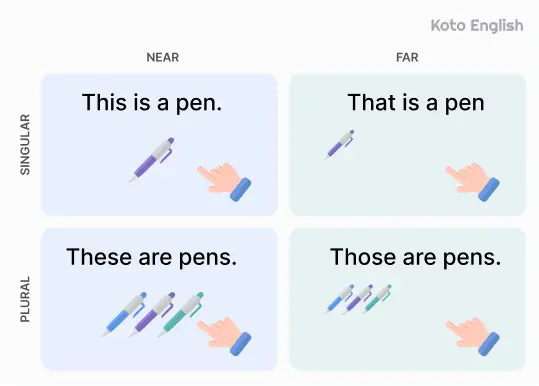
Let’s look at some demonstrative pronouns examples:
As the demonstrative pronouns definition becomes clear, we move on to the usage tips.
Level up your English with Koto!
When to use them correctly
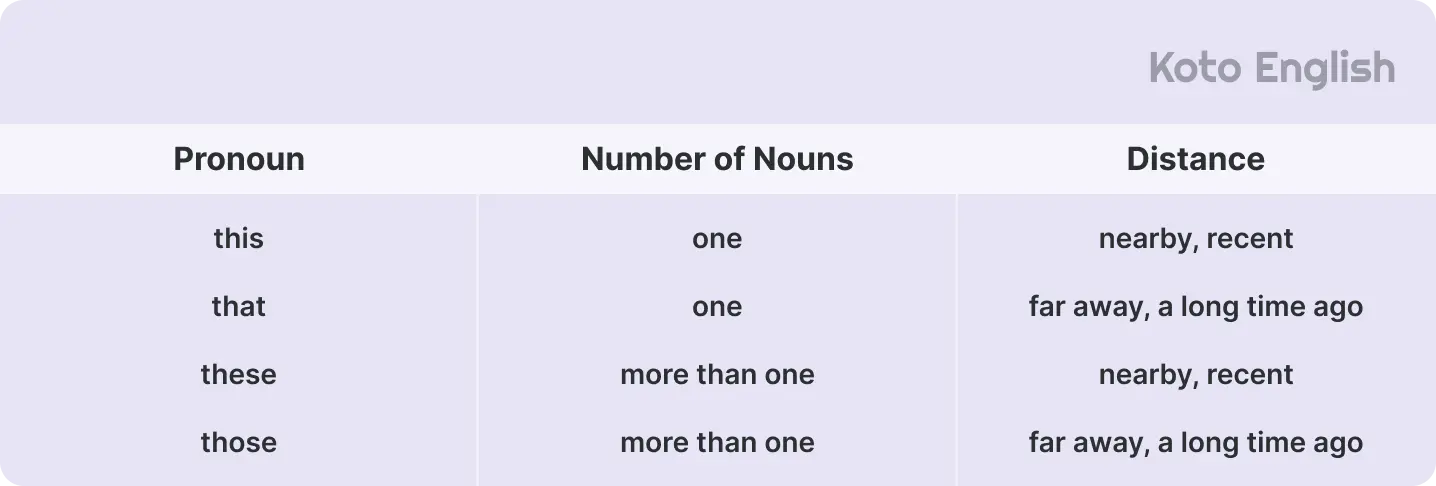
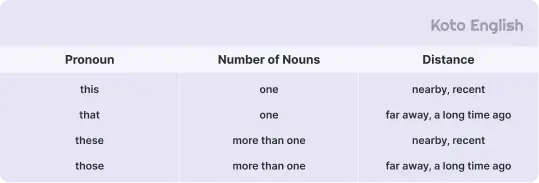
The pronouns allow you to express different thoughts, covering aspects such as time (whether something happened in the past or present), distance (a place, near or far), and the number of items or things (singular or plural).
| Pronoun | Time | Distance (physical and abstract) | Number | Example |
|---|---|---|---|---|
| This | Present | Close, near | Singular |
|
| That | Past or future | Far | Singular |
|
| These | Present | Close, near | Plural |
She won’t remember
|
| Those | Past or future | Far | Plural |
He wrote many books about
|
As you can see, you have the opportunity to refer to specific times, places, people, and more. In the next segment, we are going to look closer at the list of demonstrative pronouns and their nuances of usage.
How to use demonstrative pronouns
There are multiple ways in which these pronouns can be used, as they help emphasize the distance of items and time. Study each detail carefully and read the demonstrative pronoun examples we prepared for you.
Take into account the number
What number of people or possessions do you want to talk about? That’s what you need to do:
Rules:
-
Use this and that referring to a singular or uncountable thing.
This is the house I always wanted to buy.That was the game I received for my birthday. -
Use these or those when speaking about multiple objects.
These are the shops I visit each week.Those were the careers I considered.
Spatial use
The choice of pronouns is tied to the place where it is. Is it far from you? Can you touch it? Or is it in another room, building, or even country?
Rules:
-
This and these are used to talk about one or several objects near the speaker.
This is here.These are with me. -
That and those will help you to discuss things that are far from you.
That is far. Those are not inside my house.
Position in the sentence
As pronouns possess nouns’ spots, they can be placed in several positions in a sentence. Let’s look at the variations:
Rules:
-
At the beginning of a sentence, instead of the subject.
This is the time I need to study hard. -
Instead of the object.
You won’t remember that. -
As a complement.
The reason is this.
Formal and informal usage
Whether you want to express your feelings, emotions, or attitudes toward something in an informal way, you can do that, as well as reduce repetitions of the concepts you describe in formal contexts:
Rules:
-
Applied in scientific and academic contexts to refer to the mentioned idea. (formal)
This illustrates the importance of relying on green sources of energy. -
Help to emphasize emotions, nostalgia, and strong feelings. (informal)
That was awesome.These are cool.
Examples of the demonstrative pronoun
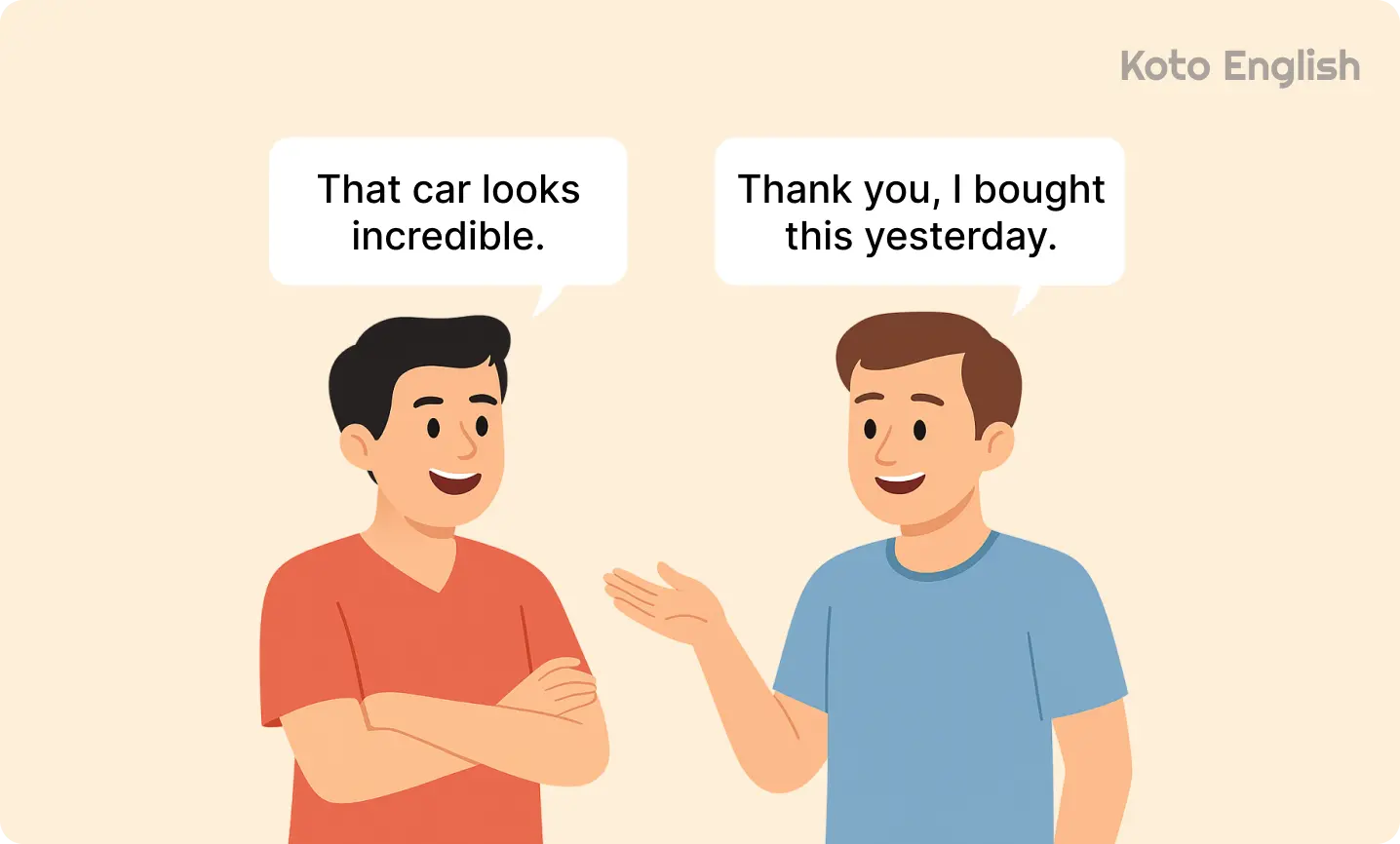
The best way to get a good grasp of the grammar, apart from knowing the demonstrative pronoun definition, is to read as many instances as you can to see the patterns and small particulars. Further, you will find some examples we gathered for you, categorized into singular, plural, and mixed instances.
This/that – instances with singular nouns
You want to specify one thing, then choose these pronouns:
| Pronounce | Example |
|---|---|
| This |
There are many gyms here. I always go to
|
|
I know many worthy brands, but
|
|
| That |
How can it be that you don’t know about
|
|
|
These/those — examples with plural nouns
Remember, when you create a sentence where a pronoun takes the place of a plural noun, then do this as it is in these examples of demonstrative pronouns:
| Pronoun | Example |
|---|---|
| These |
Are
|
|
|
|
| Those |
Were
|
|
|
Cases in context
Now, look at the mix of instances to be able to understand and speak confidently:
Demonstrative pronouns vs. demonstrative adjectives (determiners)
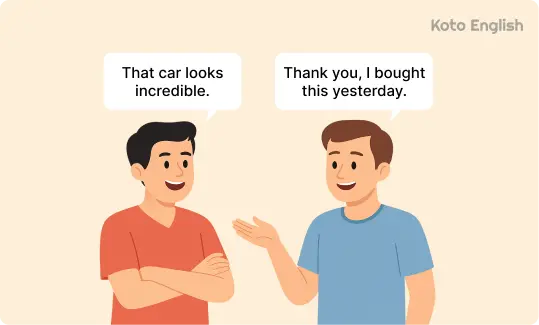
Speaking of the dialogue instance from the previous section, you may have noticed that we haven’t highlighted each this, that, these, and those in the text because not all cases have demonstrative pronoun meaning. Some examples include demonstrative adjectives or determiners, and the rules of their usage differ.
| Adjectives | Pronouns |
|---|---|
| I want to watch this movie. |
|
| That website was too slow. |
|
| These people need my help. |
|
| We will buy those shoes. |
We will buy
|
Here are some tips to take into account:
- They are the same words, but serve absolutely different roles.
- Adjectives modify nouns, and pronouns replace them (both subjects and objects).
- With pronouns, we don’t need a noun. With adjectives, we need to use nouns, as they always follow them.
What are demonstrative pronouns? Now, you know that. We studied the most important grammar points, and now we are going to explore some confusing aspects to polish your knowledge.
Enjoy personalized learning!
Common mistakes
Even though the rules seem simple, it is quite easy to make many mistakes when you are just starting to learn this grammar. Keep reading to discover some frequent errors learners make when speaking and writing sentences with the demonstrative pronouns list.
Choosing plural pronouns instead of singular
When you want to discuss one object or a person, you need to stick to this or that.
|
These is the cat that doesn’t eat fish.
|
This is the cat that doesn’t eat fish.
|
|
Those is the child that goes to a private school.
|
That is the child that goes to a private school.
|
Selecting singular pronouns in place of plural
On the other hand, when you mention several people, objects, and so on, you need to opt for demonstrative pronouns for the plural.
|
That are the specialists who are looking for a job.
|
Those are the specialists who are looking for a job.
|
|
This are the lessons that will improve your English level.
|
These are the lessons that will improve your English level.
|
Using the plural pronouns with uncountable nouns
If we can’t count a noun, it can’t be plural. It means, with uncountable words that include liquids, abstract nouns, and many other words, we can’t use these or those.
|
Those are the butter we always buy.
|
This is the butter we always buy.
|
|
These are the furniture that cost more than my apartment.
|
This is the furniture that costs more than my apartment.
|
Final tips for learners
From this grammar guide, you need to remember the following points. First, don’t confuse pronouns and adjectives. Second, remember about the number and distance: choose this and these when something is close, select that and those when an object is far. Try writing your own instances to practice usage, and you will be able to level up your English.
Enjoy personalized learning!
Demonstrative Pronouns FAQ
When you need to choose between that and those, you need to pay attention to the number of things or people you want to talk about. If you mention 1 object, which is far from you, then you need to say that. Are you going to talk about places, people, goods, and houses in the plural? Then you must use those.
Yes, you definitely can use demonstrative pronouns without specifying a noun. There are three rules you need to follow to create such sentences correctly:
-
Ensure that the person you are talking to understands what you are referring to. (Point it, mention the thing one time, and then change it for a pronoun).
The underground is the fastest way to travel from one part of the city to another. This is safe and cheap. -
Express what you have in your mind.
This sounds ridiculous! -
Introduce new information.
These are the reasons I want to go to Japan.
Certainly, they can, however you need to be aware of the contexts and rules of the usage. These are the cases you can be sure about:
- Introduction. You can introduce the people you know to your friends, relatives and colleagues by using demonstrative pronouns in English. It is going to be the following: This is my sister, Julia.
- Pointing a person out. It is correct to say “that is the man who bought my car” or “those are the people who lived next door”.
Can you change men, women, teachers, doctors, and many other words to use pronouns? Theoretically, it can be done, but such phrases will be considered rude.
These two words are close in meaning, but there are some distinctions between them.
You use this when you talk about something new, a thing that has been introduced recently, and is placed near you. By using this, you emphasize or point to an object.
At the same time, it is used to mention something you knew, regardless of where and when you discovered it. It is neutral in relation to emotions, and exists to replace a noun in order not to repeat it many times, instead of stressing a point.
Using demonstrative pronouns in formal texts helps describe ideas clearly, without repeating the same long phrase again and again. This allows your writing to be understood by others, as it is shorter and doesn’t have extra information that could lead to confusion.
Look at some examples of a demonstrative pronoun with phrases before, without pronouns, and after, to see the difference between them:
| № | Before | After |
|---|---|---|
| 1. | The business has many ideas on how to make its clients happy. Making its clients happy is one of the ways it generates money. | The business has many ideas on how to make its clients happy. This is one of the ways it generates money. |
| 2. | It is important to use a good booking website. It helps ensure a safe and positive travel experience. | It is important to use a good booking website. This helps ensure a safe and positive travel experience. |