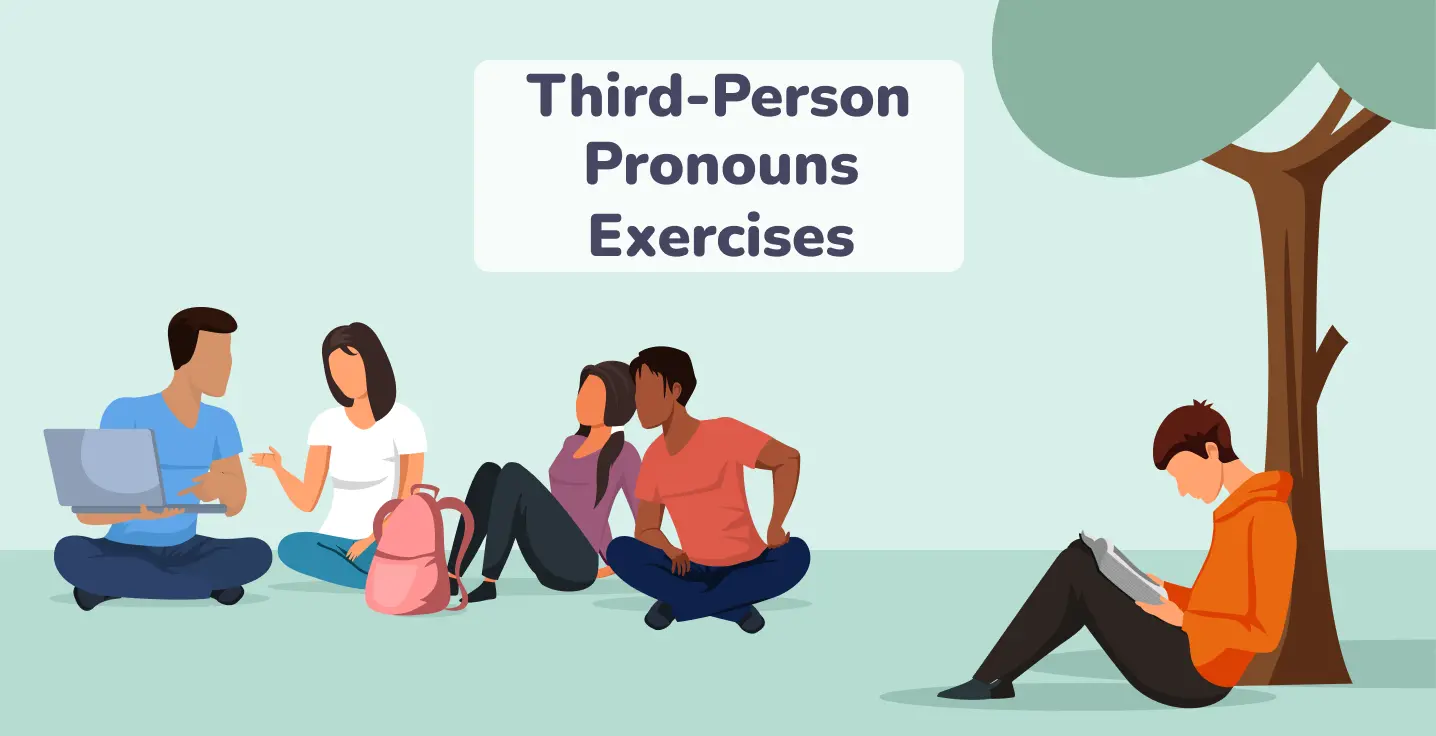
Third-person pronouns exercises
How third-person pronouns are used in everyday English
In everyday English, he, she, it, and they help us refer to people, animals, or objects without repeating their names. Speakers use pronouns because they want to avoid referring to the same noun throughout their speech, thus boosting their fluency.
It makes sentences shorter, smoother, more understandable, and easier to read. People use these words throughout their daily conversations, in their basic explanations, and in their fundamental storytelling activities.
| Pronoun | Used for | Example |
|---|---|---|
|
He |
one man/boy |
He is my brother. |
|
She |
one woman/girl |
She is a teacher. |
|
It |
one thing/animal |
It is a cat. |
|
They |
people or things (plural) |
They are my friends. |
Tips before you start the exercises
Before you start the exercises, take a moment to think about how third-person pronouns work in a sentence. A small detail like choosing the correct one can change whether a sentence sounds clear or confusing. The following tips will help you find the right practice elements that are required during your sessions of learning English.
Tip 1: Find the noun in the sentence.
First, you need to identify the person, animal, or thing in the sentence. This will be the one replaced by the pronoun. Knowing this will help you understand what object we are talking about.
Tip 2: Decide if it is one person/thing or more than one.
Check whether the noun represents one person or thing (singular) or more than one (plural). This will help you pick the right third-person pronoun to replace the noun.
Tip 3: Choose the correct pronoun.
Pick a pronoun that correctly refers to the noun you identified. As you already know, it should match its number and meaning.
Tip 4: Read the sentence again to check if it sounds natural.
After inserting the pronoun, read the sentence again. Make sure it sounds natural and clearly communicates the idea. If something sounds confusing, adjust the pronoun or wording.
Typical problems learners face
Many beginners make similar mistakes when starting to work with third-person pronoun exercises. The errors occur during the early learning phase because students have not yet mastered the process of using pronouns and do not recognize common patterns.
- He or she?
Learners sometimes choose the wrong pronoun when referring to a person. The situation occurs when a sentence fails to provide clear information about one’s gender. In such cases, it is important to look at the context or the noun used earlier in the sentence.
|
John is my brother. She lives in London.
|
John is my brother. He lives in London.
|
|
Anna is a very kind girl. He always helps people.
|
Anna is a very kind girl. She always helps people.
|
- He/She instead of it
In English, it is normally used for objects, ideas, and most animals. Beginners sometimes use he or she for things, especially if their native language uses gender for objects.
|
The laptop is new. She is very fast and glossy.
|
The laptop is new. It is very fast and glossy.
|
|
I found a wallet, and he was empty.
|
I found a wallet, and it was empty.
|
- They and verb forms
The pronoun they is always used with the verb are in the present tense. Some learners mistakenly say they is, especially when translating directly from another language. The pronoun they requires plural verb forms in all situations including basic sentence structures.
|
They is in the library now.
|
They are in the library now.
|
|
They is ready for the meeting.
|
They are ready for the meeting.
|
Conclusion
Regular practice will help you feel more confident when using he, she, it, and they in everyday sentences. The more third-person pronoun exercises you complete, the easier it becomes to use these words naturally. You can continue with other A1 grammar exercises to improve your English language skills.