

What is the difference between who and whom?
The difference between who and whom comes down to the grammatical function in a sentence: who is a subject pronoun and whom is an object pronoun.
Something that no one will teach you, even in the best English grammar books, is a little trick that helps you immediately see which of the pronouns to use.
If you’re unsure, this trick saves you every time: try switching it up to a subjective-case pronoun like he, she, or they.
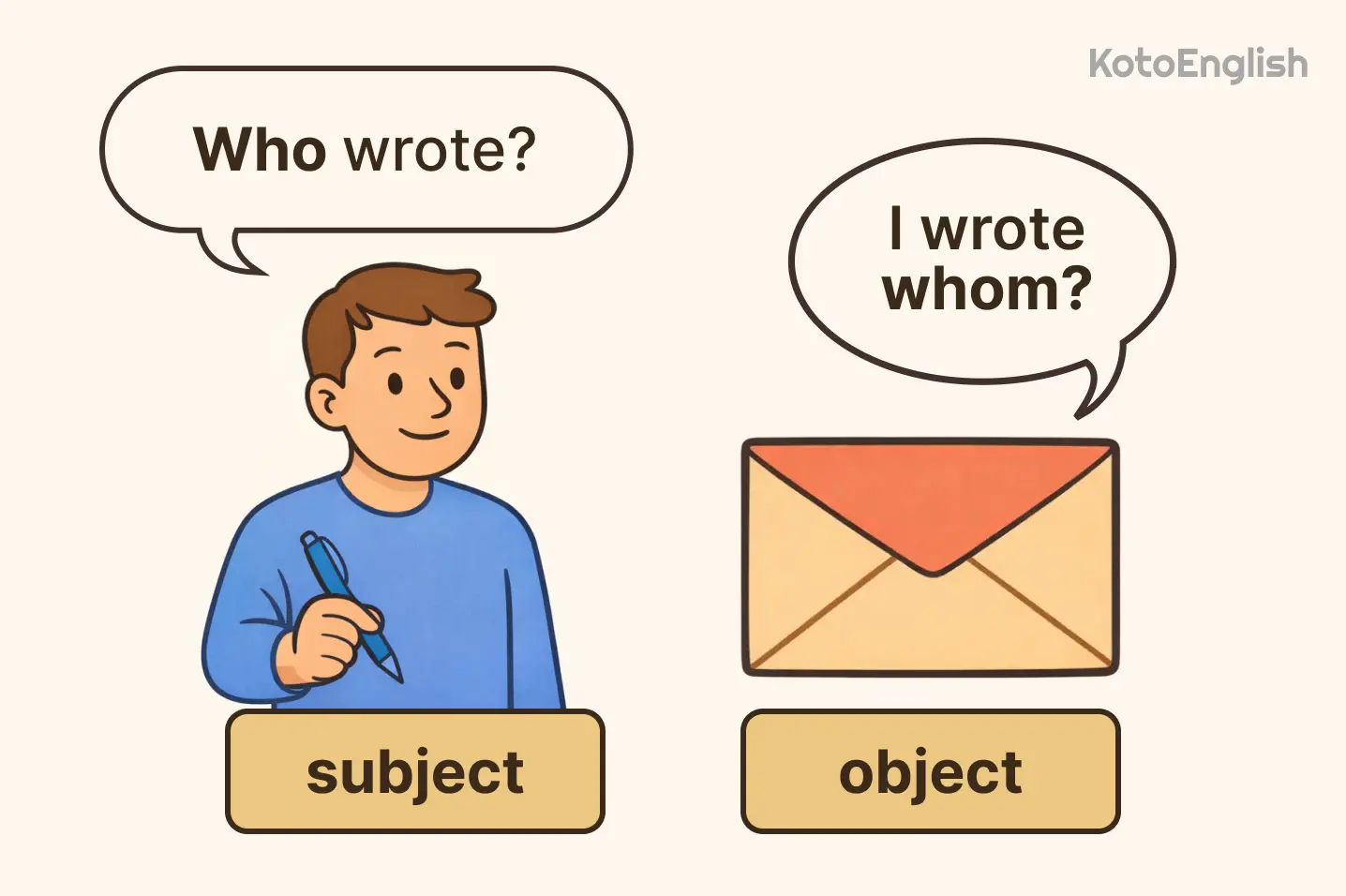
- They wrote – Who wrote?
- I wrote them – I wrote whom?
This is a great who vs whom trick that can significantly speed up your process of choosing the right pronoun while you are at the earlier stages of learning this subject. For now, let’s consider each pronoun in detail.
Level up your English with Koto!
When to use who
A few of the professionals in the field of teaching English believe that the language evolves to find an easier and less complicated way to communicate with one another. Others simply don’t find it necessary to carry on using it.
Who as a subject
The subject pronoun who appears in questions and statements together with subordinate clauses whenever someone performs an action. Your writing and speech will become easier when you learn these patterns because they lead to automatic selection of who. Here are the descriptions and real-world sentences for more understanding:
- Use who when it refers to the person performing the action in a sentence.
- The term also appears in questions where the answer identifies the subject.
- You can put who to introduce clauses that describe people performing actions.
Who is a typical pronoun that students, native speakers, use in casual and academic communication, through work emails, text messages, and more. It is rarely questioned, unlike whom that we will consider further.
When to use whom
The word whom functions like the term who because it shares the same object/subject rule but is used less frequently and requires more formal settings than conversational speech.
Whom as an object
As a rule, the pronoun whom is used as an object of a verb or a preposition. In very formal English, whom is the grammatically correct option here — but in everyday speech you’ll often hear who. For instance, whom can ba placed in sentences like these:
Whom after prepositions
Whom always follows prepositions in formal writing — positive, negative sentences and questions. Here are some examples that reveal this nuance:
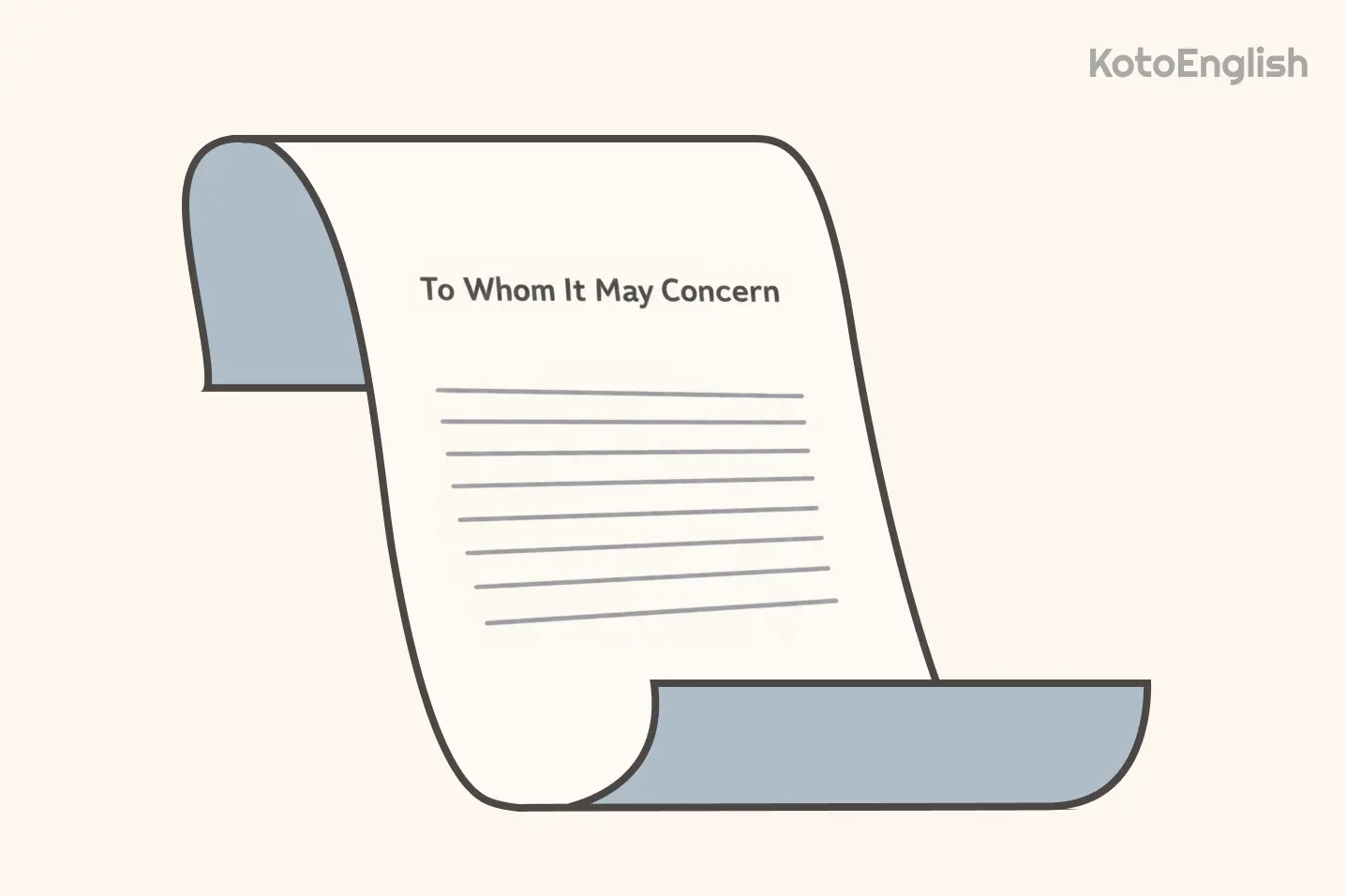
In real life, most people just ignore whom, avoiding it in both casual and formal speech. However, learning it is essential to people who work (or get ready to work) with reports, academic papers, legal documents, and even pass tests where they need to define fixed phrases (like “to whom it may concern”).
How to choose between who and whom?
The distinction between who and whom confuses many writers, but the solution is simpler than you might think. Instead of memorizing abstract grammar rules, focus on what the person in your sentence is actually doing. Here are the guides from advanced learners that will help you to answer, “Is it who or whom?”
Begin with meaning. Grammar points are essential, but asking yourself, “Is this person performing an action or receiving it?” does all the hard lifting. Someone who acts is who, and the one who gets the action is whom. It is an intuitive method fluent speakers use for English learning.
Identify the verb that matters. Who or whom are not always connected with the nearest verb, especially in complex sentences. You need to understand this relationship and memorize the rule: the verb that directly involves the person defines your pronoun choice.
Consider prepositions as hints. Words like to, for, with, from are commonly placed before whom in formal writing. It will help you to understand the context and avoid guessing if who is proper here.
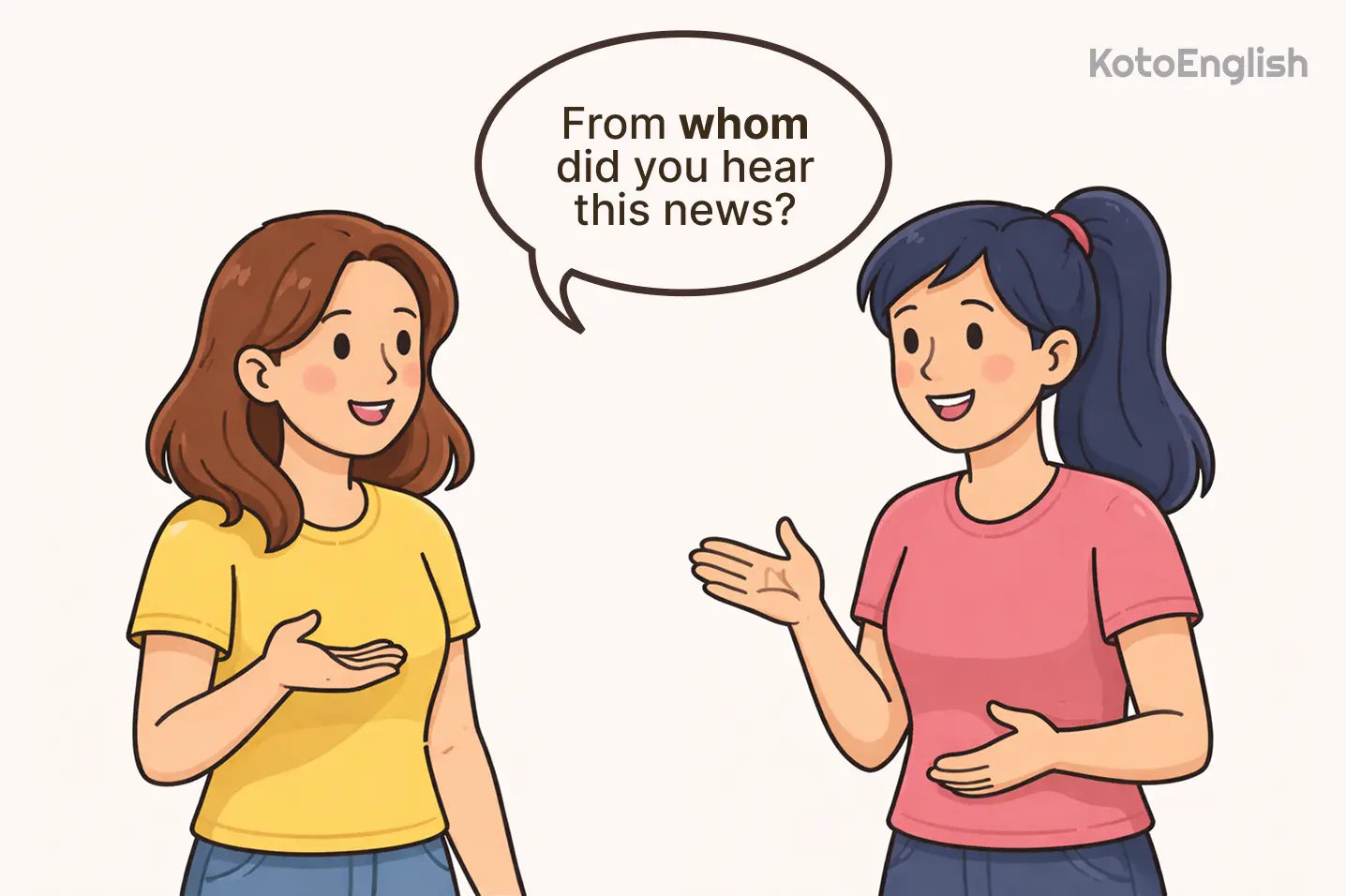
Confirm your choice with sentence structure. When defining who or whom grammar, it is worth double-checking the decision. If the person comes before the main verb and does something, then who is natural here. If the person (like a name) comes after a verb/preposition, consider whom.
Defining who vs whom difference will become easier — even intuitive — as you practice your English. This knowledge will make you more confident and prepared for language tests, job interviews, and even to understand more from your favorite series.
Common mistakes with who and whom
The grammar point you learn today is one of the trickiest, like Affect vs Effect confusion. Knowing where others go wrong can help you avoid the same mistakes. Here are the most common mistakes with who and whom, with examples and practical advice:
Confusing subjects and objects
The problem here is that using who where an object is required, or whom where the subject performs the action, can lead to grammatical mistakes that can damage your credibility. Let’s check the samples.
|
Who did you invite for dinner?
|
Whom did you invite for dinner?
|
|
Whom is coming to the presentation?
|
Who is coming to the presentation?
|
Misreading question structure
The assumption that the first word is always the subject can lead to mistakes because of word order in questions.
|
Whom do you think will do it?
|
Who do you think will do it?
|
|
Whom wrote this essay?
|
Who wrote this essay?
|
Rewrite the question as a statement to see its structure. “You think he is responsible” reveals that who is correct, not whom.
Misusing whom after prepositions
Incorrect placement happens when the preposition changes place, but whom is used based on the original formal arrangement instead of the actual sentence structure.
|
Whom are you going with?
|
With whom are you going?
|
|
Whom should I speak to?
|
To whom should I speak?
|
When the preposition is at the end (informal structure), use who. When the preposition is moved to the front (formal structure), use whom.
Placing who in fixed formal sayings
Some idiomatic expressions always follow traditional grammatical rules, no matter what the trend in conversational English. The use of who in these cases reveals a lack of familiarity with formal rules.
|
For who the bell tolls
|
For whom the bell tolls
|
|
From who did this originate?
|
From whom did this originate?
|
Learn the typical formal expressions: “To whom it may concern,” “For whom,” “With whom.”
Most errors are the result of failure to recognize whether the person is performing or receiving the action. You can use the pronoun replacement test, write the sentence as a statement, and then think about context. This will help you avoid common errors and write correctly.
Enjoy personalized learning!
Conclusion
The heated debate about whether you should use who or whom in a particular situation has been around for a long time. In fact, it took so long that it ultimately became irrelevant how people spoke to each other. For modern scholars, there are no attachments to “whom,” and it is no longer grammatically incorrect to avoid using it.
However, looking at is it who or whom and understanding the rules of appropriately forming a sentence gives us the power to make informed decisions about using them or not. Especially considering that in some contexts, the pronoun whom is necessary.
In our deep dive into this topic, we explained the difference between who vs whom in modern English . Be sure to use our tricks and practice your English skills daily to maintain steady progress.
Frequently asked questions (FAQs)
Yes, the word whom appears most often in formal writing, legal documents and professional settings. Many native speakers use who in daily conversations, even when whom should be placed according to grammatical rules.
People will understand you better in casual conversation than in formal writing or academic papers. Spoken English has started to abandon whom as a word, but formal written English still maintains its use.
Yes. The term whom needs an official context, which makes it suitable for business emails but creates an unnatural effect in daily speech. The pronoun who functions in both informal and formal situations, which makes it the best option to use when you need to choose.
Use they/them to answer the question. Here is a simple algorithm:
Ask, “Who/whom called?” If the answer is, “They called,” then use who.
Ask, “Who/whom did you call?” If the answer is, “You called them,” then use whom.