

Why are there so many ways to say hello in English
Common English greetings grow rapidly because language is flexible, yielding to people but not vice versa. Social distance, cultural traditions, and circumstances all encourage people to select different words, leading to an array of ways to greet in English.
Formality matters. English greetings act like a volume button: formal settings call for neutral, safe expressions, while informal interactions use warmer, shorter phrases to show friendliness or respect.
Culture and social habits. English-speaking cultures value personal space and subtle interactions. Light and respectful greetings help build social relationships without revealing too much too soon.
Context changes everything. Who you’re greeting and where you are determines the appropriate greeting. Digital communication adds complexity, with formal language in emails and informal shortcuts in chats and texts.
Spoken vs textbook English. Textbooks suggest polite, safe expressions, but in real life people often shorten everyday greetings in English, soften tones, and convey emotion naturally.
British vs American usage. British English uses subtle expressions like “You alright?” while American English favors cheerful phrases like “Hey!” or “How’s it going?”. Both succeed internationally, with rhythm and context helping avoid awkward pauses.
Level up your English with Koto!
Formal ways to say hello
Formal greetings communicate respect and set the tone, whether in social encounters, written messages or professional meetings.
When to use formal greetings in English:
- work and professional settings
- interviews and official meetings
- written communication
- conversations with strangers or senior contacts
Common formal greetings
These greetings work well in polite, neutral interactions with people you do not know well.
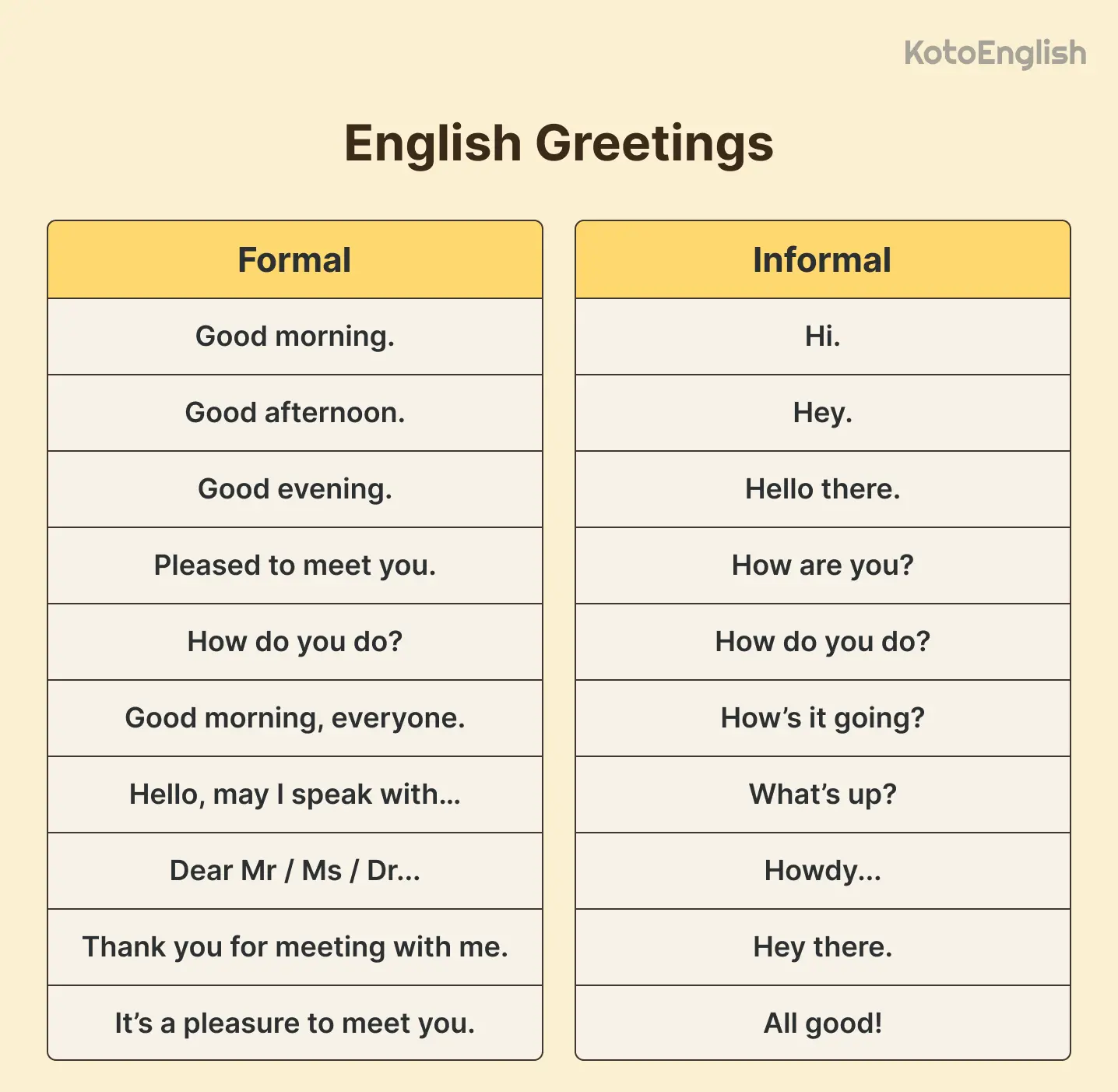
Good morning / Good afternoon / Good evening – Classic time-based greetings, often used in hotels, formal events, or first meetings.
Hello, it’s nice to meet you – Polite and universally acceptable when being introduced.
Pleased to meet you – Slightly more traditional, often heard in British English or formal settings.
How do you do? – A ceremonial greeting rather than a real question, now rare but still used in very formal or traditional environments.
Formal greetings in professional situations
Used in business, academic, and official communication.
Here are five respectful methods to greet someone in a work environment:
Good morning, everyone — A professional way to address a group.
Hello, may I speak with… — A formal greeting used on phone calls.
Dear Mr / Ms / Dr — A formal opening used in emails and letters.
Thank you for meeting with me — A respectful opener in interviews or client meetings.
It’s a pleasure to meet you — A polished greeting for first-time professional encounters.
Sometimes speakers should use informal language because their relationship with each other allows for casual conversation without using formal greetings. The phrase Good evening Mr Smith used in a Slack message creates a situation that feels both formal and awkward. The situation needs you to maintain formal behavior only during specific times.
Everyday greetings
Daily greetings give a relaxed conversational flow that preserves a genuine speaking style. The tone created by the words is amicable and suitable for ordinary, casual settings.
When to use everyday greetings:
- school
- acquaintances
- everyday communication
Standard everyday hellos
People use greetings in everyday conversation as brief and informal expressions to begin their casual talks.
Hi – The most neutral and widely used everyday greeting.
— Hi! Almost.
Hello there – Slightly warmer than hello, often used to sound friendly or playful.
— Same here!
Polite everyday greetings
Greetings for work and everyday life are friendly and polite without sounding formal. They often invite light conversation.
How are you? – A polite everyday greeting rather than a real question.
— I’m well, thank you.
How’s it going? – Casual and common in spoken English.
— Pretty good, thanks.
How are you doing? – Slightly warmer and more conversational.
— Doing great, actually.
Polite but casual greetings let you connect without overdoing formality, keeping the conversation relaxed.
Informal ways to say hello
In informal greetings, the tone of the talk seems relaxed and personal. The level of informality used by people depends on whom they are talking to and where they are having the conversation.
When to use informal greetings:
- friends and peers
- casual everyday conversations
- social settings or small talk
not suitable for formal or professional situations
Casual greetings
These greetings are common in everyday spoken English and informal online communication.
What’s up? — A casual greeting that usually expects a short, relaxed reply.
Howdy — Friendly and fun, often used in casual spoken English with a regional touch.
Hey there — Warm and slightly playful, softer than a simple hey.
Friendly responses to informal greetings
These expressions are often used as replies to informal greetings in English and help maintain a relaxed tone.


All good! — A positive, easygoing response that keeps the conversation light.
Not much — A casual reply that signals openness without detail.
Hey, you! — A warm, personal response used with close friends.
The best response is simply to match the tone. It needs only a casual response because it does not require formal communication
Modern ways to say hello
Modern greetings demonstrate the ongoing evolution of the English language. Young people and their close friends use slang together with emojis and their unique spelling systems to communicate in informal situations and online platforms.
When to use modern greetings:
- friends and peers
- informal online communication
- social media and messaging apps
not suitable for formal or professional settings
Popular slang greetings
Casual ways to say hello sound natural in spoken English and signal familiarity.
Yo — A relaxed, street-style greeting used among close friends.
Sup? — A shortened form of What’s up?, very informal and conversational.
Hey man / Hey bro / Hey dude — Friendly greetings that emphasise closeness rather than gender.
Internet and texting greetings
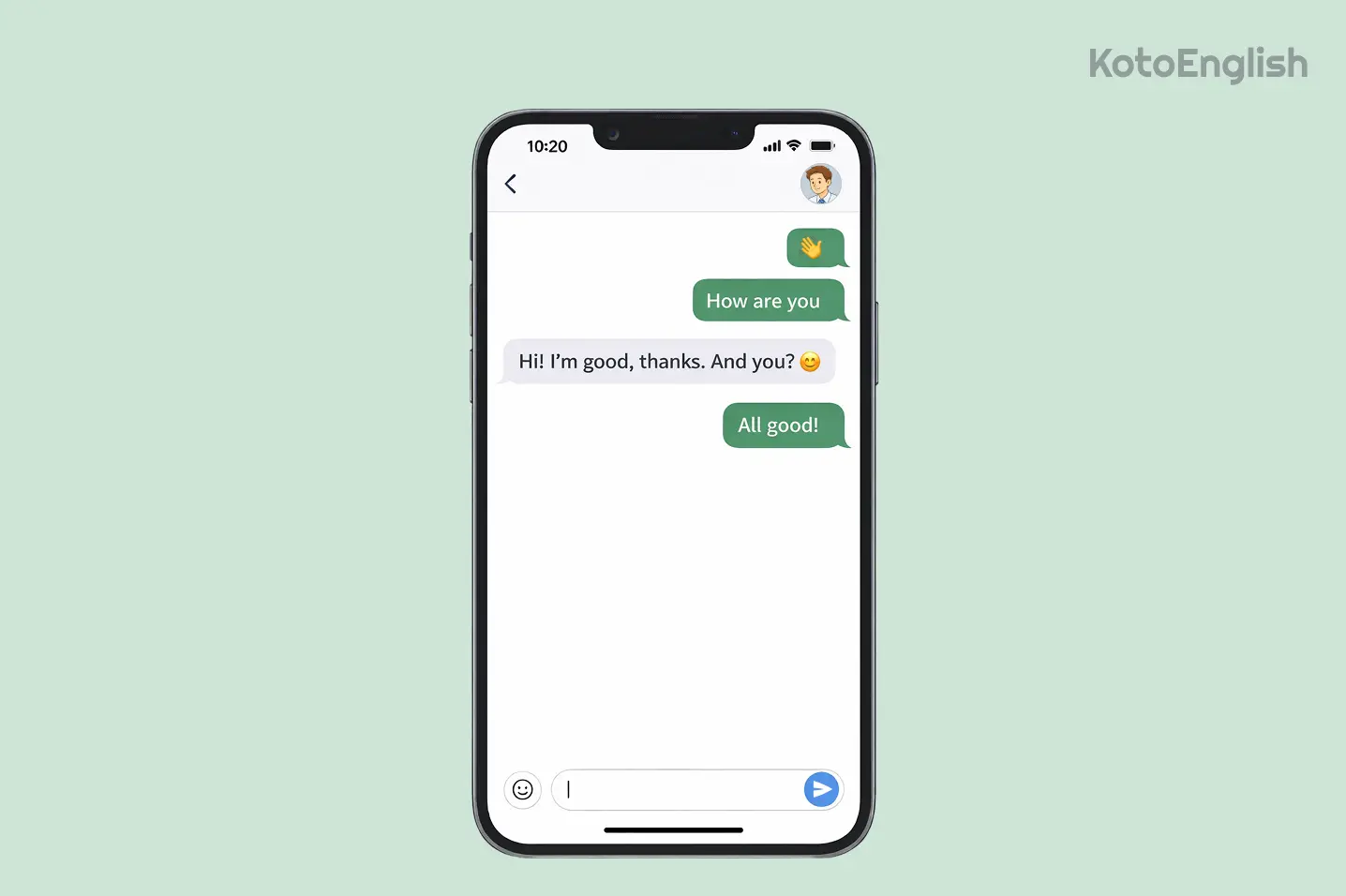
Such modern English greetings are common in chats, comments, and DMs. Tone depends heavily on spelling and context.
Heyy — An elongated hey that suggests friendliness or flirtation.
Hiya — Casual and upbeat, slightly more common in British English.
 — Visual Internet and email greetings in English that replace words entirely.
Greetings used in specific situations
The appropriate greeting for each situation depends on the particular situation which needs to be addressed. The right choice depends on three factors: medium, time of day, and audience to make your communication sound natural and suitable.
Saying hello on the phone
Phone greetings focus on clarity and identification rather than style.
Hello? — A neutral way to answer a call.
Hi, this is… — Polite self-introduction at the start of a call.
Good morning/afternoon, [Name] speaking — Slightly formal, professional greetings in professional situations.
Saying hello in emails and messages
Written greetings set the tone before the first sentence.
Hi [Name] — Friendly and professional for colleagues or acquaintances.
Hello everyone — Neutral greeting for group emails or messages.
Dear [Name] — Formal, standard for professional or official correspondence.
Greetings [Name] — Polite and slightly old-fashioned, formal without stiffness.
Saying hello in the morning vs evening
Time-specific greetings make interactions feel natural and context-aware.
Morning! / Good morning! — Casual or semi-formal greeting for early hours.
Evening! / Good evening! — Appropriate for late-day greetings, casual or semi-formal.
Top of the morning! — Playful or traditional, mostly in Irish/British English.
Night! / Good night! — Used very late in the day or in chats to greet someone briefly.
A casual “Morning!” text at 10 PM feels off, just as “Dear Mr Smith” would sound stiff in a quick chat.
Common mistakes when saying hello in English
Even simple greetings can cause awkward moments if tone, context, or relationship isn’t considered. You can avoid making the same pitfalls that learners and even native speakers do by understanding where they go wrong. These are the most typical greeting errors, along with examples and helpful tips:
Too formal with friends
The problem arises when greetings meant for professional contexts are used with friends or close acquaintances. This can make you sound stiff or distant.
|
Good evening, Mr Smith! How are you today?
|
Hey, Tom! How’s it going?
|
|
Pleased to meet you!
|
Hi there!
|
Slang in a work context
Using slang greetings in English or overly casual ones at work can make you appear unprofessional or disrespectful.
|
Sup, manager? Got any updates?
|
Good afternoon, Mr Lee. I wanted to check on the project.
|
|
Hey dude! Need that report ASAP!
|
Hello, John. Could you please send me the report?
|
“How are you?” as a real question
Many learners treat How are you? as a request for detailed information, but in English, it is often a polite greeting rather than an invitation for a full life update.
|
— How are you?
— I started learning guitar, ran 10 km, and my cat is sick… |
— How are you doing?
— Fine, thanks. What about you? |
|
— How are you?
— I’ve been so busy with work, school, and life in general! |
— How’s everything?
— Great, thanks! |
You can spot common greeting errors and learn how to correct them as you learn English online, helping your conversations feel natural and confident.
How to choose the right greeting
The appropriate greeting selection requires three elements to be evaluated which are the situation and the existing relationship and the chosen communication method. A few quick questions can help you decide instantly.
- Define who your interlocutor is
|
Who is this person? |
Suggested greetings |
|---|---|
|
Friends or peers |
Hey, Hi, Yo |
|
Colleagues or clients |
Hello, Hi [Name], Good morning |
|
Strangers or formal contacts |
Pleased to meet you, Dear [Name] |
- Check the place
|
Where do you communicate? |
Suggested greetings |
|---|---|
|
In-person |
Hi, Morning, How’s it going? |
|
Phone |
Hello? / Hi, this is… |
|
Email or message |
Hi [Name], Hello everyone, Dear [Name] |
- Verbal or written?
Spoken: casual, flexible and expressive
Written: more structured and clear, especially in professional contexts
Use a neutral greeting when you need to make an introduction because you can change your tone after you start speaking.
Enjoy personalized learning!
Conclusion
English is a diverse and flexible language that is capable of communicating even the smallest of details. By learning a wide variety of welcome phrases, you broaden your speech and equip yourself to navigate many social situations.
In our guide, we demonstrated ways to say hello in English in informal, professional, funny, old-fashioned and modern-day interactions. Be sure to practice these greetings in a suitable situation and keep growing your English skills!
Frequently asked questions (FAQs)
The most common greeting in English is “Hello”. It’s versatile and can be used in almost any situation, whether formal or casual. Other common alternatives include “Hi” and “Hey” for more casual settings.
“Hey” is informal and friendly. It is appropriate among friends, if one knows their colleagues well, or in casual conversations, but it may sound too casual, even impolite, in formal or professional contexts.
Well, “Hi” is usually fine in business emails, especially if it is someone you have dealt with before or if it’s part of an ongoing correspondence. In the case of a first contact or highly formal situations, it would be better to use “Hello” or even “Dear [Name]” as a way of showing respect.
It is safest to greet a person you do not know with formal greetings, such as “Hello,” “Good morning/afternoon,” or “Dear [Name]” in emails. This sounds friendly and professional; if done right, it creates a good first impression.