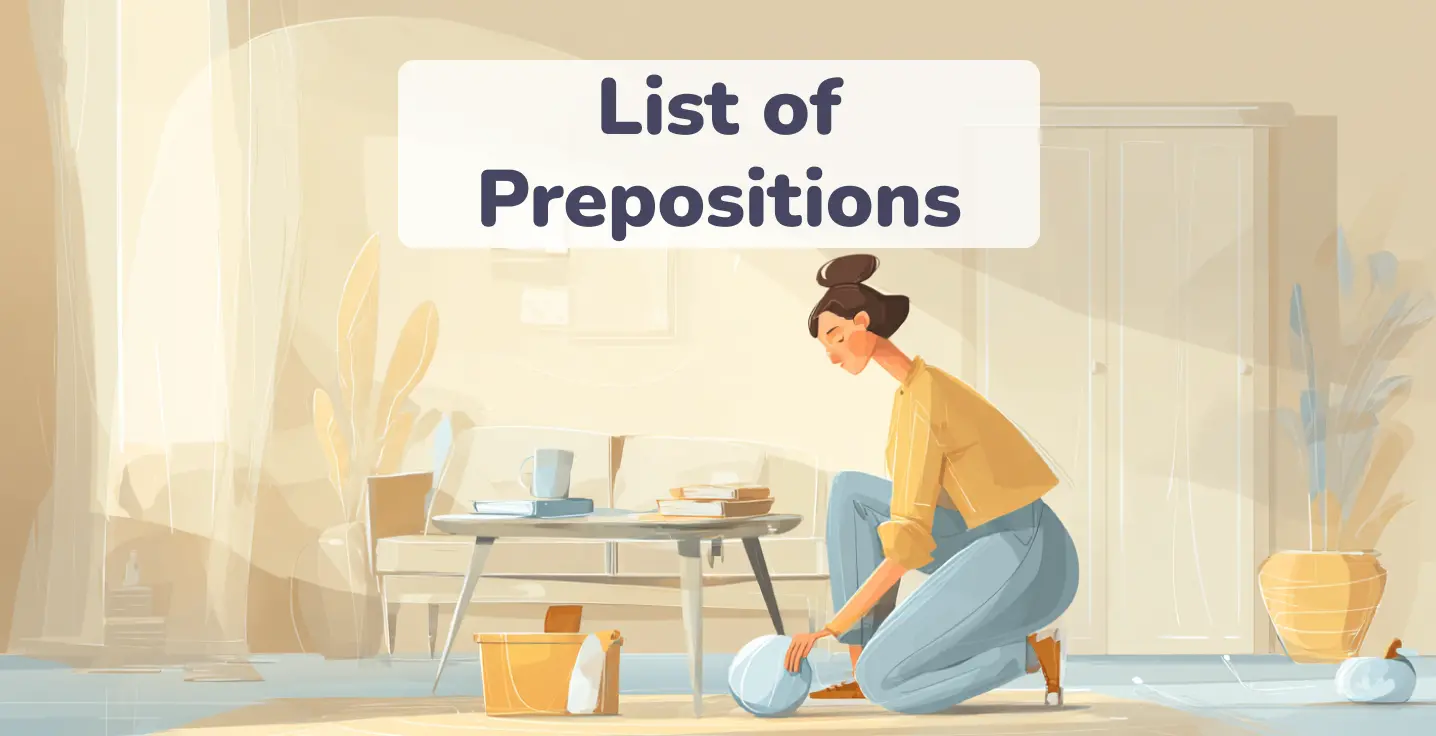
What is a preposition?
A preposition is a mini-word that connects other words, showing how they fit together: in, on, at, with, from, and to. All English speakers use those words widely, but probably without even realizing it.
They are short-term, but do a lot of lifting in the language. How else can we talk about where things are, when things happen, and how things fit together except with prepositions? Only with prepositions, that’s why they are vital in English grammar books.
How prepositions work in a sentence
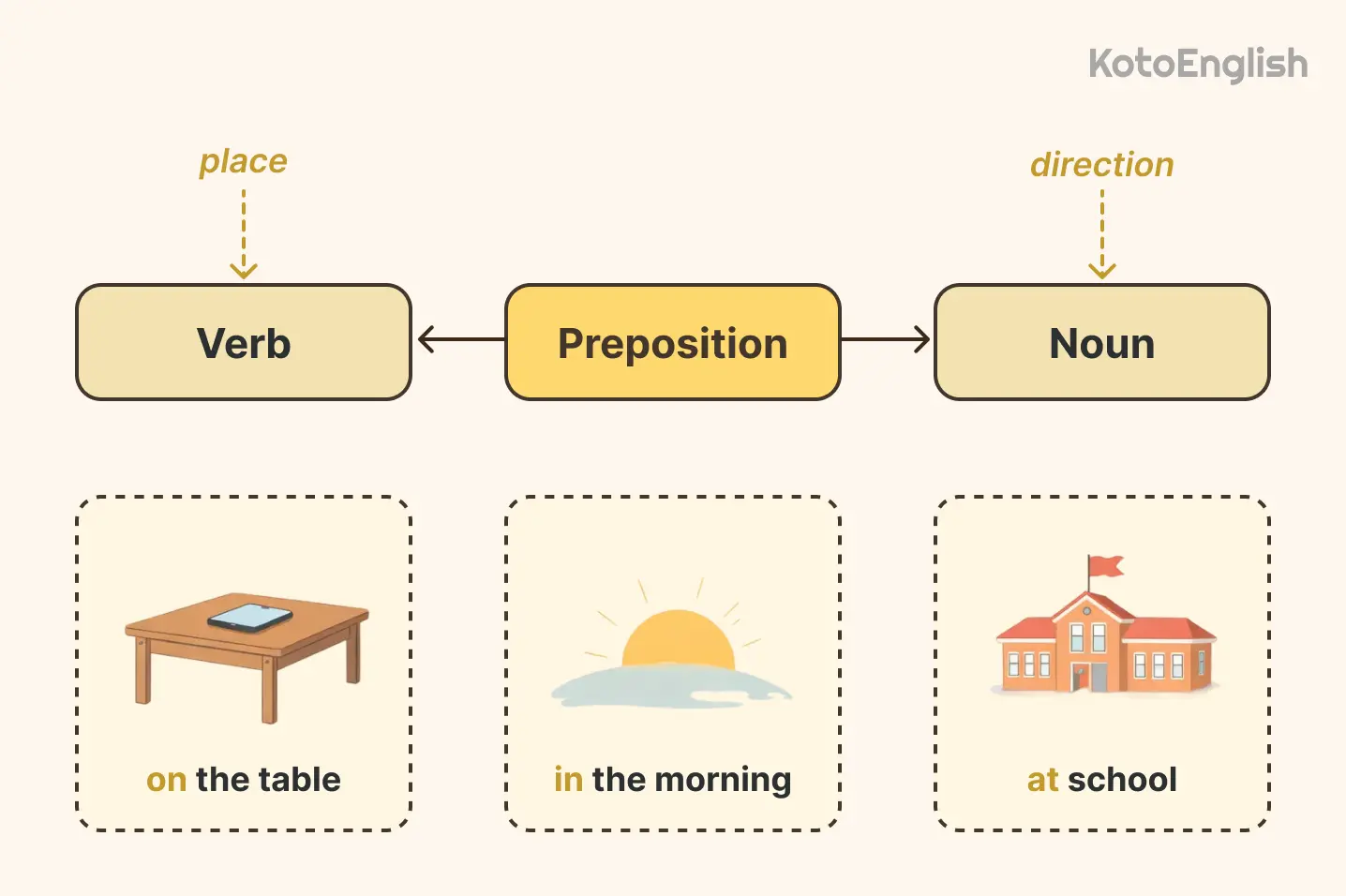
Commonly, prepositions are put in a sentence before a noun or pronoun, playing a crucial role that explains the following patterns:
- Where something is:
- When something happens:
- Which direction something moves:
- How things relate to each other:
One little preposition can turn around what you’re saying. Instead of saying “on the table,” say “under the table,” and you’ve shifted onto a completely different location. That’s the power these small words possess.
Why prepositions are difficult for English learners
Prepositions can be tricky, catching even native speakers due to the lack of rules and a formula you can memorize to apply to every speech or writing. Here is why they cause trouble when advancing English grammar:
- They have multiple meanings.
- They don’t translate directly.
- They depend heavily on the context.
With a sense of what prepositions are and why they are important, we will move to a comprehensive, A-to-Z list of common English prepositions. Each entry includes real-world examples and pronunciation hints to help you hear them in use.
Level up your English with Koto!
Complete list of prepositions (A–Z)
English is an exciting language with a myriad of fascinating figures of speech, idiomatic expressions, phrasal verbs, and more. Prepositions are not expected as there are over a hundred of them in the English language.
However, exploring them all at once is quite difficult and time-consuming. Hence, we put together an English prepositions list that contains 50 of the most commonly used ones. Let’s get started in alphabetical order.
Types of Prepositions in English
Prepositions are not just some arbitrary bunch of words. They break down by function: some pinpoint time, some indicate location, and some describe direction or how things relate to each other, which you can check in our detailed guide. Here’s a quick, laid-back guide to show how they’re organized:
|
Type |
Common prepositions |
|---|---|
|
Time |
|
|
Place/location |
|
|
Direction/movement |
|
|
Manner |
|
|
Relationship/connection |
|
Once you start noticing these groupings, it will become easier to put them in sentences correctly. Use this table to solve grammar puzzles with prepositions when doing your homework, preparing for a class, or even during a chat on WhatsApp.
Prepositions in common phrases
Prepositions often go with certain verbs and adjectives to form set phrases. Sometimes these do not make logical sense, they are just what you’re used to hearing. Here are some of the most common prepositions for beginners you’re likely to encounter:
Verb + prepositions:
Adjective + prepositions:
With that in mind, let’s move to the prepositions and their place in questions, learning how to put them correctly, ask questions more clearly, and sound more natural for native speakers.
Prepositions in questions
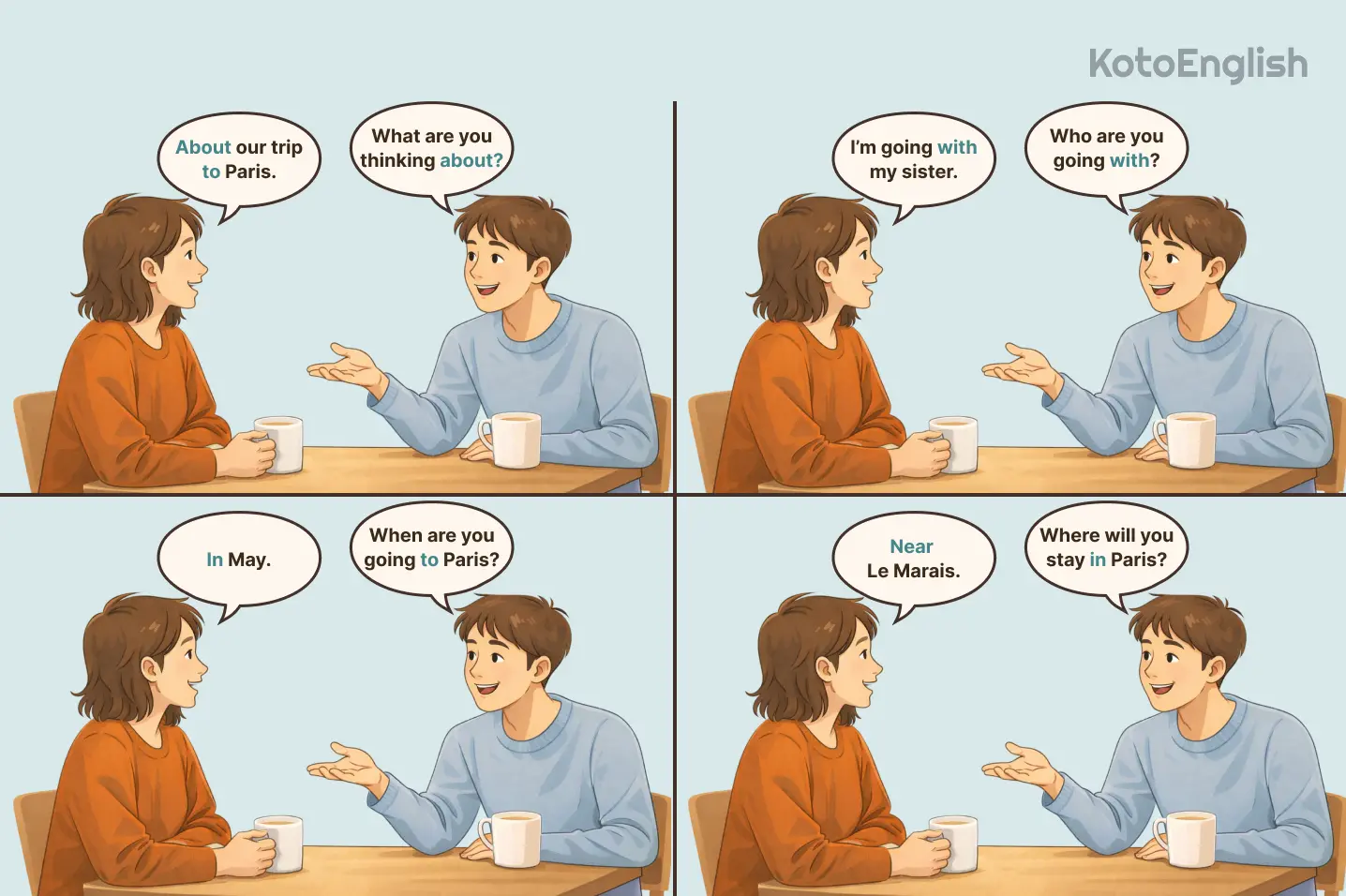
When crafting questions in English, prepositions can sometimes cause trouble. How do you know where to place the prepositions? Does it even work to put prepositions at the end of the question? A gleam of hope is that perhaps, in the end, English gives you more options than you might believe, and it will actually place the preposition at the very end.
- Prepositions at the end of questions. In everyday English, it is preferred to end a question with a preposition, as most fluent speakers do, to sound less formal.
- How prepositions appear in questions. They connect to verbs, remaining the same structure despite the topic of conversation, even when the question word is placed at the front.
The key tip here is to trust your hearing, like what sounds natural to you, and with time, you will recognize it with ease.
How to learn prepositions effectively?
Learning prepositions is not something to be accomplished in one day — it’s more of a journey and something to keep working at in the right fashion instead of trying to work with too many rules on your mind at once. With that said, here are three ways to utilize prepositions in your everyday writing in an easy-to-use fashion:
Tip 1. Turn to the context
Memorizing individual rules about English prepositions will not drive you far, especially if your goal is to become fluent, pass tests. It is recommended to read books, articles, listen to podcasts or even watch Reels in English, seeing them in real-world usage.
Tip 2. Focus on common phrases
Many terms pair with pre-defined verbs/adjectives/nouns in fixed ways, so you need to learn them by heart, for example, “apologize for,” “afraid of.”
Tip 3. Practice constantly
If you practice journaling in English, put prepositions in your sentences and see how they work. When communicating with your friends or in class, completing exercises that require this grammar knowledge, you can practice it differently but regularly.
The key to mastering prepositions is to get exposure and repetition. As you encounter them in context and use them repeatedly, you will develop, almost intuitively, a sense of which small words go where without guessing.
Conclusion
Uncovering the rules behind how a preposition is formed and understanding how to use it is the topic that takes many by surprise, with how complex and nuanced it is. Many students who learn English as a second language stumble upon difficulties when it comes to this subject.
However, by pushing forward and persevering through the issues, you can master this form of speech and become much more advanced in your skills. Wrapping your head around the right way to use prepositions in English allows you to be more proficient in your writing and sound more native than before.
Frequently asked questions
There are around 150 of these small words in English, with the exact number varying since it may include phrasal prepositions and compound forms. You can learn simple ones, defined as one-word prepositions, and expand your vocabulary with time, studying more complex phrases.
The prepositions that you can see in texts, hear in songs, movies and even everyday conversations are: in, on, at, by, with, to, from, of, and about. They make up the majority of all prepositions, and by learning them, you will understand the foundation and almost every situation.
Yes, definitely, it is common to put a preposition at the end of a sentence to make English sound more natural and not that old-fashioned, like in historical series. You can see that “What are you talking about?” sounds more informal than “About what are you talking?” but you can adjust it to the context.