
What are idioms?
In order to fully comprehend funny idioms and phrases, you should understand the meaning of an idiom in the first place. Cambridge Dictionary defines “idiom” as:
“a group of words in a fixed order that has a particular meaning that is different from the meanings of each word on its own”
Idioms are a figurative part of speech that often uses words imaginatively or unusually. The issue most English students run into when hearing idioms is that they understand words’ literal meaning rather than the phrase’s context.
Generally, English teachers divide idioms into four categories:
- Pure idiom. This represents regular idioms, the meaning of which can’t be understood by trying to decipher the words within them. For example, “the pot calling the kettle black” is a pure idiom.
- Binomial idiom. Such idioms are constructed with a conjunction. An example of a binomial idiom is the phrase “plain and simple,” which means something is fundamentally true.
- Partial idiom. This means such idioms can be shortened without losing their original meaning. For instance, you can say “throw a wrench” without continuing “in the works,” and fluent speakers will be able to understand the context you’re trying to convey.
- Prepositional idiom. Such idioms combine a verb and a preposition to create a phrase, like “in the end.” Some students can confuse prepositional idioms with phrasal verbs. However, the difference between them is that prepositional idioms are formed with a figurative meaning, while phrasal verbs are formed literally.
Hopefully, this can help you differentiate these idiomatic expressions more efficiently, regardless of context.
Level up your English with Koto!
Why funny idioms sound natural to native speakers
Below are 35 idioms grouped by theme to make them easier to remember:
- Hold your horses
- The elephant in the room
- When pigs fly
- Monkey business
- Running around like a headless chicken
- The tail wagging the dog
- Cold turkey
- Blue in the face
- Head in the clouds
- Keep your eyes peeled
- Armed to the teeth
- Bend over backward
- Piece of cake
- Cool as a cucumber
- Everything but the kitchen sink
- Cast-iron stomach
- Take it with a grain of salt
- In a pickle
- Thick as thieves
- Sacred cow
- Put a sock in it
- The lights are on, but nobody’s home
- Get up on the wrong side of the bed
- Call dibs
- Kick the bucket
- Go down a rabbit hole
- The pot calling the kettle black
- Throw a wrench in the works
- Fly off the handle
- It’s not rocket science
- Out of the blue
- Pick someone’s brain
- A bone to pick
- The neck of the woods
- Bite the dust
Let’s begin looking at funny idioms in English one by one!
Animal-based funny idioms in English
Hold your horses
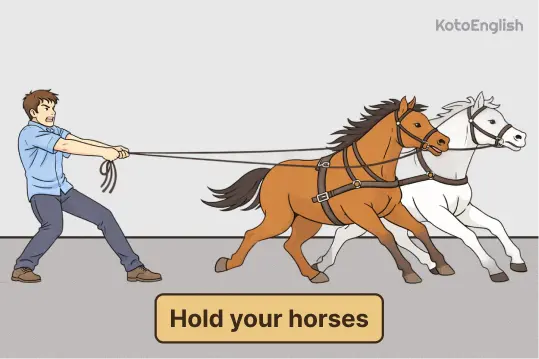
Meaning: “To hold your horses” means to slow down for a moment and wait. Interestingly, this idiom is believed to originate in Ancient Greece, referring to horseback riding and used to mean keeping your horses still.
The elephant in the room
Meaning: Saying “the elephant in the room” refers to an obvious issue or difficult situation that no one wants to discuss. Such idioms can carry a more serious tone since they are based on the notion that something can be intentionally overlooked to avoid unpleasant situations.
When pigs fly
Meaning: “When pigs fly” takes a rightful place among funny English idioms. You can use it to say that something will never happen. After all, it is implausible to witness pigs fly.
Monkey business
Meaning: The idiom “monkey business” refers to mischievous, improper, or dishonest behavior that is not socially acceptable.
Running around like a headless chicken
Meaning: “Running around like a headless chicken” is all about panicking and doing things without clear direction or much thinking — usually, such a mental state results in a futile effort.
The tail wagging the dog
Meaning: This particular idiom refers to situations where a less influential or important group controls a larger and more powerful group. This phrase originally came from an 1858 play called Our American Cousin.
Cold turkey
Meaning: “Cold turkey” essentially means completely or abruptly. “Going cold turkey” denotes suddenly stopping some kind of activity or a habit.
Idioms related to the body
Blue in the face

Meaning: It refers to being exhausted from anger or frustration when arguing with someone but yielding no results. This popular English idiom itself is a reference to the blueish skin color as a result of being breathless from talking.
Head in the clouds
Meaning: When someone’s head is in the clouds, it suggests they are distracted or daydreaming and not concentrating on the situation around them. It can also mean being lost in your own thoughts.
Keep your eyes peeled
Meaning: It basically stands for carefully watching for something or someone.
Armed to the teeth
Meaning: Being armed to the teeth is an example of a funny idiom with double meanings. The first one is relatively straightforward and means being equipped with a lot of weapons, like guns. The second one is more figurative and refers to being fully prepared before starting a new project or entering a new field.
- To be equipped with many guns.
- To be fully prepared.
Bend over backward
Meaning: It is another representation of funny idioms in English with a context that is hard to grasp just by reading it. “Bending over backward” denotes trying everything you can and putting hard effort into helping or pleasing someone.
Food and kitchen Idioms
Piece of cake
Meaning: This expression refers to a straightforward job or a task that is easily done without putting much effort into it.
Cool as a cucumber
Meaning: Undoubtedly, “cool as a cucumber” is among the idioms in informal English you should incorporate into your daily speech. Essentially, it means remaining calm and collected, even if the situation is surprising or shocking.
Everything but the kitchen sink
Meaning: This idiom refers to a large number of things, whether needed or not. “Everything but the kitchen sink” symbolizes almost everything one can think of. You can also consider it funny since the meaning behind it is pretty silly.
Cast-iron stomach
Meaning: Having a “cast-iron stomach” expresses being able to eat any kind of food without getting ill or experiencing stomach aches. Another meaning of this phrase is being able to withstand uncomfortable or disgusting situations without being nauseated.
- To withstand uncomfortable situations.
- To be able to eat everything.
Take it with a grain of salt
Meaning: “Taking something with a grain of salt” refers to not taking something you’re told very seriously because you believe it might not be completely true. It’s a great example of an idiom in everyday English that is used to express a level of skepticism.
In a pickle
Meaning: Among our idioms about food, being “in a pickle” means being stuck in a difficult situation. One theory about the origin of this word comes from a Dutch saying that originally used the idiom “drunk.”
Idioms about people and behavior
Thick as thieves
Meaning: Being “thick as thieves” with someone stands for having a close, friendly relationship in which you feel secure sharing secrets. It was originally meant to describe a complicated relationship between criminals who wouldn’t dare to reveal each other’s secrets.

Sacred cow
Meaning: A “sacred cow” is a belief or a notion that people assuredly support and do not want or dare to criticize. This expression may not be held universally and can refer only to specific communities. This one is among the funny idioms in English, which is believed to originate from the Hindu belief that cattle are sacred.
Put a sock in it
Meaning: It is an impolite way to tell someone to stop talking or be quiet.
The lights are on, but nobody’s home
Meaning: This saying is used to describe someone who may appear normal or conscious, but is actually baffled or daydreaming. In other words, this idiom refers to a socially awkward or inept person struggling to fit in.
Get up on the wrong side of the bed
Meaning: It signifies being in a bad mood or feeling annoyed all day, from the moment you wake up.

Call dibs
Meaning: It is all about claiming ownership or first rights to a particular thing before others can do so. It is sometimes considered as part of the funny idioms for kids, as people usually think “calling dibs” on something is childish.
Idioms that sound weird literally
Kick the bucket
Meaning: In simple terms, to kick the bucket means to die. This phrase definitely represents popular English idioms for adults, which hopefully wouldn’t need to be used very often.
Go down a rabbit hole
Meaning: It is a metaphorical idiom that means to be transported into a bizarre yet intriguing situation or a state of mind. You can use this phrase to describe investing in a very interesting or time-consuming topic.
The pot calling the kettle black
Meaning: This one is among the more serious but still funny idioms for adults. This one is typically applied to criticize or accuse someone of having a fault they also have. Essentially, this idiom points out hypocrisy.
Throw a wrench in the works
Meaning: It stands for disrupting or causing problems, preventing an event or an activity from going as planned. Initially, this idiom was created during the era of industrialization, where a factory machine could be sabotaged by throwing a tool into it.
Fly off the handle
Meaning: It is all about losing control over your emotions and becoming extraordinarily agitated or angry. Often, this anger is unjustified because of a misinterpreted situation.

It’s not rocket science
Meaning: Used to describe something that isn’t complicated or difficult to understand. The meaning behind this idiom in informal English is that rocket science is a very complex subject to comprehend and a person must be very smart to be proficient in it.
Out of the blue
Meaning: The situation was completely unexpected and occurred without anyone having prior knowledge.
Pick someone’s brain
Meaning: This idiomatic expression is all about persistently asking someone questions on a certain topic because they know much more about the subject than you do.
A bone to pick
Meaning: It is a desire to talk or argue with someone about something annoying they’ve done. The meaning of this idiom comes from the idea that dogs gnaw at the meat on the bone, even when the meat is almost completely gone.
The neck of the woods
Meaning: The neck of the woods refers to a particular part of the town or a specific area. Generally, people use this English expression when talking about their own location.
Bite the dust
Meaning: When you say “bite the dust,” it means someone has fallen to the ground or has suffered a significant failure in a particular instance and is left behind. Interestingly, this idiom was popularized by the iconic rock band Queen when they released their song “Another One Bites the Dust” in 1980.

Common mistakes learners make with idioms
Idioms are among the trickiest aspects of mastering any language because their meanings do not follow logical rules and cannot be understood through their individual words.
For English learners, these colorful expressions become a source of embarrassment when they use them incorrectly. The most common pitfalls should be studied by students so they can improve their skills to understand idiomatic expressions.
-
Mixing up words within an idiom
The most common mistake involves replacing words in established idiomatic expressions. Idioms function as fixed expressions in everyday conversations because their components require specific usage that must not be changed through word replacement.
|
Break a foot before your performance tonight!
|
Break a leg before your performance tonight!
|
|
I need to hit the notebooks for my exam tomorrow.
|
I need to hit the books for my exam tomorrow.
|
-
Using idioms in the wrong context or register
Even when you know the literal meaning vs real meaning correctly, you may accidentally use it in inappropriate situations. The specific tones of idioms show that some expressions maintain a casual and humorous tone while others use a more neutral delivery.
|
This research aims to think outside the box regarding climate solutions.
|
This research aims to explore innovative approaches to climate solutions.
|
|
Dear Mr. Johnson, let’s touch base next week about the contract.
|
Dear Mr. Johnson, let’s schedule a meeting next week to discuss the contract.
|
-
Translating idioms literally
People often assume that idioms from their mother tongue will translate directly into English, which results in both confusion and unintentional humorous outcomes. Every language has its own unique idiomatic expressions and direct translation of them fails to produce accurate results.
A well-known example is Ukrainian boxer Oleksandr Usyk’s phrase “don’t push the horses,” a literal rendering of the Ukrainian idiom meaning “don’t rush,” where natural English equivalent would be “hold your horses,” clearly showing how idioms rarely survive word-for-word translation.
|
I have a cat in my stomach before every job interview. (literal translation from German)
|
I have butterflies in my stomach before every job interview.
|
|
Their argument is not my circus, not my monkeys. (direct rendering of Polish variant)
|
Their argument is none of my business.
|
-
Changing the grammatical structure of an idiom
Funny idioms for ESL learners maintain specific grammatical structures that speakers must use according to their established rules. Students sometimes try to change the tense, make a singular noun plural, or rearrange the word order, which breaks the idiom.
|
She is biting more than she can chew with this new project.
|
She is biting off more than she can chew with this new project.
|
|
We made our offers, so now the balls are in their courts.
|
We made our offers, so now the ball is in their court.
|
-
Overusing idioms in speech or writing
People who learn new idioms sometimes become so enthusiastic about the new knowledge that they end up using too many expressions in their speech which combine multiple idioms into single paragraphs and conversations.
Native speakers use idioms in their speech because they want to make extra emphasis, yet their natural speaking patterns show that they use these constructions only at specific times.
|
At the end of the day, we need to bite the bullet and stop beating around the bush about this issue.
|
At the end of the day, we need to make a difficult decision and address this issue directly.
|
|
This task is a piece of cake, just like the last one was a piece of cake.
|
This task is a piece of cake, just like the last one.
|
How to learn funny idioms effectively?
You have already seen idioms, common contexts in which they are used and what mistakes to avoid while learning them! Now it is time to get the ball rolling with the following methods, to make your studying process not only effective, but also engaging.
-
Learn idioms through music and lyrics.
Songs naturally embed idioms within emotional and narrative contexts, which creates stronger memory associations than abstract definitions. The rhythmic and melodic patterns of music activate different parts of the brain than spoken language, making phrases easier to recall even months later.
You can find lyric annotation websites such as Genius to help you understand idiomatic expressions through their line-by-line explanations, which will reveal cultural references that you would most likely miss on your own.
-
Read comic strips and editorial cartoons.
The visual humor demonstration operates through the comparison of an idiom’s two meanings because it shows how the absurdity of the situation helps people understand the proper interpretation.
The native speakers of English use language in humorous ways through the comic strips Calvin and Hobbes and The Far Side which represent classic newspaper comics. Political cartoonists use idioms to create their political commentary while showing you how idioms function in public discourse and satirical contexts.
-
Study regional variations.
The same base language can produce dramatically different idiomatic expressions depending on geography, history and local culture. People who understand these differences will avoid embarrassing miscommunication because “pissed” means angry in American English but drunk in British English.
The study of regional idioms helps you build cultural knowledge which enables you to identify characters’ backgrounds in movies, understand international song lyrics and interact more genuinely with speakers from different English-speaking regions.
-
Learn idioms in dialogue pairs.
The study of idioms during spoken interactions functions as a training method that is present in most of the best books for learning English enables your brain to access idioms without need for deliberate translation.
You will create a practice session in which an individual asks you “How did the exam go?” and you answer them “It was a piece of cake,” to develop your brain’s ability to connect specific situations with particular funny idioms in English.
The process of active language development advances through practice dialogues which learners create with their language partners and through self-recording activities where they assume dual roles.
-
Analyze news headlines.
Journalists compress complex stories into attention-grabbing phrases, often relying on idioms and wordplay to convey meaning quickly. Reading headlines across different publications exposes you to how the same expression can be adapted, extended or subverted for rhetorical effect.
The practice of using headlines for your idiom learning process keeps your knowledge up to date because headline writers create new pictures and bring back old ones to match current events and cultural trends.
Final thoughts
Learning idioms is a useful way to expand your vocabulary and impress your friends with new exciting expressions. They also help make your speech sound more like a native speaker. The key to understanding English idioms is memorizing their meaning and not necessarily focusing on the literal definition of words used to form them.
In this article, we looked at 35 funny English idioms that fluent speakers most commonly used and explained what they mean. To make your learning experience easier, we also provided some examples of how to use these idioms in a sentence. Hopefully, you’ve learned a lot of helpful information.
Remember to practice your speaking skills daily to stay on top of your progress!
Frequently asked questions (FAQs)
The system relies on fundamental cultural elements, which include historical background and shared community experiences that people need to learn. Without context or explanation, idioms can sound confusing or even illogical.
Yes, especially in informal and friendly settings. They create a more entertaining experience to help people understand different messages better. Natives use them in their speech, yet they sometimes do not realize how strange they sound to language students.
There is no specific number, but the learners will benefit most if they can master the most popular and applicable ones. A few dozen popular idioms are generally sufficient to enable you to comprehend most everyday conversations and media.
Yes, but only selectively and with care. Neutral or widely accepted idioms may appear in business or academic writing, while colorful or humorous ones are usually avoided. In formal contexts, clarity and precision are more important than stylistic flair.