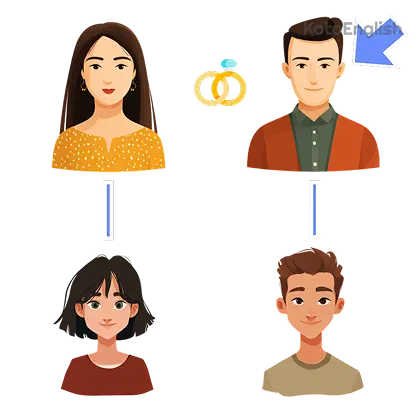
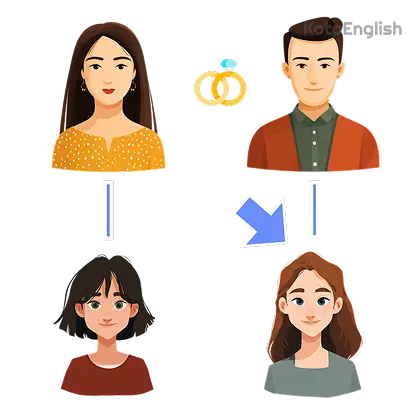
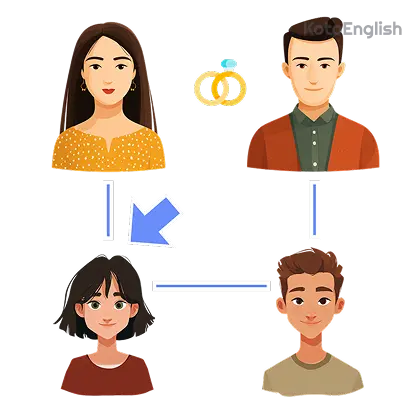
Stepmother – a woman who is married to or in a long-term partnership with your biological father, but who is not your biological mother.
Word “Stepmother”: Tips for Pronunciation
 Audio (UK):

 Audio (US):
Three syllables, stress placed emphatically on the first: STEP-mo-ther. The th in “mother” is the voiced /ð/ sound, just like that in “the,” “them,” and “bathe.” Don’t make the mistake of substituting a d sound for the th sound in “stepmother.” In everyday speech, most of the time, the variation of this word is “stepmom.”
Level up your English with Koto!
Plural & Possessive: All the Forms You Need
“Stepmother” is a completely regular noun, there are no surprises in terms of irregularity here. That being said, the use of the apostrophe for possession and that for pluralization consistently results in errors in learner production, particularly when the word is used within a larger sentence with several members of the family.
|
Form |
Example |
|---|---|
|
Singular: stepmother |
His
|
|
Plural: stepmothers |
Not all
|
|
Singular possessive: stepmother’s |
Her
|
|
Plural possessive: stepmothers’ |
Both
|
|
With possessive pronoun: my/your/his |
|

One word, no hyphen, no space. “Step-mother” and “step mother” are both wrong in standard written English. Write “stepmother” as a single, unhyphenated word every time.
The Cultural Weight of "Stepmother": What the Word Carries
“Stepmother” is one of the most culturally charged words in English when it comes to family roles, and grasping its cultural weight is part of speaking the term fluently. From folklore and fairy tales to modern journalism, the word arrives with associations that a speaker needs to be aware of, whether they intend to use or simply navigate around them.
The Stereotype: Where It Comes From
The “wicked stepmother” archetype is an extremely old trope in European folklore literature, appearing in such famous stories as Cinderella, Snow White, Hansel and Gretel, as well as many other not-so-well-known fairytales. This archetype has appeared so frequently that it has resulted in the word “stepmother” having a slightly negative connotation in modern English.
Neutral & Positive Use in Modern English
“Stepmother” is used by most modern English speakers in its entirely positive meaning without any connotation from fairy tales. Feel free to use it as you like since the surrounding sentence will do all the work.
Common Mistakes with “Stepmother” in English
Look out for the following mistakes. The first two are mechanical errors and occur in written communication. The next three are grammatical errors.
|
Why? |
||
|---|---|---|
|
My step-mother is very beautiful.
|
My stepmother is very beautiful.
|
One word, no hyphen. Always. |
|
Her step mother called.
|
Her stepmother called.
|
No space either. One solid word. |
|
His stepmother are strict.
|
His stepmother is strict.
|
Singular noun, singular verb. No exceptions. |
|
Do not say that all stepmother are stereotypically bad! My is the kindest person in the world!
|
Do not say that all stepmothers are stereotypically bad! My is the kindest person in the world!
|
“All” signals two people, so use the plural form. |
Spanish, French, and German Translations of “Stepmom”
In French, the word used to mean both “stepmother” and “mother-in-law” is identical, so you really need the context, and that’s where the trouble really starts when learning to translate from one language to another. In Spanish, there’s a special suffix used to convey the idea of step-. German is more similar to English.
| Language | Word for “Stepmother” |
|---|---|
 Spanish
|
Stiefmutter |
 French
|
Belle-mère |
 German
|
Madrastra |