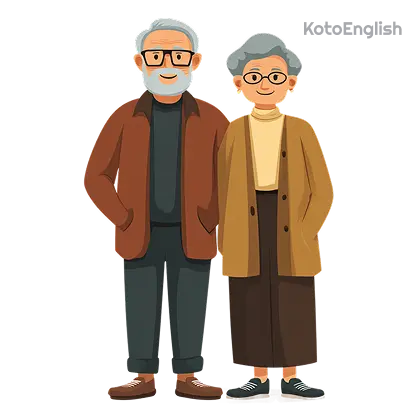
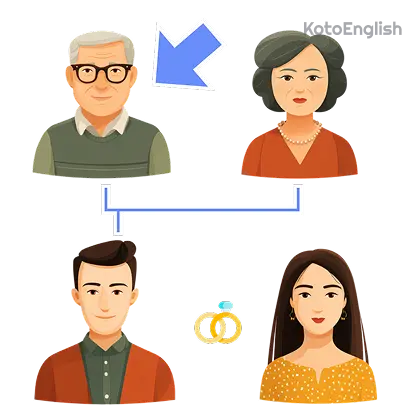
Great-grandfather – the father of your grandmother or grandfather. The term refers to a male ancestor who belongs to an older generation of your family history.
Pronunciation & Spoken Tips for Great-Grandfather
 Audio (UK):

 Audio (US):
This word consists of four syllables, and the main stress comes in GRAND: great-GRAND-fa-ther. The letter combination th in “father” represents a voiced dental fricative /ð/ that is identical in pronunciation to the same letter combination in “the” and “this”; therefore, make sure not to pronounce it as a d or f.
Level up your English with Koto!
Plural & Possessive Rules for Great-Grandfather
Family-related vocabulary becomes even more complicated when considering hyphens and possession. The term “great-grandfather,” for instance, obeys English grammar conventions in all respects except that students tend to omit the hyphen or make errors when using the apostrophe.
|
Form |
Example |
|---|---|
|
Singular: great-grandfather |
Her
|
|
Plural: great-grandfathers |
Both of his
|
|
Singular possessive: great-grandfather’s |
His
|
|
Plural possessive: great-grandfathers’ |
Both
|
|
With article “a”: a great-grandfather |
She never knew she had
|
|
With possessive pronoun: my/your/her |
|

Always keep the hyphens. “Great grandfather” (no hyphens) is a common error in learner writing. The correct written form is always hyphenated: “great-grandfather.”
Real-Life Examples Across Different Contexts
Definitions in the abstract will not help you become fluent. It’s the sentence that does this. Look at these examples grouped according to their context and note how the word is modified slightly depending on the context – it’s more colloquial when used in family contexts and more formal when used historically.
Family History & Personal Stories
Genealogy, Research & Writing
Casual Conversation & Modern Life
Common Mistakes with the “Great-grandfather” Word
These errors crop up frequently in essays written by students as well as in spoken English. While some of these errors are related to spelling, others are grammatical, so it is important to understand how to correct them in order to be fluent.
|
Why? |
||
|---|---|---|
|
My great grandfather was a farmer.
|
My great-grandfather was a farmer.
|
The hyphen is mandatory in written English. |
|
Her great-grandfather are 90 years old.
|
Her great-grandfather is 90 years old.
|
Singular noun always takes a singular verb. |
|
I visited my great-grandfather house.
|
I visited my great-grandfather’s house.
|
Possessive requires the apostrophe + s. |
|
His grandgrandfather fought in WW2.
|
His great-grandfather fought in WW2.
|
“Grandgrandfather” does not exist in English. Use “great-grandfather.” |
Great-Grandfather in Spanish, French, and German
Having knowledge of the corresponding term in other languages brings out something fascinating: almost all languages make use of a word similar to “great” or “grand” to indicate another generation. When you recognize the pattern, memorizing the term becomes simpler.
| Language | Word for “Great-grandfather” |
|---|---|
 Spanish
|
Bisabuelo |
 French
|
Arrière-grand-père |
 German
|
Urgroßvater |
German uses “Ur-” as a generational prefix, the same root you see in the English word “primordial” (original, ancient). Think of your “great-grandfather” as the “first/original grandfather” and the German word clicks into place.