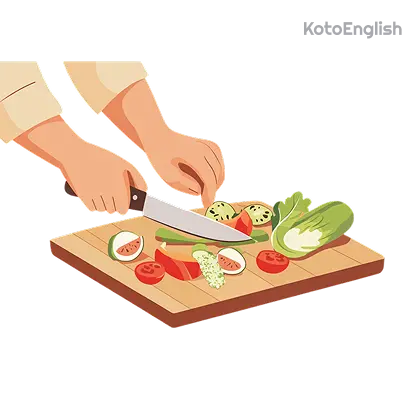
Fry – to cook food by using heated oil or fat. It can be done in either a pan with some oil or by immersing the food in a larger amount of oil. This cooking verb is among the most commonly used and encompasses various cooking methods, covering a wide range of techniques, from a simple fried egg in a little butter to full “deep-frying” in a vat of oil.
How to Pronounce “Fry”?
 Audio (UK):

 Audio (US):
One-syllable word: /fraɪ/. The vowel is the long diphthong /aɪ/, which is identical to the vowel in “try,” “dry,” “cry,” and “sky.” This diphthong starts at /a/ and ends at /ɪ/; hence, pronounce it fully and don’t reduce it to one sound.
Level up your English with Koto!
Tenses & the Y-to-IED Spelling Rule
The verb “fry” is a regular verb. However, this is another example where there is a crucial spelling rule associated with its formation, which can also be extended to forming the plural of nouns and the present tense third-person forms: when a verb ends in a consonant + “y”, the “y” becomes “i” before “es” and “ed” endings.
Basic Forms of the Verb “Fry”
|
Form |
Structure |
Example |
|---|---|---|
|
Base Form |
fry |
I usually
|
|
Past Simple |
fried |
She
|
|
Past Participle |
fried |
The fish was
|
|
Gerund |
frying |
|
|
Third Person Singular |
fries |
He
|
Continuous and Perfect Forms
|
Tense |
Structure |
Example |
|---|---|---|
|
Present Continuous |
am/is/are frying |
|
|
Past Continuous |
was/were frying |
They
|
|
Future Continuous |
will be frying |
This time tomorrow,
|
|
Present Perfect |
have/has fried |
He
|
|
Past Perfect |
had fried |
By noon, she
|
|
Future Perfect |
will have fried |
By the time the party starts, we
|
|
Present Perfect Continuous |
have/has been frying |
She
|
|
Past Perfect Continuous |
had been frying |
He
|
|
Future Perfect Continuous |
will have been frying |
By six o’clock,
|

Types of “Frying”: The Full Vocabulary Set
On its own, “fry” refers to a variety of processes, but in English, there are different compound terms used for each process, and the knowledge of which marks the difference between mere cooking language and actual culinary English. Each compound has been used to refer to a unique process and result in recipes, menu cards, TV shows, and food packages.
|
Term |
Technique |
Oil Amount |
Typical Foods |
|---|---|---|---|
|
fry / pan-fry |
cook in a shallow pan with a small amount of oil |
thin layer |
eggs, fish, chops, vegetables |
|
deep-fry |
submerge completely in a large quantity of hot oil |
full submersion |
chips/fries, doughnuts, battered fish, spring rolls |
|
stir-fry |
cook quickly in a very hot wok with minimal oil, stirring constantly |
very little |
vegetables, noodles, meat (Asian cooking) |
|
shallow-fry |
cook in oil that comes halfway up the food |
medium amount |
schnitzel, fish cakes, fritters |
|
dry-fry |
cook in a pan with no oil at all |
none |
spices, seeds, nuts, tortillas |
|
sauté |
cook quickly in a small amount of butter or oil over relatively high heat |
small amount |
mushrooms, potatoes, leafy greens |
Common Mistakes with “Fry”
These errors appear regularly in learner writing and spoken English. The spelling error in the Past Tense is the most common in written work. The vocabulary confusion between “fry” and “sauté” is the most common in cooking contexts.
|
Why? |
||
|---|---|---|
|
She fryed the eggs.
|
She fried the eggs.
|
Consonant + y before “-ed”: change y to i → fried, not “fryed.” |
|
He fries the potatoes yesterday.
|
He fried the potatoes yesterday.
|
Past tense requires “fried,” not the present tense “fries.” |
|
She sautéed the chips.
|
She fried the chips.
|
Chips (fries) are fried, not sautéed. “Sauté” implies quick, small quantities over high heat with motion. |
|
Can I have fried potatoes? (in the UK)
|
Can I have chips?
|
In British English, fried potato strips are “chips.” “Fried potatoes” is understood but unusual phrasing in a British café or restaurant. |
“Fry” in Spanish, French, and German
Discover how to properly spell and pronounce this word in other languages. Listen to each translation and repeat.
|
Language |
Word for “Fry” |
|---|---|
|
|
freír |
|
|
frire |
|
|
braten |