Text (noun) — written or printed words that form a document, book, article, or other piece of scripted material; the main body of content in any document, excluding titles, images, or footnotes.
How to Pronounce “Text”?
 Audio (UK):

 Audio (US):
Say t + ext. X is pronounced like ks, make it clear and fast. It’s a simple one-syllable word that is similar to “next.”
Level up your English with Koto!
Examples: How to Use “Text” in a Sentence?
To define a “text” look at these everyday situations where native English speakers use this word to describe both written content and mobile messages naturally.
What Are Synonyms for the Word “Text”?
Broaden your range of vocabulary by using these different alternatives that capture all the aspects of what “text” means in various contexts.
Related nouns: writing words content
Synonyms (contextual): article
Common collocations: written text original text full text
“Text” Word Formation and Description in Context
Build fluency by learning how to say “text” with other words and parts of speech in different communication settings.
With adjectives: long text short text original text main text
With verbs: read a text analyze a text interpret a text translate a text
With nouns (noun + noun): text analysis text structure text format textbook
Idioms and Phrases with “Text”
Discover the “text” meaning by learning it in different idiomatic contexts. Understanding of these specifics will give more clarity to your language and give you more interesting ways to talk about various interactions.
-
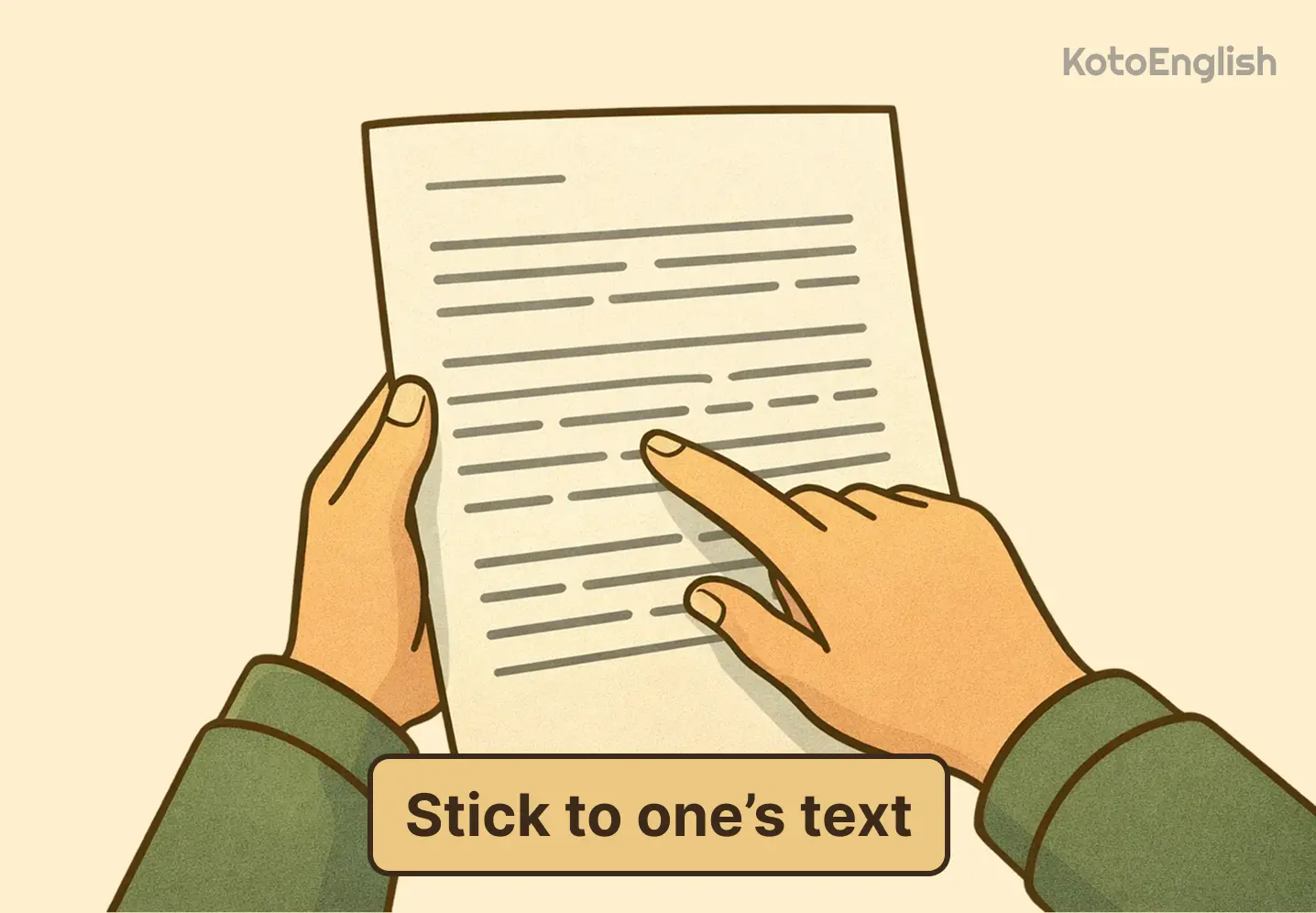
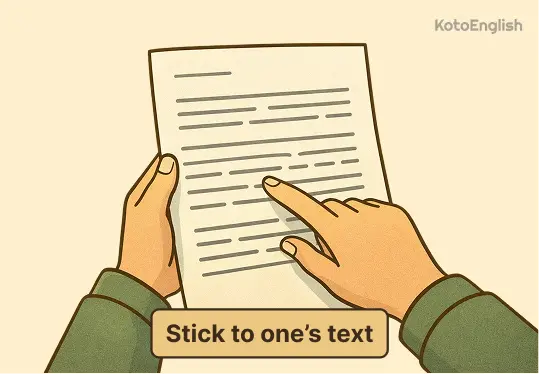
Stick to one’s text — following the source material closely, without adding, changing, or improvising beyond what is written.
The actor was advised tostick to his text during the performance to avoid confusion.
-
Triple text — refers to a message or written content that is repeated a lot of times in a row just for the sake of emphasis, clarity, or strong emotional effect.
She sent atriple text to make sure her message was noticed. -
Text interpretation — it is the procedure of making clear or comprehending the sense of a written text, notably by investigating its ideas, symbols, or intentions.
The class focused ontext interpretation to uncover the deeper meaning of the poem.
Test Your Knowledge of “Text” Meaning: Quiz Time!
Evaluate your understanding of this word through these questions in our intellectual game. Complete all tasks and as a result reinforce your comprehension of this term and English in general.
Enjoy personalized learning!
“Text” Word in Other Languages
Broaden your international vocabulary by learning how to spell “text” and how written content and documents are described across different languages.
| Language | Word for “Text” |
|---|---|
 Spanish
 |
Texto |
 French
 |
Texte |
 German
 |
Text |
Discover Fun Facts About “Text”
The written “text” has definitely played a fundamental role in the development of human civilization. The presented interesting information clearly shows that words and sentences have a very strong impact on our world.
-
The oldest known text is over 5,000 years old.
The very first written texts that still exist are represented by the Sumerian cuneiform tablets that had their origin in ancient Mesopotamia and were dated around 3400 BCE. Such text on clay tablets was used for the purpose of keeping administrative records and making laws. -
The Gutenberg Bible revolutionized text production.
Before Johannes Gutenberg invented the printing press around 1440, all texts had to be copied by hand, so that books were very few and costly. His invention allowed the production of texts in large numbers, thus knowledge became available to the common man. -
Different writing systems read in different directions.
English text is read from left to right and from top to bottom, which is the most commonly used reading direction. Other directions of can be found in Arabic and Hebrew languages (from right to left), or in traditional Chinese and Japanese scripts (from top to bottom and from right to left). -
Early texts had no spaces or punctuation.
This was called scriptio continua, which was a practice that involved the letters flowing continuously without any breaks. Hence, reading was very slow and tiring, usually performed aloud because the reader had to understand the meaning and pauses only through the context.
Quotes Featuring the Word “Text”
Discover how different people incorporate phrases with “text” in their saying to convey various meanings and thoughts that are relatable to the majority of us.
— Roland Barthes
Explanation: According to the French literary theorist Roland Barthes, not a single text is absolutely original, each written work relies on, reacts to, and carries the previous texts around. This point of view, named “intertextuality,” implies all texts are linked through history.
Explanation: According to the quote, having a strong connection with poetry and written materials is good for the mind and spirit. It is by learning words, meanings, and ideas that an individual becomes mentally active, emotionally aware, and in touch with human experience.
— Kevin Harvick
Explanation: The human voice not only carries words, but also expresses feelings, and as a result, it is possible to get the speaker’s point. This statement implies that texting is fine for daily use, but for crucial matters, face-to-face communication can be a better option.