

Resume (noun) — a written document that lists your education, work experience, skills and achievements, submitted to employers when applying for jobs to show your qualifications and background.
How to Pronounce “Resume”?
 Audio (UK):

 Audio (US):
Say REZ-oo-mei with three syllables. Don’t confuse it with “resume” re-ZOOM, which is a verb and means “to continue.”
Level up your English with Koto!
How to Use “Resume” in a Sentence?
Broaden your understanding of the definition of a “resume” with the aid of actual cases where individuals searching for jobs and professionals discuss this topic in the course of their career and application processes.
What Are Synonyms for the Word “Resume”?
Knowing these alternative terms and synonyms for “resume” will help you understand job postings and communicate effectively in different professional contexts worldwide.
Related nouns: application profile portfolio credentials
Synonyms (contextual): CV curriculum vitae
Common collocations: submit a resume professional resume
“Resume” Word Formation and Description in Context
Get a good control over the collocations that are frequently used by recruiters and job seekers in their conversations regarding employment applications and hiring processes.
With adjectives: strong resume impressive resume updated resume well-written resume
With verbs: write a resume send a resume review a resume look at a resume
With nouns (noun + noun): resume format resume template resume section resume builder
Idioms and Phrases with “Resume”
Learn the meaning of “resume” with career-focused expressions that will help you navigate professional conversations about work, applications and building your career path.
-
Update a resume — this means to add new information, such as recent work experience, skills, or achievements, so it reflects your current professional status.
After finishing the course, she decided toupdate her resume to include her new qualifications. -
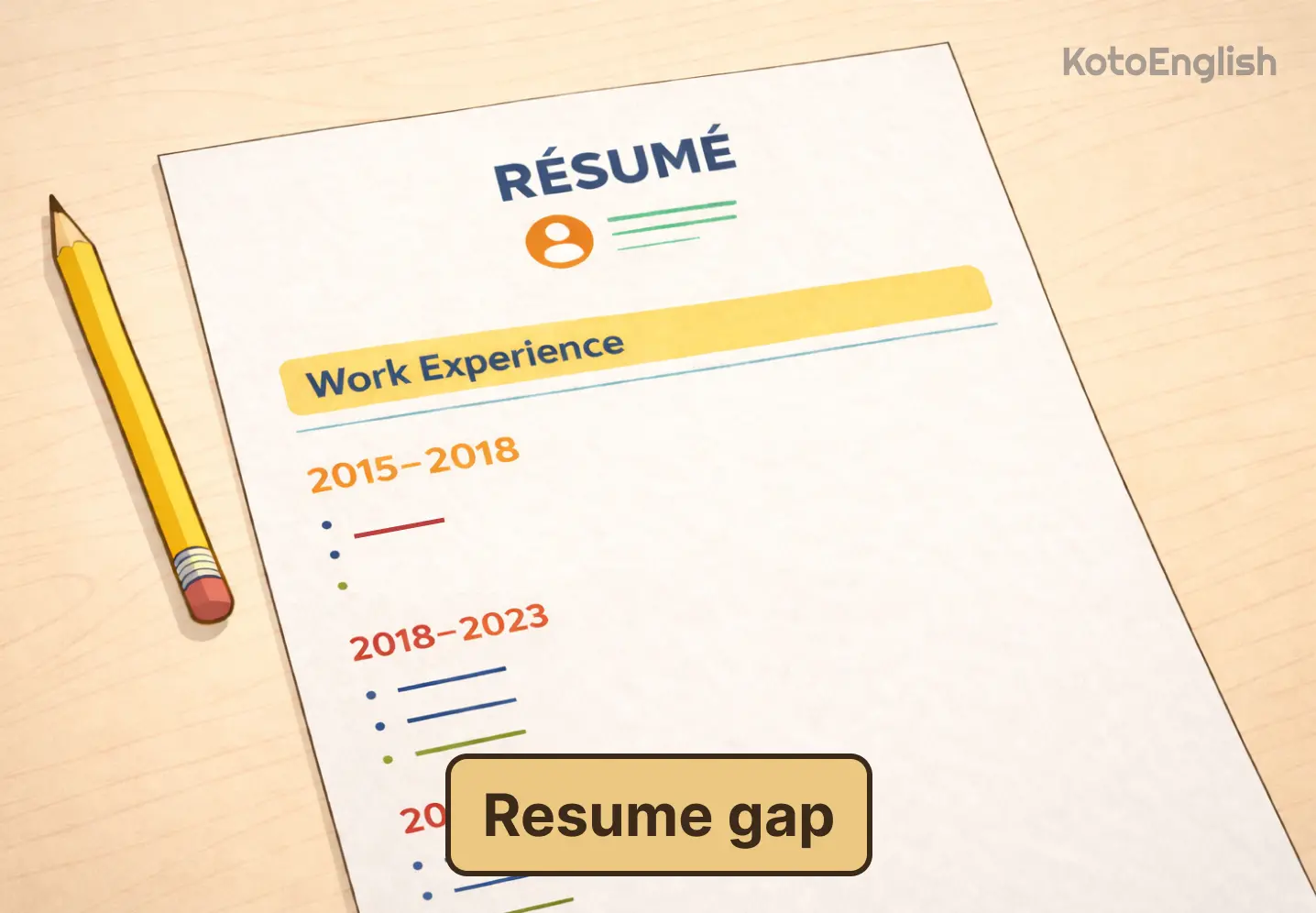
Resume gap — refers to a period of time when a person was not employed or did not list professional activity on their resume.
He explained theresume gap by talking about the time he spent studying and gaining new skills.
-
Resume screening — a process in which employers or recruiters review resumes to decide which candidates should move forward in the hiring process.
Duringresume screening , only applicants who met the key requirements were selected for interviews.
Test Your Knowledge of “Resume” Meaning
Check the knowledge on resume-related terminology and professional phraseology in the following exercises.
Enjoy personalized learning!
“Resume” Word in Other Languages
Learn how to spell “resume” and listen to it in other languages to expand your linguistic horizons.
| Language | Word for “Resume” |
|---|---|
 Spanish
 |
Currículum |
 French
 |
CV |
 German
 |
Lebenslauf |
Did You Know It? Fun Facts About “Resume”
The word “resume” has fascinating origins and surprising statistics that reveal how dramatically job hunting has changed over the decades.
-
The first known resume was written by Leonardo da Vinci.
In the year 1482, Leonardo da Vinci wrote what is widely regarded as the first-ever resume while seeking the position of a military engineer at the court of the Duke of Milan. The document, covering one page, enumerated all his qualifications and talents. -
The “resume” word comes from French.
This term is derived from French, where it literally means “summary.” It came to the English language at the beginning of the last century to denote a short synopsis of a person’s professional life. -
Applicant Tracking Systems scan most resumes first.
Around 75% of the resumes are not seen by humans at all because the first step in the process is made by Applicant Tracking Systems (ATS). To be able to go through these automated systems, resumes are supposed to have important keywords from the job description.
Famous Quotes Featuring “Resume”
Discover the insights that successful professionals and career experts have shared on the topics of “resumes”, applications, and the development of professional reputations.
— Seth Godin
Explanation: Godin claims that the real worth of people is not determined by their titles, academic degrees, or resume bullet points. The real impact is determined by the quality, originality and significance of your work, not by the impressiveness of your credentials.
— Nancy Lublin
Explanation: Acts taken solely to enhance one’s reputation are not genuine. The real transformation takes place when the motives behind actions are love and faith, rather than career perks.
Explanation: He claims that a mixed CV indicates flexibility and openness to performing different roles, even the ones that are risky or not very popular. The citation emphasizes the notion that growth usually comes from taking more paths than just the safest one.