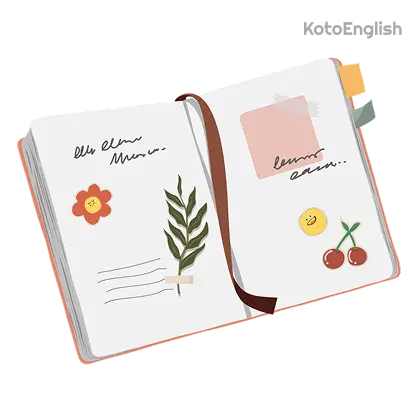

Diary (noun) — a personal book, paper-based or digital, in which daily events, thoughts, plans, or emotions are recorded gradually over time. The vast majority of individuals keep their diaries secret and write in them often.
How to Pronounce “Diary”?
 Audio (UK):

 Audio (US):
Split it into two beats: die / uh-ree and give more power to the first beat.
Level up your English with Koto!
Examples: How to Use “Diary” in a Sentence
Get to know how to define a “diary” through commonly encountered situations, school life, and personal habits.
What Are Synonyms for the Word “Diary”?
A stronger journal-focused vocabulary improves the ability to communicate about personal logs, schedules, reflections.
Related nouns: notebook journal planner
Synonyms (contextual): journal log
Common collocations: personal diary daily diary travel diary
“Diary” Word Formation and Description in Context
A group of words with “diary” help remind us of how they have become common parts of daily life.
With adjectives: personal diary private diary digital diary
With verbs: keep a diary write a diary read a diary
With nouns (noun + noun): diary entry diary page diary app
Idioms and Phrases with “Diary”
The majority of the idioms and expressions including a diary have to do with the arrangement and documentation of private life.
-
Keep a diary — to write down every day the ideas and happenings.
To be more accountable, she decided tokeep a diary for the purpose of monitoring her improvements. -
Put it in your diary — to jot down something for later use.
So you don’t miss it,put the appointmentin your diary . -
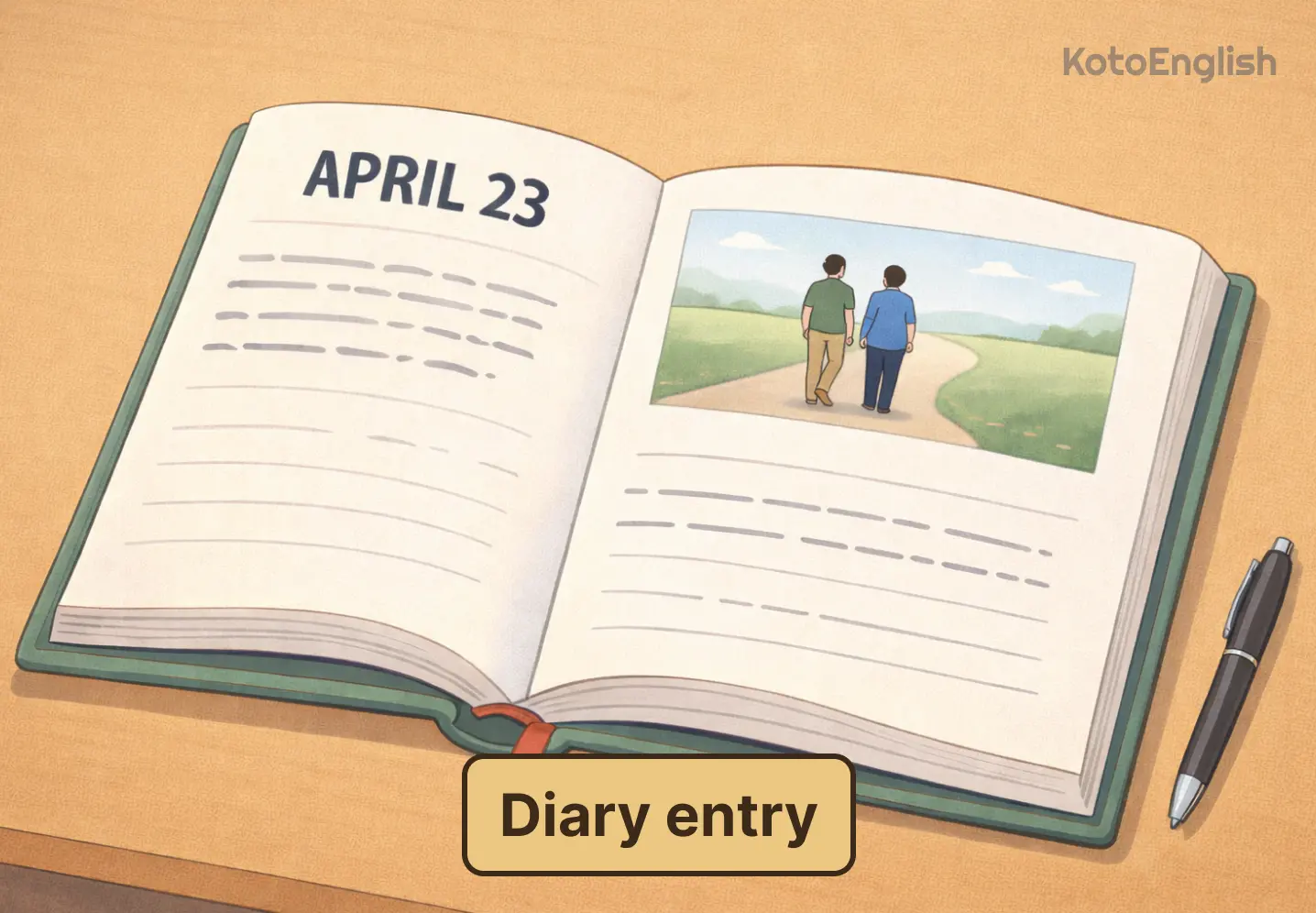
Diary entry — record made in writing for one day only.
Hisdiary entry told about the first day of working at a new place.
Test Your Knowledge of “Diary” Meaning
Practice recognizing how the “diary” is used in different contexts.
Enjoy personalized learning!
“Diary” Word in Other Languages
Below, you can see how to say “diary” in three commonly spoken European languages.
| Language | Word for “Diary” |
|---|---|
 Spanish
 |
Diario |
 French
 |
Journal |
 German
 |
Tagebuch |
Did You Know It? Fun Facts About “Diary”
A really interesting fact about diaries is that it might appear that they are very simple, yet they still play a powerful role in the history and personal growth of mankind.
-
Diaries have had long years of existence.
From the earliest days of humanity, people communicated with each other through personal diaries, in which they wrote down their daily lives, journeys, and thoughts. -
The impact of some historical diaries on history was massive.
One of the greatest impacts that Anne Frank’s diary had was giving a personal perspective on and insights into historical events through the eyes of a human being. -
Digitalized modernization of diaries.
Diaries were no longer restricted to writing only; rather, they became part of computer usage as many people now diary through apps, which is a well-organized habit that is also easily searched. -
Diaries were not supposed to be private at all times.
First diaries were frequently passed to family members and served not for self-exploration but documenting events such as weather, expenses, or even important moments. -
Travel diaries were instrumental in drawing the world.
Diaries of explorers and sailors contained accounts of new lands, peoples, and routes that were already so informative that they were equivalent to present-day maps even before they were created.
Famous Quotes Featuring “Diary” in English
The metaphor of the diary has been extensively used to signify memory, truthfulness, and introspection.
— Franz Kafka
Explanation: The statement by Franz Kafka emphasizes that maintaining a personal journal goes beyond simply noting down the day-to-day happenings — it enables to you see your personal development and change through the years.
Explanation: Picasso likened painting to keeping a diary as they both reflect humanity through personal experiences, feelings, and thoughts. In a similar manner, a painting captures them instantly.