
Contract (noun) — a legal document that is the outcome of a formal negotiation with the mutual consent of the parties concerned and is binding on all of them. Frequently specify rights, duties, and liabilities.
How to Pronounce “Contract”?
 Audio (UK):

 Audio (US):
Say con like “con” in “connect,” and tract like “tracked.” Put the stress on the first syllable: CON-tract.
Level up your English with Koto!
Examples: How to Use “Contract” in a Sentence
Learn how to define a “contract” through real-life examples that we come across in the workplace, agreements, and day-to-day scenarios.
What Are Synonyms for the Word “Contract”?
As you expand your vocabulary in the area of “contract,” it allows you to discuss agreements, legal matters, and business situations with much greater clarity of perspective.
Related nouns: agreement deal document
Synonyms (contextual): pact arrangement
Common collocations: employment contract rental contract service contract
“Contract” Word Formation and Description in Context
There are some combinations you can look for in order to find out how “contract” appears in normal as well as in professional English:
With adjectives: written contract formal contract binding contract
With verbs: sign a contract draft a contract terminate a contract
With nouns (noun + noun): contract terms contract clause contract negotiation
Idioms and Phrases with “Contract”
“Contract” is a term that can be used in different ways but is mostly found in business and legal contexts. Some of the most important uses of the “contract” along with their definitions and examples are given below.
-
Sign a contract — to legally agree to the conditions of the deal.
Shesigned the contract for the new apartment yesterday. -
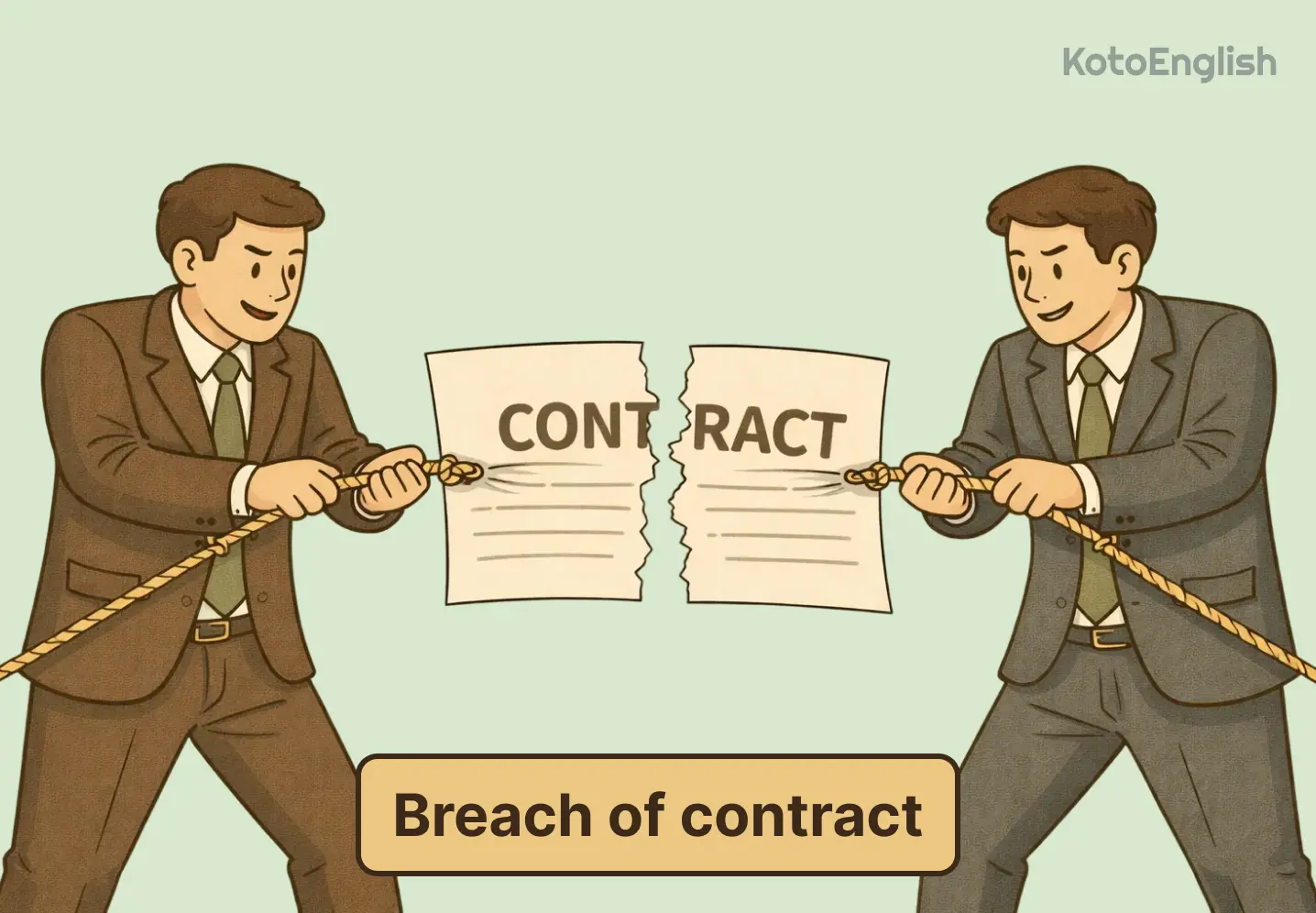
Breach of contract — not fulfilling the commitments as stated in the contract.
The company faced a lawsuit forbreach of contract because of not meeting the delivery deadline.
-
Terminate a contract — to cancel the contract before the time specified.
The decision toterminate the contract was taken as the work was not up to the mark. -
Draw up a contract — to make a formal written agreement.
The legal practitionerdrew up a contract for the business partnership. -
Fulfilling the contract — to carry out all the duties and responsibilities agreed upon in the contract.
The construction companyfulfilled the contract sooner than expected.
Test Your Knowledge of “Contract” Meaning
This is a good way to practice recognizing the different meanings of the term “contract” and testing your understanding.
Enjoy personalized learning!
“Contract” Word in Other Languages
Here’s how to say “contract” in three widely spoken European languages:
| Language | Word for “Contract” |
|---|---|
 Spanish
 |
Contrato |
 French
 |
Contrat |
 German
 |
Vertrag |
Did You Know It? Fun Facts About “Contract”
Contracts, even if many times just paper or digital files, are always active players in day-to-day life. Their range is large and among the most frequent are the contracts of engagement for work, service, and trade.
-
The earliest known written contracts.
Around 2500 BCE, the Sumerians already had the practice of making sales, loans, and service agreements in written form on clay tablets. They were packed in clay “envelopes,” a primitive means of keeping contracts secure. -
The first modern employment contracts.
Written employment contracts in Europe became the rule in the 17th Century, detailing the duties, wages and workers’ responsibilities, thus formalizing labor relations and protecting both sides: workers and employers. -
Digital contracts revolutionized agreements.
The Internet and electronic contracts made it possible for people and businesses to sign agreements online, thus making legal commitments faster, more convenient, and universally accessible.
Famous Quotes Featuring “Contract” in English
The concept of contract is mostly brought up in discussions about law, society, and human duties. Writers and thinkers also use this term to refer to the ideas of trust, obligation, and the rules which are the glue of humanity.
— Jean-Jacques Rousseau
Explanation: Rousseau made it clear that a contract is at the very base of society where the people accept common rules for the sake of order and protection in return.
Explanation: Blackstone underscores that a contract comes into existence only through the unanimous consent of all parties involved, thereby, making consent the foundation of legal agreements.
— John D. Calamari
Explanation: The statement reveals legal nature of contracts, asserting that they are not simple promises but rather unenforceable commitments by the law.
— Roscoe Pound
Explanation: Pound points out accountability, claiming that a contract refreshes obligations whenever it is performed.