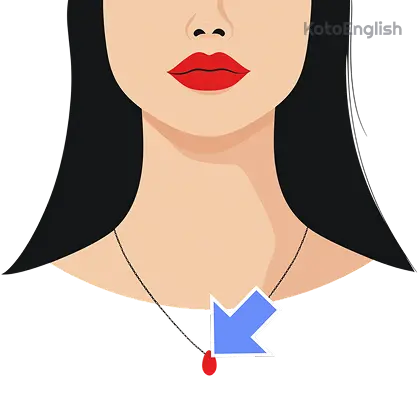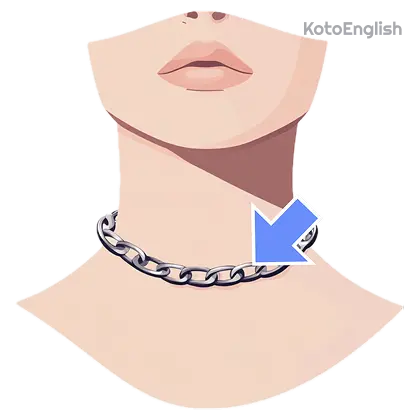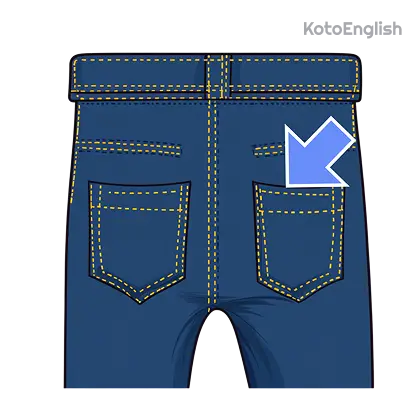

Pocket (noun) — a small fabric pouch sewn into clothing where you can keep money, keys, phones, and other small items.
How to Pronounce “Pocket”?
 Audio (UK):

 Audio (US):
Start with a strong p sound, then say ock like in “rock,” and finish with it. Stress falls on the first syllable: POCK-et.
Level up your English with Koto!
Examples: How to Use “Pocket” in a Sentence?
Pockets are everywhere in daily life, from jeans to jackets to backpacks. Here are some natural ways to use “pocket” in English.
What Are Synonyms for the Word “Pocket”?
While “pocket” is quite specific, there are related words that describe similar storage spaces in clothing and bags.
Related nouns: pouch bag slot holder
Synonyms (contextual): none it is a specific noun
Common collocations: back pocket empty pocket pocket money
“Pocket” Word Formation and Description in Context
The word appears in many everyday phrases, so to define “pocket” correctly in each case, you need to learn them as well.
With adjectives: deep pocket empty pocket front pocket back pocket
With verbs: pick a pocket reach into a pocket empty a pocket check a pocket
With nouns (noun + noun): pocket knife pocket watch pocket money pocket book
Idioms and Phrases with “Pocket”
The meaning of “pocket” in idioms is almost always close to personal belongings and finances.
-
In somebody’s pocket — a phrase that implies being under someone’s control or influence, usually in an unethical way.
The corrupt official wasin the businessman’s pocket for years. -
Out of pocket — this refers to having lost money or personally paid for something.
We ended up $500out of pocket for the hotel after the cancelled trip. -
Pocket change — it is a phrase that represents a small, unimportant sum of money.
For that billionaire, a million dollars is justpocket change .


Test Your Knowledge of “Pocket” Meaning: Quiz Time!
As you’ve learnt what “pocket” means, it’s time to practice your understanding. Dive into these exercises to be sure that you know everything about this word.
Enjoy personalized learning!
“Pocket” Word in Other Languages
This simple clothing feature exists in every culture. Here is how to say “pocket” in three widely spoken European languages.
| Language | Word for “Pocket” |
|---|---|
 Spanish
 |
Bolsillo |
 French
 |
Pouche |
 German
 |
Tasche |
Did You Know? Fun Facts About “Pocket”
You’ve learnt how to spell “pocket”, its collocations, and even translations, so now you’ll extend your knowledge beyond vocabulary. When did pockets appear? How do women’s pockets differ from men’s? Keep reading to know the answers:
-
The term “pocket” traces its roots to an ancient French word that meant “bag.”
The process of coming up with the English word started with Middle English poket and Old French pouche, both referring to a small pouch or bag. That is the reason why “pocket” and “pouch” are pronounced nearly the same. -
The introduction of pockets in men’s garments took place around the late 1600s.
Up until that time, men and women both used small pouches attached to their belts for carrying purposes. The fashion historians from the Victoria & Albert Museum say that women’s pockets were still kept as separate accessories tied under their skirts for an extended period of time. -
Women’s jeans pockets are 48% smaller than men’s.
As per a 2018 survey covering the popular jeans brands, women’s front pockets are a great deal shorter and narrower than men’s. A mere 10% of women’s pants had pockets that could accommodate an entire hand. -
The “Suffragette Suit” from 1910 was designed with six pockets.
When women demanded the right to vote, they also insisted on wearing practical attires. The suffragette suit turned into the icon of freedom with its many functional pockets that were seldom seen in women’s fashion at the time.
Famous Quotes About “Pocket”
From athletes to musicians, many famous people have used “pocket” in memorable sayings about life and success.
— Arnold Schwarzenegger
Explanation: The renowned actor and ex-governor teaches us a lesson that success is based on taking steps. Being passive and keeping your hands out of sight will not contribute to accomplishing your aspirations.
— Norman Vincent Peale
Explanation: This writer thought that being short of money is not the real obstacle in life. Actually, the main things that can restrict people are lack of ideas, passion and emotional power.
Explanation: Using metaphors, Rumi illustrates that attachment often causes us to search for what is already ours, thereby promoting appreciation of what we are chasing.”