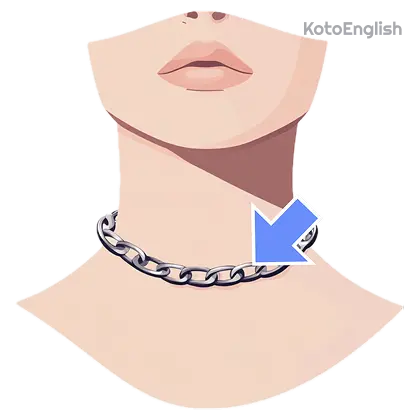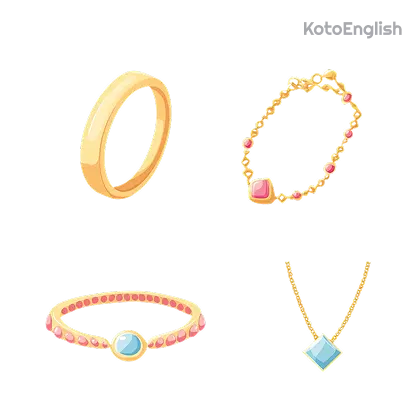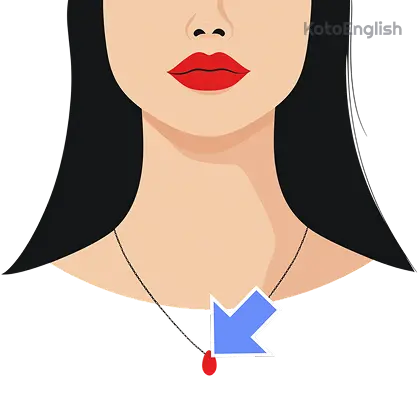
Necklace (noun) — a piece of jewelry worn around the neck, often made of metal, beads, or gems. Necklaces can be simple or elaborate, and they are used to decorate or make a fashion statement.
How to Pronounce “Necklace”?
 Audio (UK):

 Audio (US):
Start with neck like the body part. End with -lace, which sounds like “liss” in fast speech.
Level up your English with Koto!
Examples: How to Use “Necklace” in a Sentence
Learn from these real-life examples that show how “necklace” works naturally in everyday English.
What Are Synonyms for the Word “Necklace”?
No doubt, the word “necklace” itself is beautiful, but getting acquainted with the terms of related jewelry will give you the confidence to speak about accessories with more ease.
Related nouns: jewelry pendant chain
Synonyms (contextual): none it is a specific noun
Common collocations: silver necklace gold necklace beaded necklace
“Necklace” Word Formation and Description in Context
Widen your vocabulary by learning how “necklace” appears in use when spoken along with other everyday words.
With adjectives: long necklace simple necklace pearl necklace colourful necklace
With verbs: wear a necklace buy a necklace lose a necklace choose a necklace
With nouns (noun + noun): necklace clasp necklace chain necklace box necklace stand
Idioms and Phrases with “Necklace”
Discover phrases of daily life that hint at the ways people communicate about necklaces when they actually wear them. Such expressions are very useful in depicting actions, habits, and normal cases related to jewelry wearing.
-
Put on a necklace — to wear a necklace around your neck.
She decided toput on her best necklace for the party. -
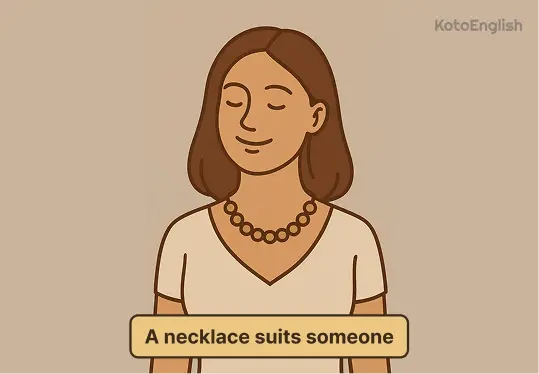
A necklace suits someone — a necklace looks good on a person.
Thatnecklace suits you because the color matches your eyes.

-
Lose a necklace — to lose the necklace or perhaps even the necklace falls off.
My aunt was desperate because shelost her favoritenecklace . -
Give a necklace as a gift — to present a necklace to someone as a gift for a special occasion.
Michaelgave his mothera necklace as a birthday present.
Test Your Knowledge of “Necklace” Meaning
Challenge yourself with these questions to check how well you understand the word “necklace,” its meaning, and common phrases.
Enjoy personalized learning!
“Necklace” Word in Other Languages
Are you wondering how to say “necklace” in different languages? Let us present the names of this ornament in three of the most common European languages.
| Language | Word for “Necklace” |
|---|---|
 Spanish
 |
Collar |
 French
 |
Collier |
 German
 |
Halskette |
Did You Know It? Fun Facts About “Necklace”
Here are some facts surrounding necklaces, their cultural implications and some of the well-known pieces that exemplify how a necklace can be a lot more than just an ordinary ornament.
-
Over $55 million was spent on the most costly necklace ever sold.
The Incomparable Diamond Necklace is among the world’s most expensive necklaces. This necklace was made by the luxury jeweler Mouawad and consisted of an internally flawless, 407‑carat yellow diamond in the center with smaller diamonds on either side set in 18k gold. -
Necklaces served as protective and powerful symbols in ancient Egypt.
People thought they could stay safe by wearing them. They displayed their social standing as well. -
The longest pearl necklace in the world.
316,474 pearls make up the largest pearl necklace in the world. It is longer than 2 hundred meters. It is on display for visitors to see in museums. -
Certain necklaces are priceless family treasures.
Children inherit them from their parents. They are therefore extremely expensive and unique.
Famous Quotes Featuring “Necklace” in English
Wearing necklaces has inspired thoughts on beauty, style, and life. Here is some unforgettable jewelry-related words that demonstrate the importance and charm of wearing a piece of necklace.
— Grace Kelly
Explanation: Grace Kelly thought many pearl necklaces made a strong style statement. Pearls are classic and elegant jewelry. Wearing several at once can look very beautiful.
— Karen Quan
Explanation: This compares emotional support to a necklace around the neck. It shows that support can feel protective, but it isn’t forever.
— Rumi
Explanation: Using metaphors, Rumi illustrates that attachment often causes us to search for what is already ours, thereby promoting appreciation of what we are chasing.”